



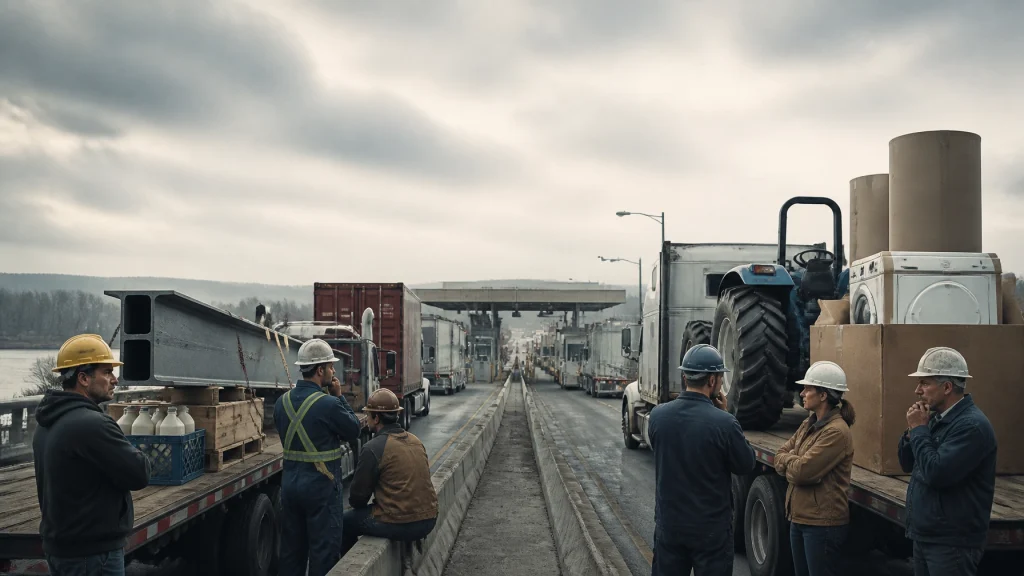
A trade war sounds like something that happens in a conference room, surrounded by flags, microphones, and people who have never had to explain a layoff to a mortgage company.
The reality is much less theatrical. It shows up in a factory schedule, a trucking route, a grocery receipt, or a town meeting where everyone knows the plant is the largest employer.
Starting September 8, Canada will impose retaliatory tariffs of 15%, 25%, and 50% on approximately $27.6 billion of goods imported from the United States. The targeted products include steel, dairy, appliances, agricultural equipment, pulp and paper, and electronics. The rates are designed to match the U.S. tariffs that Canada says triggered the response.
That is the official language: countermeasures, tariff schedules, product classifications.
The kitchen-table translation is simpler:
- Some American products will become more expensive in Canada.
- Some Canadian products will become more expensive in the United States.
- Companies will lose customers on one side of the border.
- Workers on both sides will be asked to absorb the damage.
- Politicians will declare victory while businesses calculate how long they can keep the lights on.
The first casualties are not abstract “trade flows.” They are American jobs: and Canadian jobs right behind them.
What Canada is actually doing
According to Finance Canada’s official tariff announcement, the new measures take effect at 12:01 a.m. on September 8, 2026.
The tariff rates will vary by product:
- 50% tariffs will apply to certain steel and aluminum products, furniture, clothing, and apparel.
- 25% tariffs will apply to appliances, dairy products such as cheese, and some steel and aluminum derivatives.
- 15% tariffs will apply to selected electronics, tools, and other goods.
The policy is meant to match the U.S. approach “dollar for dollar, rate for rate.” That sounds orderly. Trade wars rarely are.
A tariff is simply a tax charged when a good crosses a border. The importer pays it first. Then the importer decides what to do next: raise the price, accept a smaller profit margin, find another supplier, move production, or stop selling the product altogether.
The tariff does not arrive at the border carrying a sign that says, “Paid by Washington” or “Paid by Ottawa.” It gets mixed into the price of a refrigerator, a tractor part, a roll of paperboard, or a block of cheese.
Eventually, somebody pays.
Usually, it is some combination of the customer, the company, and the employee.
The Quebec mill where the numbers became personal
The clearest example is in Témiscaming, Quebec, a community of roughly 2,500 people near the Quebec-Ontario border.
RYAM, a U.S.-owned paper and paperboard manufacturer, announced that it would indefinitely shut down operations at its Témiscaming mill beginning September 15. About 425 workers are expected to be affected.
The mill is not just another business in town. It is the largest employer. When a plant like this closes, the damage does not stop with the workers carrying lunch boxes through the exit gate for the last time.
It reaches:
- Trucking companies hauling timber and finished products.
- Restaurants serving shift workers.
- Repair contractors.
- Local landlords.
- Grocery stores.
- Municipal tax collections.
- Every small business that depends on a steady industrial payroll.
The shutdown has been linked to U.S. tariffs of approximately 50% on Canadian forest products. RYAM has said the tariff environment made operations unsustainable.
Témiscaming Mayor Alain Gauthier, a former mill employee and general manager, called the tariffs a “nuclear bomb” for industries dependent on U.S. markets. He also described the situation as an economic war.
That language may sound dramatic until the largest employer in town announces that 425 paychecks are disappearing.

The important detail is that this closure is not primarily caused by Canada’s new September 8 retaliation. It is an early consequence of the broader U.S.-Canada tariff conflict, particularly the U.S. duties hitting Canadian forest products.
That distinction matters. It also does not make the outcome any better.
A Canadian mill loses access to its American customers. American companies that bought the paperboard lose a supplier. Workers in Quebec lose jobs. American workers in packaging, shipping, and related industries now face higher costs or disrupted supply.
This is how a tariff chain works. The border may be a line on a map, but the supply chain is a web.
The American worker is not standing outside the blast zone
Retaliation means Canada is now targeting American goods that Canadian businesses and consumers buy.
Take agricultural equipment. A Canadian farmer purchasing an American tractor or replacement part may face a tariff as high as 50%, depending on the product classification. That farmer has a few choices:
- Pay more.
- Delay the purchase.
- Buy a substitute.
- Ask the dealer to absorb some of the cost.
- Use older equipment longer and hope it does not break down during harvest.
None of those options is particularly good for the American manufacturer.
If sales fall, the manufacturer may cut overtime, reduce production, postpone a new facility, or trim its workforce. The tariff may protect a Canadian competitor, but it does not magically create a new order for the American factory.
The same logic applies to appliances, electronics, tools, steel, and dairy products. A company selling into Canada is not exporting “goods” in the abstract. It is selling to a distributor, a contractor, a farmer, a retailer, or a household.
Make the product 25% or 50% more expensive overnight and demand tends to become less enthusiastic. Customers are remarkably sensitive to price when their budgets are already tight.
For a deeper look at how the trade dispute can eventually appear in consumer prices, see the Regular Guy Economics analysis, “The Trade War With Canada Just Got Personal: and It’s Going to Show Up on a Window Sticker.”
“Buy domestic” is not a magic spell
The standard response to tariffs is that consumers should simply buy domestic products.
That advice works only when a domestic substitute exists, has enough capacity, and can be produced at a competitive price.
A North American supply chain is not a vending machine with a Canadian button and an American button. Parts can cross the border multiple times before a finished product reaches a customer. Steel may be melted in one country, formed in another, assembled into a component somewhere else, and installed in a final product across the border.
Replacing that system takes time and money.
A company cannot instantly build a new paper mill, steel plant, appliance factory, or electronics supply chain because a tariff appeared in a government announcement. It needs land, permits, machinery, workers, financing, suppliers, and customers willing to pay the new price.
Until then, “domestic production” often means a more expensive version of the same product: or no product at all.

Governments can cushion the fall, but they cannot erase it
Canada has announced a C$7.5 billion support package for workers and businesses affected by the tariff conflict. The measures include assistance for small and medium-sized companies, liquidity programs, funding for diversification projects, and expanded support for worker training and income protection.
The Canadian government’s support announcement describes programs involving:
- C$1.5 billion for regional tariff responses.
- C$500 million in additional business liquidity support.
- C$2 billion for the Canada Strong Diversification Fund.
- C$3.5 billion in rapid-response support for workers and employers.
That money may help keep some companies solvent and some workers connected to a paycheck. It is better than pretending the problem does not exist.
But government support is a bandage, not a cure. It comes from taxpayers, borrowing, or money that could have been used elsewhere. It can soften the fall, but it cannot make a lost customer reappear or restore every closed shift.
The United States will face the same arithmetic if American exporters lose Canadian buyers. Subsidies may protect a factory for a while. They do not guarantee that the factory’s products will remain competitive once the tariff bill arrives.
Who actually wins?
The honest answer is: probably nobody, at least not in the broad economic sense.
There can be narrow winners. A Canadian producer competing against an American importer may gain market share. An American producer protected from Canadian competition may enjoy a temporary advantage. A politician may gain a talking point.
But the larger system pays through higher prices, reduced trade, weaker investment, and fewer choices.
The protected industry may hire a few workers while a downstream manufacturer cuts many more because its inputs have become expensive. A domestic producer may receive more orders, but consumers may buy less because the product costs more. A government may collect tariff revenue while businesses quietly move operations or stop expanding.

The first casualties are especially concentrated in towns that depend on one employer or one industry. Témiscaming is a warning because the numbers are easy to understand: 425 jobs, one major mill, one community, and no clear reopening date.
There are American towns with the same exposure. A factory that depends on Canadian orders does not need to lose its entire business to start cutting jobs. A reduction in sales can mean fewer temporary workers, fewer hours, smaller bonuses, delayed hiring, and less money flowing through the local economy.
That is the part of trade policy often missed in the television argument. The economy is not made of countries. It is made of people and businesses that exchange money for useful things.
When governments turn that exchange into a battlefield, the casualties are ordinary workers who never got a vote on the tariff schedule.
The regular-guy takeaway
Watch what happens after September 8 in four places:
- Prices: Appliances, electronics, dairy, equipment, and other targeted goods may become more expensive.
- Orders: American exporters may see Canadian customers delay or cancel purchases.
- Employment: Paychecks are often affected before official layoffs appear in national statistics.
- Investment: Companies may postpone factories, equipment purchases, and expansion until they know what the rules will be next month.
Trade wars are sold as strength. The bill arrives as uncertainty.
And uncertainty is expensive. Businesses do not hire confidently when they cannot calculate the cost of their inputs or the price their customers will face at the border.
For households already dealing with squeezed budgets, the advice is not complicated: keep a little flexibility, be careful with major purchases, and do not assume that a political announcement has no effect on the family finances. As discussed in “Your Raise Is Losing to Your Grocery Bill,” the household budget is already doing enough heavy lifting without adding a tariff to the shopping cart.
The United States and Canada are neighbors, trading partners, and deeply connected economies. A fight between them is not a clean boxing match where one side wins and the other hits the canvas.
It is more like two families sharing a wall, smashing holes in each other’s kitchens, and then congratulating themselves for owning the hammer.
Disclosure: Regular Guy Economics is not a financial advisor. This article is for educational and informational purposes only and is not investment advice, a recommendation to buy or sell securities, or a substitute for professional financial guidance.
Be mindful, be watchful and good luck.