



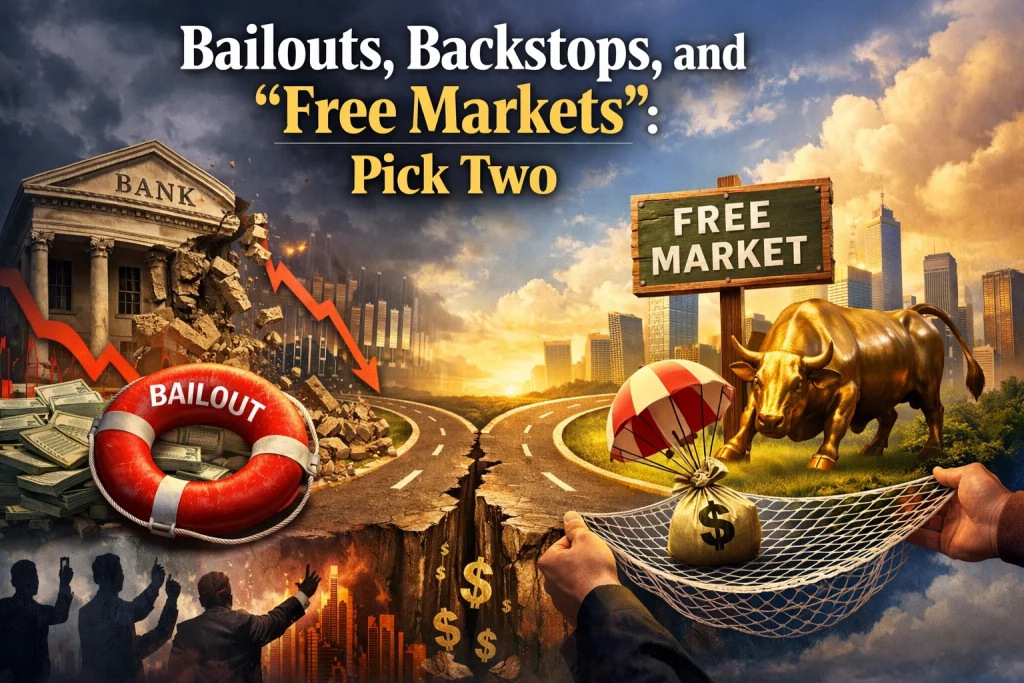
If you’ve ever played a video game or worked in construction, you’ve probably heard of the "Project Management Triangle." You can have it fast, you can have it good, or you can have it cheap: but you can only pick two.
The global economy has its own version of this, and it’s a lot more expensive than a kitchen remodel. The three choices on the table are: Authentic Free Markets, Total Financial Stability, and Government Bailouts.
In a perfect world, we’d want all three. We want a market that rewards hard work and punishes bad bets (Free Markets). We want a world where the ATM always works and our 401(k) doesn't vanish overnight (Stability). And when things get really scary, we want a safety net (Bailouts).
But here’s the cold, hard truth: You can’t have all three. In fact, for the last forty years, the people running the show have tried to convince us we can. But look closely at the math, and you'll see they’ve already made the choice for us. They’ve chosen Bailouts and Stability, which means the "Free Market" part? That’s just marketing.
The "Little Guy" version of the Free Market
For you and me: the regular guys: the free market is very real. It’s actually quite brutal.
If you decide to open a pizza shop on a corner that already has five pizza shops, and your crust tastes like cardboard, you’re going to go out of business. Nobody is coming to save you. The Federal Reserve isn't going to lower interest rates specifically for your pepperoni overhead. The Treasury isn't going to send you a "Backstop Check" because you're "too tasty to fail."
In the real world, "Free Market" means the freedom to fail. It’s what keeps the system honest. If you take a risk and it doesn't pan out, you lose your shirt. That fear of losing your shirt is what prevents you from doing something incredibly stupid, like betting your entire life savings on magic beans.
But somewhere along the line, the rules changed for the people at the top of the food chain.
The Socialization of Risk (and Why Your Wallet is Hurting)
When we talk about "Socializing Risk," we’re talking about a fancy way of saying: "Heads they win, tails you lose."
In a healthy economy, financial crises and recessions actually serve a purpose. The economist Hyman Minsky: a guy who spent a lot of time thinking about why markets crash: noted that these downturns are necessary. They act like a forest fire, clearing out the dead wood and discouraging investors from taking insane risks.
But when the government and the Fed step in to "backstop" every crisis, they remove the consequences. This creates something called Moral Hazard.
Think of it like this: If you go to Las Vegas and the casino tells you, "Go ahead and bet a million dollars on red. If you win, you keep the money. If you lose, the government will pay us back with taxpayer money," would you ever stop betting? Of course not. You’d bet the house every single time.
This is why we’ve seen the gap between "trading" and "productive investment" explode. In 1980, the ratio of stock market trading to actual productive investment (building factories, creating jobs, researching tech) was about 2:1. By 2019, that ratio had ballooned to 30:1. We aren't building a better future; we’re just gambling with a safety net that we: the regular guys: are paying for.

The Irony of the Backstop
A "backstop" sounds like a nice thing. It’s a safety net. It’s the "Fed Put." It’s the promise that if the market starts to tank, the central bank will start printing money to buy up assets and keep prices high.
But there’s no such thing as a free lunch. When the Fed creates "unlimited liquidity" to save a failing bank or a crashing bond market, that money has to come from somewhere. It comes from the purchasing power of your paycheck.
This is the central irony: To maintain "stability" for the big players, the system creates "instability" for everyone else in the form of inflation. Your groceries cost more because the system refused to let a few giant banks eat their losses in 2008, 2020, or 2023. We are essentially paying a "Bailout Tax" every time we go to the checkout counter.
The Medical Industry: A Case Study in Broken Markets
If you want to see what happens when "Free Markets" are replaced by a messy web of backstops and bad incentives, look no further than the American medical industry.
In 1960, medical costs in the U.S. were about five percent of our GDP. Fast forward to today, and we’re barreling toward twenty percent. We are spending more than ever, yet for the first generation in history, our children might not live longer than we do.
Why? Because it’s not a free market. It’s a captured one.
In a real market: like car insurance: the math is clear. An automobile has an established value. If a car is smashed beyond repair, it’s "totaled." There’s a ceiling on the cost. In medicine, there is no ceiling. Because "life" is priceless, the industry has decoupled costs from reality.
We see the same "socialized loss" pattern here. We have more chronic illness, more obesity, and more addiction than ever, yet the profits for pharmaceutical companies and hospital conglomerates keep hitting record highs. They are protected by a maze of regulations and insurance backstops that prevent actual price competition.
It’s reached such a level of madness that even the biggest capitalists are crying foul. A few years ago, Amazon, Berkshire Hathaway, and JPMorgan Chase: the literal titans of the economy: tried to form their own healthcare company. Their goal? To create a system "free from profit-making incentives and constraints."
When the world’s biggest bankers and retailers say the system is too expensive and inefficient to survive, you know the "backstop" has become a noose.

Why We Can’t Just "Pick Two" Anymore
We are currently living in a world that has chosen Bailouts and Stability (or at least the appearance of it). But this choice has effectively murdered the Free Market.
When you remove the risk of failure, you remove the reason for efficiency. Why should a company optimize its costs or treat its employees well if it knows the "Economic Narrative Machine" will eventually manufacture a reason to save them from their own bad decisions?
This is the last frontier of expense reduction. Smart companies are starting to realize that the current system: whether it’s the financial market or the medical industry: is unsustainable. We see companies starting to hire their own medical staff, building their own clinics, and negotiating drug costs directly because the "market" they are forced to participate in is a fiction.
They are trying to opt-out of the madness. They’re realizing that investing $100 in a gym membership for an employee is better than paying $10,000 for a cardiac event later. They’re looking for "health outcomes" instead of "medical billing units."
The Bottom Line for the Regular Guy
The "Free Market" is a beautiful idea, but right now, it’s mostly used as a bedtime story to tell small business owners while the giant corporations enjoy the warm embrace of a government backstop.
We are told we live in a capitalist society, but we actually live in a "Headroom Society." There’s plenty of room for us to fail at the bottom, but there’s a hard ceiling on how much the people at the top are allowed to lose.
Until we stop socializing the losses of the big players, we will never have a truly free market. And until we have a free market, we will continue to see the price of everything: from eggs to heart surgery: climb higher while our actual quality of life stays flat.
We spend a third of our lives working to fuel this machine. It’s time we started asking why the machine only seems to have a safety net for the people who already own it.
Be mindful, be watchful and good luck.