



October 21, 2026
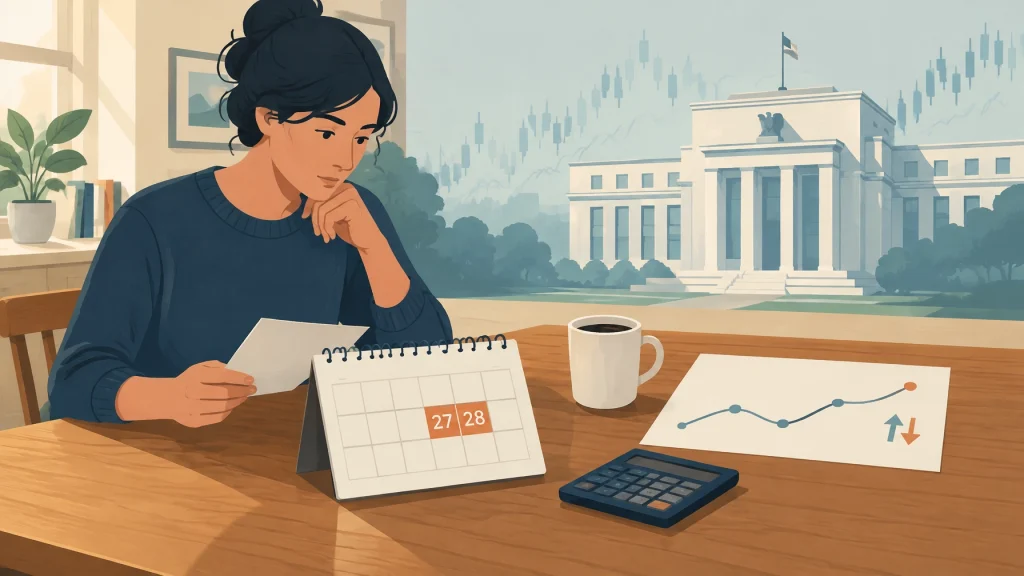
The Federal Reserve meets October 27–28, and two clues are pointing in different directions. The Fed’s September projections suggest another rate increase this year. But after employers added just 29,000 jobs in September, unemployment rose to 4.2%, and earlier months were revised down by 60,000, the market leaned toward a pause. CME FedWatch put the odds of an October hold at 77%.
That doesn’t mean the market knows what the Fed will do. It means traders are pricing in one likely outcome based on the information available to them right now.
Here’s how to check the clues for yourself, without a finance degree or a crystal ball.
First, know what the Fed is deciding
The Federal Reserve sets a target range for the federal funds rate, a key short-term interest rate. It influences borrowing costs throughout the economy, but it does not set the rate on every credit card, car loan, or mortgage.
At each meeting, the Federal Open Market Committee (FOMC) can raise, lower, or leave its target range unchanged. The decision matters. So do the projections, economic data, wording of the statement, and comments from the Fed chair afterward.
For this meeting, the key question is whether the committee follows through soon on the additional increase shown in its September projections, or waits for more evidence.
Tool 1: Read the dot plot as a set of opinions
Four times a year, the Fed releases a Summary of Economic Projections, including the famous dot plot. Each dot represents one policymaker’s estimate of where the federal funds rate should be at the end of each year, given that policymaker’s view of how the economy will unfold.
The September projection’s median rate for year-end 2026 was 4.1%. That points to roughly one more quarter-point increase this year. You can see the projections on the Fed’s September 2026 page.
How to read it:
- Find the median dot. This is the middle projection, not a promise from the Fed. The current median points to another increase in 2026.
- Look at the spread. A tight cluster suggests policymakers are relatively close in their views. Dots scattered across a wide range show more disagreement or uncertainty.
- Remember what the dots are. They’re individual forecasts, not votes, commitments, or a schedule carved in stone.
The dots can also move when the outlook changes. A projection published in September is a useful clue in October, not a binding instruction.

Tool 2: Use CME FedWatch as a live market gauge
The CME FedWatch Tool translates prices in federal funds futures into market-implied probabilities for possible rate decisions.
In everyday terms, traders buy and sell contracts tied to where they think short-term interest rates will be. FedWatch reads those prices and estimates how likely different outcomes appear to be. A 77% chance of a hold means that current market pricing implies a 77% probability of no change at the October meeting.
The important words are current market pricing. These are not odds set by the Fed, and they’re not a promise about what will happen. They can shift quickly after inflation or employment data, and the October hold probability was very different before the jobs report.
Think of FedWatch as a snapshot of the market’s mood, not a forecast delivered from the future. If the number moves, ask what changed: new data, new comments, or simply a change in traders’ positioning?

Tool 3: Check what’s left on the calendar
The September Consumer Price Index report was released October 14. It’s now part of the information policymakers can consider. When you review it, look at both headline inflation and core inflation, which excludes food and energy. One month matters; the direction across several months matters more.
The next key scheduled labor-market check before the decision is weekly jobless claims on October 22. Claims can offer a timely read on layoffs, but they are noisy: one week’s change doesn’t, by itself, establish a trend. The Bureau of Labor Statistics calendar lists upcoming releases.
Don’t expect helpful Fed speeches during the blackout window. Under the Fed’s published schedule, the blackout around this meeting runs from October 17 through October 29. That means there should be no normal policymaker appearances to decode before the decision. The data and market prices have to do the talking.
The meeting runs October 27–28, with the policy statement scheduled for October 28. The Fed’s official calendar has the details.
Tool 4: Read the statement, not just the rate decision
The rate decision is usually the easiest part to understand: up, down, or unchanged. The statement and press conference tell you more about why the Fed acted and what could come next.
Start with changes in wording. In its September statement, the Fed said economic activity was expanding “at a solid pace” and that “inflation remains elevated.” Those phrases are useful clues. Solid activity can leave room to keep rates restrictive; elevated inflation says policymakers don’t think the job is finished.
Here are a few plain-English translations:
- “Inflation remains elevated.” The Fed still sees too much price pressure. That makes it harder to assume rate cuts are around the corner.
- “Economic activity is expanding at a solid pace.” The economy may be strong enough to withstand high borrowing costs, or even another increase.
- “Job gains have kept pace with the workforce.” That described the September statement’s view of the labor market then. After a 29,000-job report and downward revisions, watch whether the new statement softens its assessment.
Also compare the statement’s balance-of-risks language, if included, with the prior version. Does it give more weight to inflation risks, employment risks, or both? The September statement emphasized elevated inflation and a timely return to the 2% goal. A change in how the Fed describes those risks could tell you whether it is becoming more concerned about one side of its job than the other.
Then listen to the press conference. Does the chair describe the decision as a pause to gather evidence, or suggest that the committee still expects to raise rates? The explanation can add important context to a one-line decision.

Hold both clues in mind
The dot plot points toward another increase in 2026. FedWatch, after the weak jobs report, showed a 77% chance of an October hold. The jobs data help explain the gap: a cooling labor market gives policymakers a reason to wait, while persistent inflation could still argue for a higher rate.
If the Fed hikes despite the weak jobs report, that would suggest it is prioritizing the inflation fight over waiting for more labor-market evidence. If it holds, the committee may be balancing competing risks, or simply choosing to wait for more data. A hold alone does not prove policymakers are split; check the vote tally and statement to see whether there was actual disagreement.
Either way, watch whether the statement keeps language pointing toward another increase. That can help distinguish “not this time” from “we’re done.”
Your five-minute Fed check
Before the announcement, take these steps:
- Check the latest probabilities in CME FedWatch.
- Compare the market’s expected decision with the September dot plot.
- Check the latest inflation and labor data on the BLS release calendar.
- After the announcement, compare the new statement with the September statement, especially its descriptions of inflation, economic activity, jobs, and risks.
- Listen for what the chair says about the next meeting. Don’t treat a single adjective, or a single market probability, as the whole story.
What it means for household bills
The effect of a Fed move doesn’t arrive everywhere at once. Credit-card rates can adjust relatively quickly, so cardholders may notice changes in the months ahead. Mortgage rates are influenced by longer-term bond markets and expectations about future rates, so they don’t simply move in lockstep with the Fed’s announcement.
For most households, October 28 matters to upcoming statements and borrowing decisions, not to every bill due this week. Keep the decision in perspective, and check your own loan terms before making changes based on a headline.
Be mindful, be watchful and good luck.
Educational disclaimer: This article is for informational and educational purposes only. It is not investment advice or a recommendation to make financial decisions. Consider speaking with a qualified financial professional about your individual circumstances.