



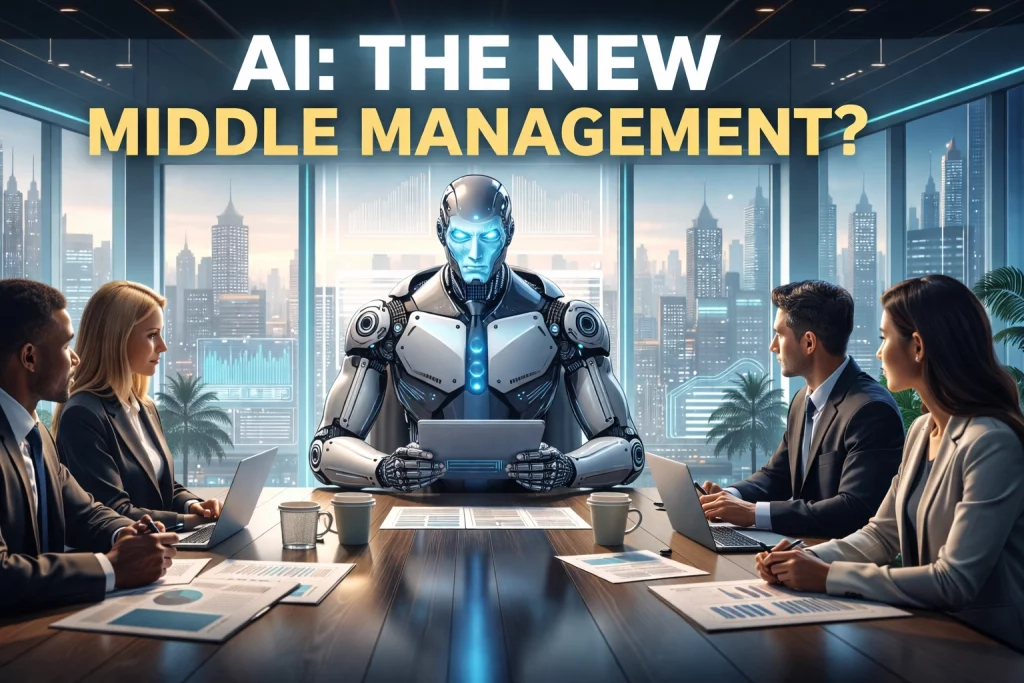
Remember when robots were supposed to take over the factory floor? We were all warned that assembly line workers and warehouse staff were on the chopping block. Hollywood made movies about it. Politicians debated it. And yeah, some of that happened.
But here's the twist nobody saw coming in 2026: the robots aren't just welding car frames anymore. They're scheduling your meetings, reviewing your performance, and basically doing the job of that middle manager down the hall who always seemed to be in meetings about other meetings.
Welcome to the new reality, where AI isn't coming for the hard hat, it's coming for the corner office.
The Cubicle Revolution Nobody Predicted
For decades, we assumed automation would eat jobs from the bottom up. Start with the repetitive stuff, the manual labor, the tasks that don't require a college degree. That was the playbook.
But AI had other plans.
Turns out, a lot of what middle managers do is actually pretty… automatable. Think about it. What does a typical middle manager spend their day doing?
- Compiling reports from various teams
- Monitoring employee performance
- Coordinating workflows between departments
- Scheduling and running meetings
- Passing information up and down the chain
Now look at that list again. Every single one of those tasks can be handled by AI tools that already exist. Real-time dashboards eliminate manual report compilation. Project management platforms with built-in AI handle workflow coordination. Performance tracking? There's an algorithm for that.
According to research from BearingPoint, roughly 43% of standard managerial tasks are now impacted by generative AI. About 24% of those tasks are fully automated, and another 19% are "augmented": meaning AI does the heavy lifting while a human just signs off.

The Numbers Don't Lie (And They're Not Pretty)
Here's where it gets real for the regular guy.
Gartner: one of those big research firms that companies pay a lot of money to listen to: predicts that by the end of 2026, about 20% of companies will use AI specifically to "flatten" their organizational structures. Translation: they're cutting out layers of management.
And in those companies? They expect to eliminate more than half of their middle manager positions.
Let that sink in. Not 10%. Not 20%. More than half.
We're not talking about some distant future here. We're talking about this year. Right now. The layoff announcements you've been seeing in the news? A lot of them aren't random belt-tightening. They're strategic moves to replace human coordination with digital coordination.
The irony is thick enough to cut with a knife. For years, middle managers told factory workers to "adapt or die" when automation came for their jobs. Now the shoe's on the other foot.
But Wait: There's a Twist
Now, before we start planning funerals for every middle manager in America, there's a nuance here that matters.
The smart companies aren't just firing their managers and plugging in ChatGPT. They're repositioning them.
See, AI is great at crunching numbers, tracking metrics, and generating reports. But it's still pretty terrible at the human stuff. Coaching a struggling employee through a rough patch. Navigating office politics. Reading the room when a team is burnt out. Making judgment calls that require context and empathy.

The middle managers who survive this transition are the ones who pivot hard into those human-centric roles:
- Coaching and mentorship instead of monitoring
- Strategic contributions instead of status updates
- Facilitating human-AI collaboration instead of just passing messages
In other words, the job title might stay the same, but the job itself is getting a complete makeover. If you're a middle manager reading this, the writing is on the wall: your value isn't in being an information middleman anymore. Your value is in being the person who helps humans work alongside machines without losing their minds.
The Burnout Paradox
Here's something that should concern everyone, whether you're a manager or not.
Middle managers who use AI tools report a 42% average productivity increase. That's higher than the 36% increase reported by individual contributors. So AI is making managers more productive, right? Problem solved?
Not so fast.
At the same time, 76% of middle managers report experiencing burnout. That's compared to 69% of individual contributors.
Read that again. The people using AI the most are also the most burned out.
How does that make any sense? Because productivity and wellbeing aren't the same thing. These managers are doing more work, handling more responsibilities, and constantly learning new tools: all while their job security feels shakier than ever. They're running faster on a treadmill that might get unplugged at any moment.
It's the cruel math of modern work: you can be more "productive" than ever and still feel like you're drowning.
The Real Problem: Nobody Has a Plan
Here's what really gets me about this whole situation.
According to the research, 68% of organizations report "AI-driven efficiency gains." Sounds great, right? But only 35% have structured change management programs to actually support their people through this transition.
So two-thirds of companies are seeing benefits from AI, but only about a third have any real plan for how to help their workers adapt.
That's not a strategy. That's hoping for the best and planning for nothing.
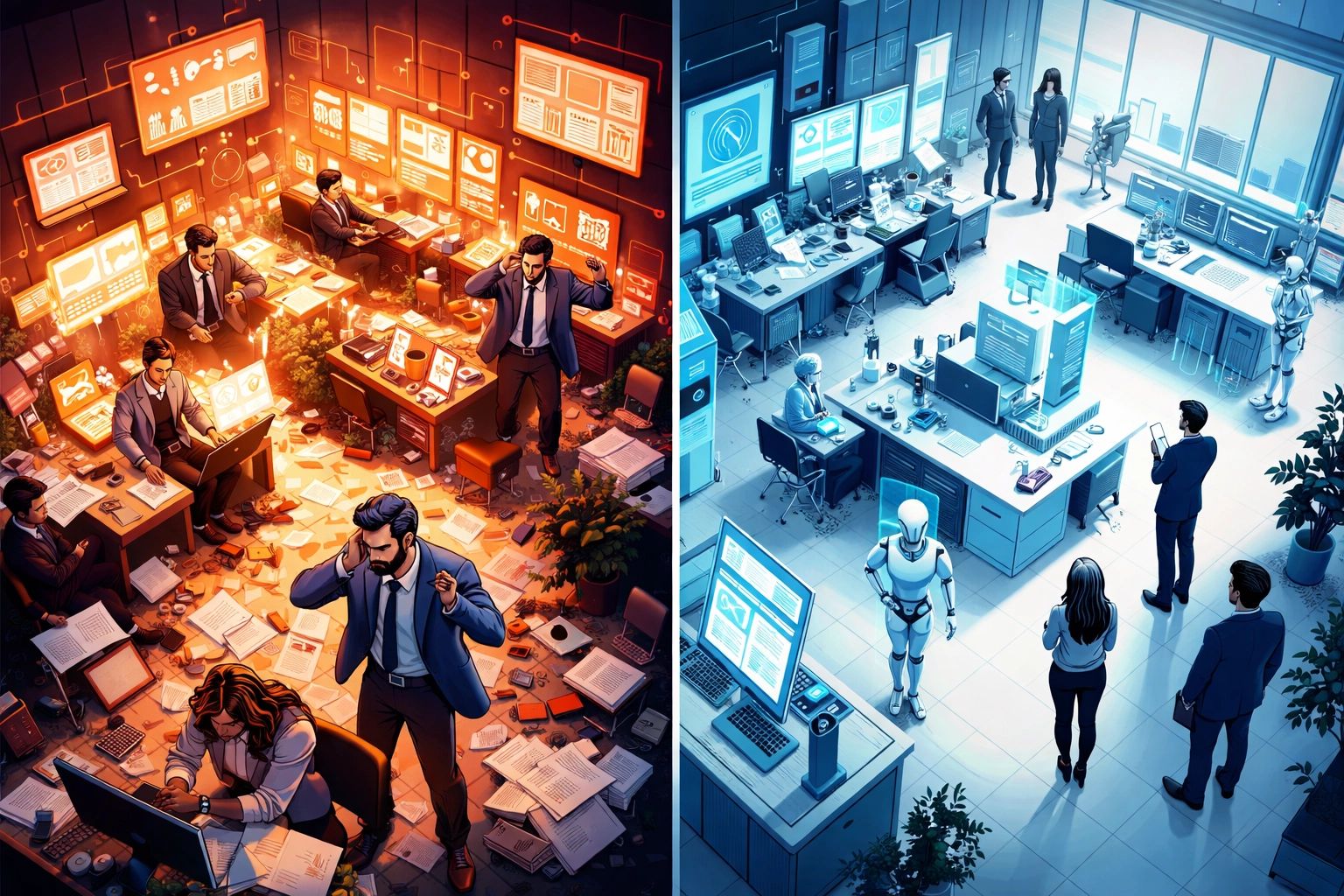
When companies strip out middle management without thinking about the consequences, they lose institutional knowledge. They create isolated employees who have no one to turn to when things get confusing. They destroy the informal networks that actually keep organizations running.
Middle managers: for all the jokes we make about them: are often the glue that holds company culture together. They're the ones who notice when someone's struggling. They're the ones who translate executive-speak into actual action items. They're the ones who remember why things are done a certain way.
Replace all that with an algorithm, and you might save money in the short term. But you're also building an organization that's brittle, disconnected, and one crisis away from falling apart.
What This Means for the Regular Guy
So where does this leave you?
If you're a middle manager: start thinking about what makes you irreplaceable in ways that AI can't replicate. Double down on relationships, mentorship, and strategic thinking. The report-compiling version of your job is disappearing. The human-connection version might actually become more valuable.
If you're not a manager: don't assume you're safe just because you're not in the crosshairs right now. The same logic that's flattening management structures will eventually come for other roles too. The question isn't whether AI will change your job: it's when and how.
If you're a company leader: for the love of all that's decent, make a plan. Don't just plug in AI tools and hope your people figure it out. Invest in training. Be honest about what's changing. Treat your middle managers like partners in transformation, not obstacles to efficiency.
The robots came for the factory floor first. Now they're coming for the cubicle. Eventually, they'll come for everyone who isn't paying attention.
The career ladder we all grew up believing in: work hard, get promoted, manage people, climb higher: is being rebuilt while we're still standing on it. Some rungs are disappearing entirely. Others are being replaced with something we don't quite recognize yet.
The only certainty is that standing still isn't an option.
Be mindful, be watchful and good luck.