



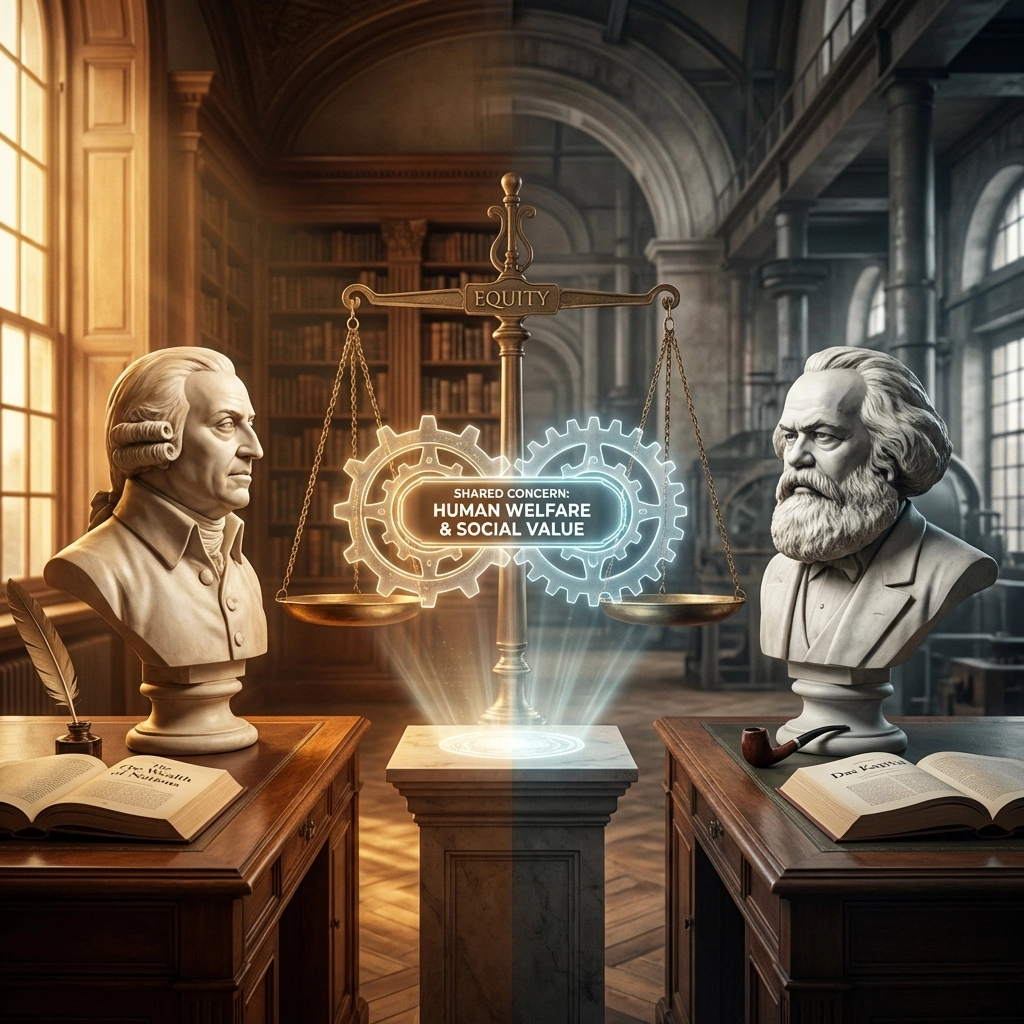
Here's a question that'll blow your mind: What do the father of capitalism and the father of communism actually have in common? More than you'd think, and way more than either side wants to admit.
Adam Smith and Karl Marx are usually painted as total opposites, like Batman and the Joker of economics. Smith gets credit for free markets and invisible hands, while Marx gets blamed for everything from gulags to your college professor's weird political rants. But if you actually read what they wrote (and I mean really read it, not just the Twitter summaries), you'll find something interesting: these guys agreed on a lot more than they disagreed on.
Meet the Heavyweight Champions
Let's start with the basics. Adam Smith wrote "The Wealth of Nations" in 1776, same year as the Declaration of Independence, which is fitting since both were about breaking free from old, stupid systems. Smith was basically saying "Hey, maybe we don't need kings and nobles controlling every trade route."
Karl Marx wrote "Das Kapital" about 100 years later, in 1867. He'd watched the Industrial Revolution turn workers into factory machines and said "This whole system is rigged against regular people."
Different centuries, different problems, but both guys were looking at the same basic question: How does this whole economy thing actually work, and why does it seem so unfair to most people?
Common Ground #1: Labor is Everything
Both Smith and Marx agreed on something that seems obvious now but was revolutionary then: workers create all the value in an economy. Everything else: the factories, the land, the money: it's all just stuff sitting there until someone actually does work with it.
Think about it this way: You can have the fanciest restaurant in the world, but without cooks, servers, and dishwashers, you're just serving empty plates to nobody. Smith called this the "division of labor" and thought it was awesome because it made everyone more productive. Marx agreed it made people productive, but he thought it also made work soul-crushing and dehumanizing.
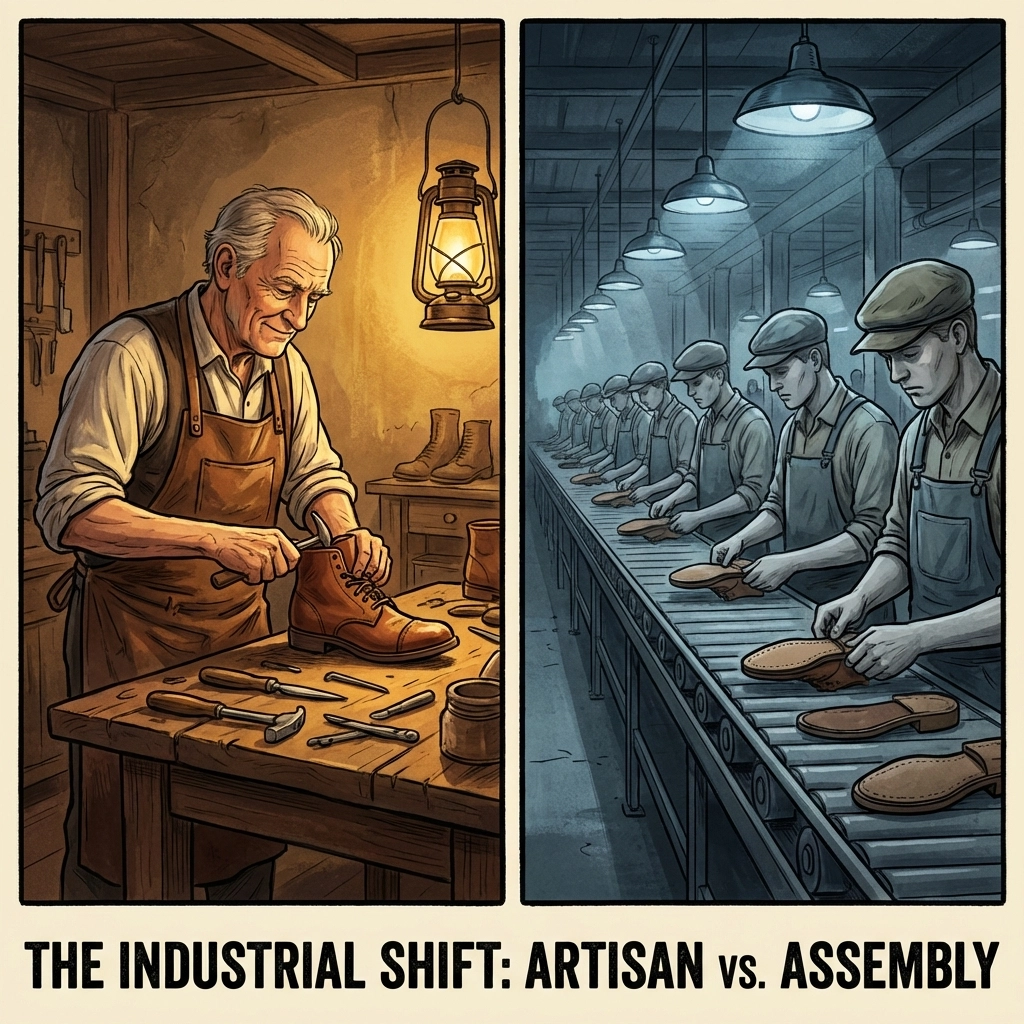
Here's where it gets interesting: they both saw the same thing happening. Take a guy who used to make entire shoes by hand: he knew every step, took pride in the final product. Then factories come along and suddenly he's just gluing the same sole to the same shoe 500 times a day. Smith said "Great! Now we can make way more shoes!" Marx said "Great! Now we've turned humans into robots!"
They were both right. Division of labor does make us more productive, and it does make work feel meaningless for a lot of people. Walk into any modern office where someone spends eight hours a day updating spreadsheets that feed into other spreadsheets, and you'll see exactly what Marx was worried about.
Common Ground #2: They Both Hated Landlords
This one's my favorite because it's so relatable. Both Smith and Marx thought landlords were basically parasites. Not the guy who owns a couple rental houses: we're talking about the landed gentry who inherited massive estates and collected rent just for existing.
Smith was particularly brutal about this. He basically said landlords "love to reap where they never sowed": they contribute nothing to production but take a cut of everything. Marx agreed and took it further, arguing that all property-based income was theft from workers.
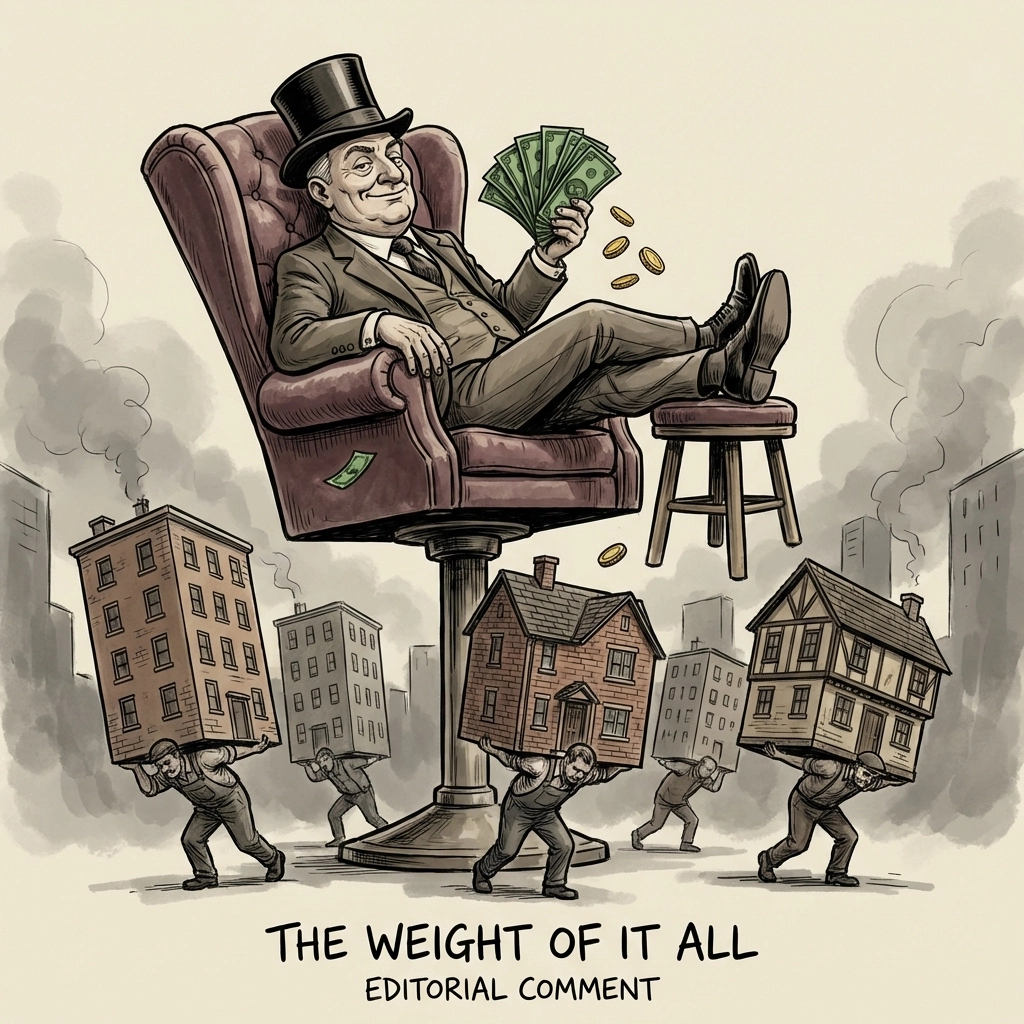
Fast-forward to today, and you've got people inheriting apartment complexes worth millions, raising rent every year, and contributing exactly zero value to society. Some things never change.
Common Ground #3: Profits Always Fall Over Time
Here's where Marx basically took Smith's homework and ran with it. Smith noticed that as economies develop, profit rates tend to fall over time. More competition, more capital needed, less return on investment. It's like how the first guy to sell coffee in your neighborhood makes a killing, but by the time there are five coffee shops on the same block, everyone's margins are razor-thin.
Marx read this and thought "Aha! This is why capitalism will eventually collapse!" He figured that falling profits would lead to economic crises, worker uprisings, and eventually a new system altogether.
Smith was more optimistic: he thought markets would naturally adjust and find new ways to create wealth. But they both saw the same basic pattern: the easy money gets harder to make over time.
Look around today and tell me they weren't onto something. How many industries are getting squeezed by competition, automation, or just plain saturation? From retail to tech to finance, everyone's fighting for smaller slices of a slower-growing pie.
Common Ground #4: They Were Both Radicals
This is the big one that people forget. In their time, both Smith and Marx were dangerous revolutionaries with ideas that threatened the entire social order.
Smith was challenging a system where governments controlled trade, nobles controlled land, and guilds controlled who could work where. His idea that regular people should be free to buy, sell, and work however they wanted was basically economic anarchy to the powers that be.
Marx was challenging the idea that some people should own everything while others own nothing. His vision of worker ownership and economic equality was just as radical: and just as threatening to the people in charge.

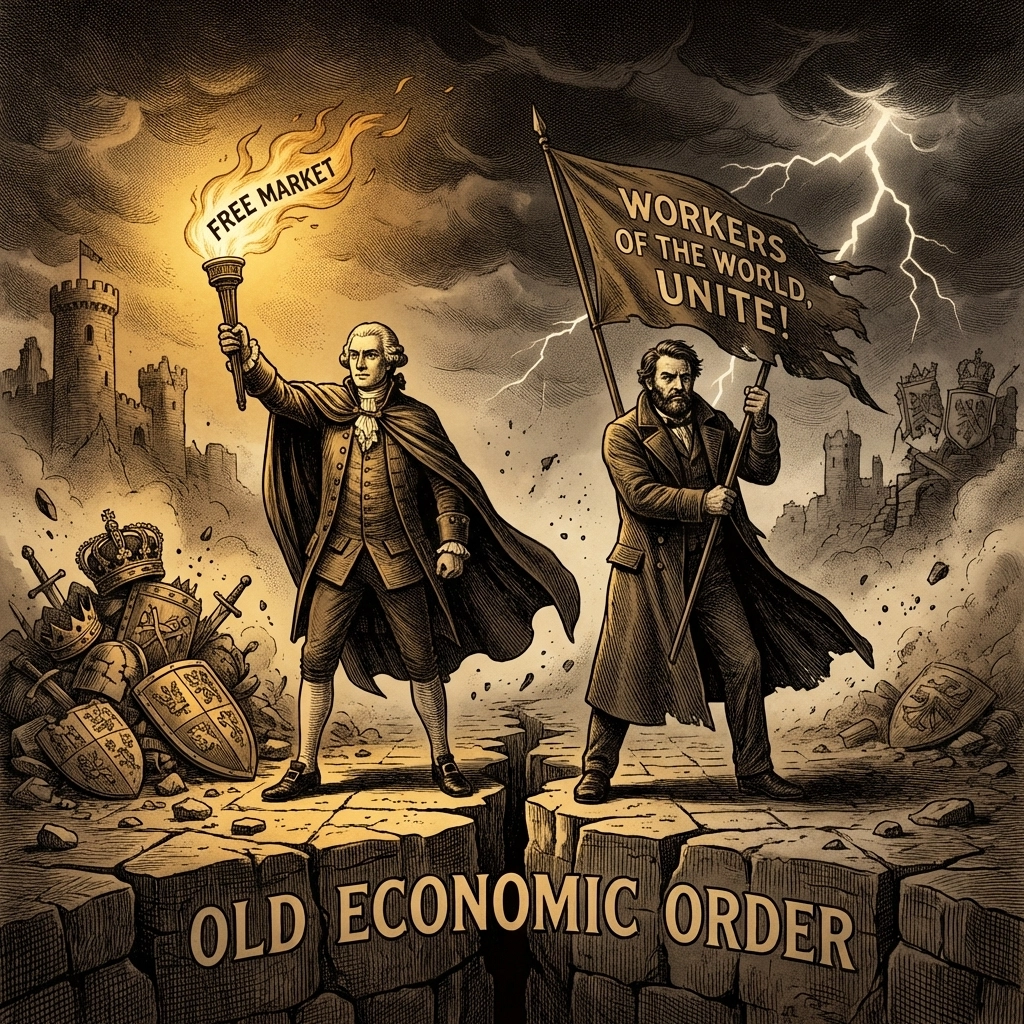
Today we think of Smith as the safe, conservative choice and Marx as the dangerous radical. But in their time, they were both throwing bombs at the establishment. Smith's "invisible hand" was just as scary to kings as Marx's "workers of the world unite" was to factory owners.
The Big Difference: Solutions
So if they agreed on so much, what was the big fight about? Simple: what to do about it.
Smith looked at all the problems with the economy: monopolies, corruption, inequality: and said the solution was more freedom. Get rid of the regulations that protect the rich and powerful, let everyone compete fairly, and the market will sort it out.
Marx looked at the same problems and said the solution was less inequality. The whole system of private ownership creates these problems, so we need to get rid of private ownership altogether.
Smith believed in fixing the game. Marx believed in changing the game entirely.
It's like they both agreed the casino was rigged, but Smith wanted better dealers while Marx wanted to burn down the casino and build something completely different.
Why This Matters Today
Here's the thing: we're still fighting the same fights these guys were fighting 150+ years ago. We've got massive wealth inequality, workers feeling disconnected from their jobs, landlords extracting value without creating it, and profit margins getting squeezed across entire industries.
The debates about minimum wage, universal healthcare, housing costs, and corporate power: Smith and Marx were already having these conversations when your great-great-great-grandparents were kids.
Maybe instead of treating them like religious figures whose every word is gospel, we should treat them like what they were: smart guys trying to figure out how to make the economy work better for regular people.
Smith's insights about competition and market efficiency are still valuable. Marx's insights about worker exploitation and wealth concentration are still relevant. Neither one had all the answers, but they both asked the right questions.
The next time someone tells you capitalism is perfect or socialism is the answer to everything, remind them that even the supposed founders of these ideologies agreed on most of the problems. Maybe we should focus more on the problems they identified and less on picking teams based on 200-year-old solutions.
The economy is still rigged in favor of people who already have money and power. Workers still feel disconnected from their jobs. Housing is still too expensive for the people who actually do the work. And profits are still getting squeezed as markets mature.
Smith and Marx saw all of this coming. They just disagreed on what to do about it.
Be mindful, be watchful and good luck!