



October 24, 2026
Oil crossing $100 a barrel sounds like a market story. Then the gas tank clicks off, the grocery total climbs, and the monthly budget starts asking uncomfortable questions.
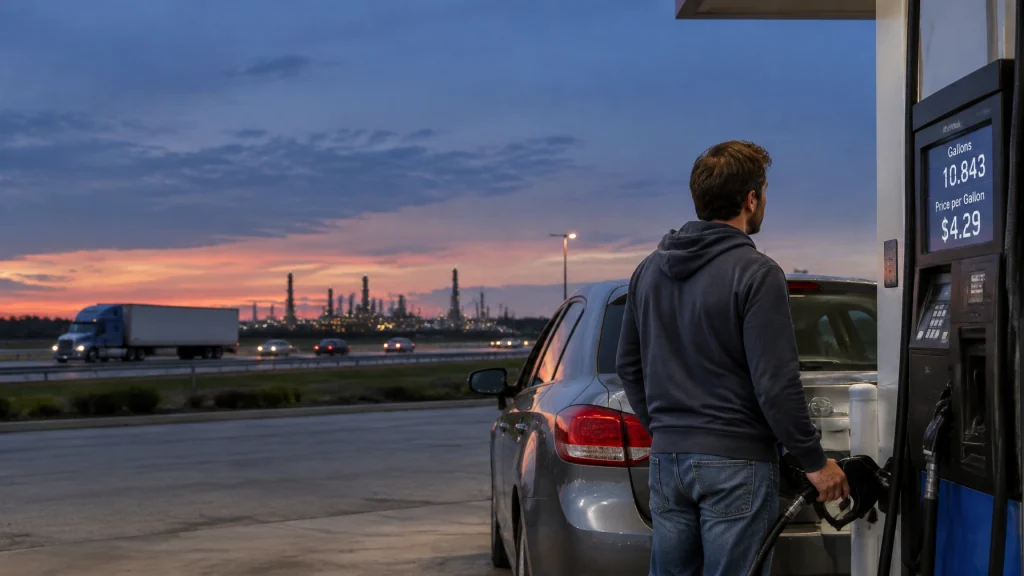
Stocks slipped Friday under pressure from rising oil prices, with crude topping $100 a barrel. The number that may matter more to your household, though, is at the pump: the national average for regular gas rose from $2.93 a gallon in February to $4.29 on October 19.
That is a $1.36 increase per gallon, or roughly 46%. Here is what that increase looks like in ordinary dollars, and why the gas station is only the first stop on the bill.
The pump: about $650 more a year for a typical driver
A price increase is easier to understand when it is attached to a fill-up.
- A 14-gallon fill-up costs about $19 more than it would have at $2.93 a gallon.
- A 20-gallon truck fill-up costs about $27 more.
- A household that drives 12,000 miles a year in a vehicle averaging 25 miles per gallon uses about 480 gallons annually. At $1.36 more per gallon, that is roughly $653 extra a year, or about $54 a month.
That calculation holds driving and fuel efficiency constant. It is not a forecast of where gas prices go next, and it does not include more expensive deliveries or groceries. It simply shows what the price change means for the same number of miles.
For a household running two vehicles, the direct cost can be larger. For a family already stretching each paycheck, $54 a month is not a rounding error. It can be a utility bill, a few grocery trips, or money that was supposed to go toward savings.
The AAA national gas price tracker is a useful place to follow the average, though local prices can differ substantially. The number on a national chart is a starting point, not necessarily the number on the sign down the road.
Why the barrel is expensive: the route matters
The current price shock is tied to the Iran war and disruption around the Strait of Hormuz, a narrow shipping route through which roughly one-fifth of the world’s petroleum supply normally moves. When tankers cannot move freely, or when the market fears they might not, the risk gets priced into oil.
We have covered the Hormuz disruption before; the important point here is how it reaches a household budget. A barrel of crude is not a gallon of gasoline, and crude is not the only thing in the price of fuel. Oil must be shipped, refined into products, distributed, taxed, and sold. A problem at any link can keep prices high.
And right now the pressure is not limited to gasoline. Diesel and jet fuel are also caught in a distillate squeeze. Distillates are refined products that include diesel and heating oil. The Dallas Fed has described the problem as a refining and supply shock as well as an oil-price shock: refinery outages and transport disruptions have tightened supplies of finished fuels.
That distinction matters. Even if crude prices ease, a shortage of working refinery capacity or available diesel does not disappear overnight. The U.S. Energy Information Administration’s October outlook says distillate inventories are expected to remain below their recent historical average, with East Coast stocks forecast to stay notably low through the winter and into 2027.
The hidden tax: diesel now, groceries later
A grocery store does not usually send a separate line item called “diesel surcharge.” But the food on its shelves generally had to travel there, and much of that freight moves by truck.
When diesel gets expensive, trucking businesses face higher operating costs. Smaller carriers may have less room to absorb a sudden fuel bill than giant logistics companies. They can cut expenses, raise delivery prices, or pass some of the cost along when contracts renew. Suppliers, wholesalers, and retailers then make their own decisions about how much of that added expense to absorb and how much to pass on.
It takes time for that chain to work its way through. The pump price is the visible cost today; the shelf price can be the delayed one weeks later. Same barrel, two receipts.

This does not mean every grocery item rises by the same amount, or that all food inflation is caused by fuel. Labor, weather, packaging, processing, and retailer pricing matter too. But expensive diesel adds pressure across the supply chain. As the International Energy Agency’s October assessment warned, tight diesel supplies could persist well into 2027, and replenishing inventories may not begin until the second half of next year.
That is why the biggest exposure may not be the gasoline you buy this week. It may be the goods whose delivery costs reflect a prolonged diesel squeeze.
The second-order cost: oil can make borrowing more expensive
Here is the connection that often gets missed: a costly barrel can raise borrowing costs, too.
Oil feeds into inflation directly through fuel and indirectly through transportation and production expenses. The Federal Reserve just raised its benchmark interest-rate target by a quarter point, to 3.75%–4.00%, saying inflation remained elevated. The Fed’s September statement also noted uncertainty around geopolitical developments.
The Fed cannot produce more oil or reopen a shipping lane by raising interest rates. Its tools work on borrowing and spending: higher rates can cool demand and help keep inflation expectations from becoming entrenched. But that medicine has side effects. Credit-card rates and some car-loan rates are tied to short-term borrowing costs; mortgage rates are influenced by longer-term bond yields and expectations about inflation and future Fed policy.
A rate hike does not automatically add a fixed amount to every household’s payment. Existing fixed-rate mortgages generally stay put, and lenders price different loans in different ways. Still, persistent energy inflation can contribute to a higher-rate environment just as families are paying more to fill the tank. The shock can reach your money as well as your gas.
When does it end? Nobody can give a reliable date
There is no honest way to promise when the oil shock will end. Prices depend on how the conflict develops, whether shipping through Hormuz normalizes, how much refinery capacity returns, and how quickly depleted fuel inventories can be rebuilt.
The IEA’s assessment points to a distillate shortage lasting into 2027. The EIA also expects diesel prices to remain elevated relative to recent years as inventories recover. That does not mean every forecast will come true; energy forecasts are conditional, and events can change quickly. It does mean a fast return to cheap fuel is not something households should build into their budgets as a certainty.
The Strategic Petroleum Reserve can help bridge a supply disruption, but it is not a replacement for normal production, shipping, and refining. The Dallas Fed’s analysis reported that the reserve held about 284 million barrels in September, its lowest level since 1982. A reserve release can buy time. It cannot solve a long-lasting shortage of refined products or keep the world supplied indefinitely.
What households can actually do
No household can reopen a refinery or redirect a tanker. But there are a few practical ways to reduce exposure:
- Combine trips. A separate errand may not look expensive, but repeated short drives add up.
- Check tire pressure. Properly inflated tires can improve fuel economy by a few percent, depending on the vehicle and how underinflated the tires were. Check the recommended pressure on the driver-side door label, not the maximum printed on the tire.
- Look honestly at the second vehicle. If one car or truck is used only occasionally, ask whether every trip is necessary while fuel is unusually expensive.
- Make room in the budget for indirect costs. The grocery bill and delivery prices may respond later than the pump. A little flexibility now can help avoid putting routine expenses on high-interest credit.
The point is not to scold people for driving. Many households have no realistic alternative, and no amount of clever trip planning can erase a $1.36-per-gallon jump. The point is to see the whole bill. At $100-plus oil, a household pays at the pump, through diesel-linked costs that travel through the economy, and potentially through borrowing costs if inflation stays stubborn.
The gas station posts the price in large numbers. The rest of the bill tends to arrive quietly.
Be mindful, be watchful and good luck.
Educational and informational purposes only; this post is not investment advice. For decisions about investments, borrowing, or your personal finances, consult a qualified professional.