



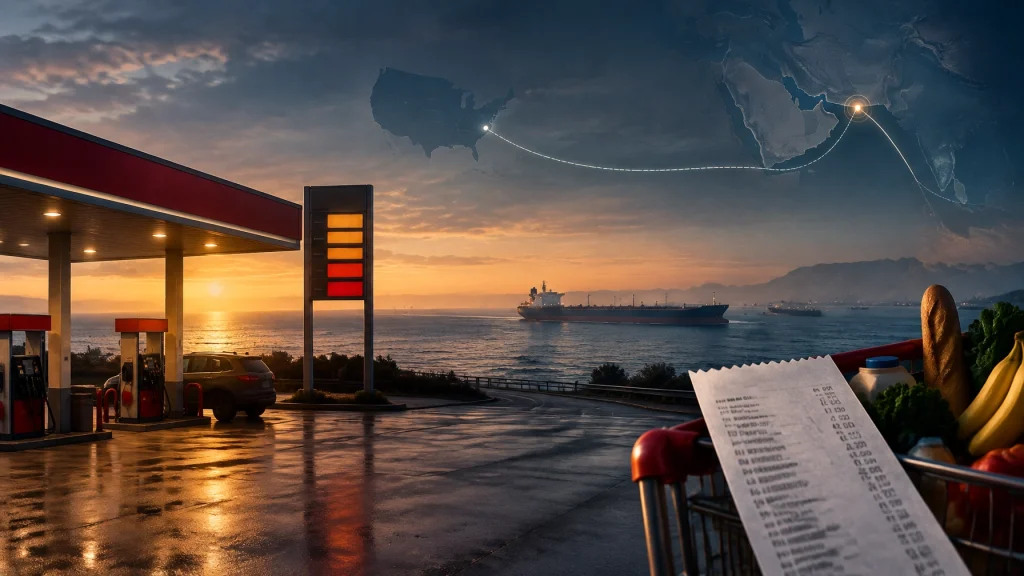
A shipping lane on the other side of the world is showing up on American grocery receipts.
Oil is hovering near $100 a barrel. The conflict involving Iran remains unresolved, and the Strait of Hormuz: the narrow waterway through which a significant share of the world’s oil moves: remains a major supply risk. Earlier in September, regular gasoline averaged roughly $4.08 per gallon nationally, about 90 cents more than a year ago. Diesel was around $5.60 per gallon.
Those numbers are not just a problem for people filling up a pickup truck. Fuel is an input into almost everything that moves, grows, flies, freezes, or arrives at your front door.
That is why the Federal Reserve is paying attention.
The Fed cannot make oil come out of the ground faster. It cannot reopen a shipping lane. It cannot order a refinery to produce gasoline at a lower cost. But it can try to stop a fuel shock from spreading into the rest of the economy.
That spread is what economists call second-order effects. The phrase sounds like something invented to make a simple problem annoying. It is not. It is the whole story.
Start with the barrel of oil
The price at the gas station is not the price of crude oil, dollar for dollar. The Energy Information Administration breaks the price of gasoline into four broad pieces:
- Crude oil
- Refining
- Distribution and marketing
- Taxes
Crude oil is usually the largest component. When oil rises sharply, the cost of producing gasoline, diesel, jet fuel, plastics, chemicals, and other petroleum products tends to rise with it.
The Strait of Hormuz matters because it is a chokepoint. A chokepoint is exactly what it sounds like: a narrow passage where a large amount of traffic must pass. If ships face delays, attacks, insurance problems, or the possibility of being trapped, the market does not wait for an actual shortage before reacting.
It prices in the risk.
That is how oil can rise before every barrel of supply has disappeared. Traders, refiners, shippers, airlines, and manufacturers are all asking the same question: “What will it cost to get the next shipment?”
When the answer becomes “probably more,” prices move first and explanations arrive afterward.
Why diesel is the bigger economic problem
Gasoline is highly visible because most households buy it directly. Diesel is less visible, but it may be more important to the economy.
Diesel powers a large portion of the nation’s trucks, agricultural equipment, construction machinery, delivery fleets, and backup generators. The average driver may buy 12 or 15 gallons at a time. A freight carrier may burn thousands of gallons moving goods across the country.
A rise from roughly $4.70 diesel to $5.60 is not a minor inconvenience for a trucking company. It changes the cost of every route.
That cost eventually appears as a fuel surcharge on freight invoices. Then it becomes part of the delivered cost paid by a manufacturer, wholesaler, supermarket, restaurant, or online retailer.
The package may not arrive with a sticker saying “Hormuz surcharge.” The charge is still in there.

The grocery-store pipeline
Consider a basic grocery item: a carton of milk, a box of cereal, or a head of lettuce.
Before it reaches the shelf, it may involve:
- Fertilizer or feed delivered to a farm
- Diesel-powered tractors and harvesting equipment
- Refrigerated transportation
- Warehousing and cold storage
- A distribution center
- A final truck delivery to the store
Every stage uses energy.
Fertilizer is especially important. Nitrogen fertilizer relies heavily on natural gas as a feedstock, while farming operations also consume diesel for planting, harvesting, and hauling. Oil, natural gas, and refined fuel markets are not identical, but they are connected through the broader energy system. When energy becomes more expensive and uncertain, the cost of growing and transporting food becomes more expensive too.
Then there is the cold chain.
Fresh food does not simply ride in the back of a truck and hope for the best. It moves through refrigerated trailers, warehouses, grocery cases, and processing facilities. Refrigeration uses electricity and fuel. The longer or more complicated the journey, the more energy is required to keep food from spoiling.
The result is not necessarily a one-for-one increase. A 20% rise in fuel does not automatically mean every grocery item rises 20%. Labor, weather, crop yields, packaging, storage, competition, and retailer margins all matter.
But fuel is embedded in the cost structure. When it stays high long enough, someone has to absorb the bill. Farmers, carriers, processors, retailers, or consumers can take the hit. Usually, the cost gets distributed across all of them.
For a household, 90 cents more per gallon means an extra $18 to fill a 20-gallon tank. That is the direct cost. The indirect cost is whatever portion of higher transportation and production expenses arrives later in the shopping cart.

Shipping costs do not stop at the port
Fuel is also central to ocean shipping, rail, trucking, and air freight.
A container ship crossing the ocean consumes enormous amounts of fuel. If a route becomes dangerous or unreliable, vessels may be rerouted, delayed, or forced to pay higher insurance premiums. Longer routes mean more fuel, more crew time, and fewer trips completed with the same equipment.
That raises the cost of moving imported goods.
The same logic applies domestically. A truck does not need to cross the Strait of Hormuz to be affected by it. The truck buys diesel in the United States, and the price of diesel reflects global crude markets and refined-product markets.
This is the part that is easy to miss: fuel is priced globally, but the bill is collected locally.
A bakery in Ohio, a hardware store in Arizona, and a restaurant in Florida may have no direct relationship with a tanker moving through the Persian Gulf. They are still connected by the cost of moving flour, tools, food, packaging, and equipment.
Airfare gets pulled into the same current
Airlines are another direct line from crude oil to the family budget.
Jet fuel is one of the largest operating expenses for an airline. When fuel prices rise, carriers have several choices:
- Raise ticket prices
- Add or increase fuel surcharges
- Reduce less-profitable routes
- Fly with less spare capacity
- Absorb the cost and accept lower margins
No airline wants to raise fares if competitors refuse to do the same. But sustained fuel pressure eventually creates a math problem that cannot be solved with cheerful customer-service language.

The timing can also be awkward. Airlines often buy fuel through contracts and hedges, so the pump-price increase may not appear in ticket prices immediately. That does not mean it disappeared. It may arrive later when contracts roll over or when the airline updates its pricing model.
What the Fed can: and cannot: do
This is where the central bank enters the plumbing.
The Federal Reserve cannot lower the price of crude oil by raising interest rates. Higher rates do not repair a refinery or protect a tanker. In fact, higher rates can make life harder for households and businesses already facing higher costs.
So why hike?
Because the Fed is not only concerned about gasoline. It is concerned about what happens after gasoline rises.
Kevin Warsh explained the dilemma in plain English after the rate decision:
“We cannot affect any individual price, whether it be oil prices, whether it be foodstuffs at the grocery store. But what we can do is ensure that any change in relative prices don’t broaden out, don’t have second and third order effects in the economy.”
That means the Fed is trying to prevent an oil shock from becoming a general pricing habit.
A trucking company facing higher diesel costs may raise freight rates. A manufacturer may raise prices to protect its margin. Workers may ask for larger raises because commuting and groceries cost more. Businesses may then raise prices again to cover higher wages.
That is the second-order effect: the original shock is oil, but the next round reaches freight, food, wages, services, and expectations.
If everyone begins assuming that prices will keep rising, the shock becomes harder to contain. Businesses price ahead. Consumers buy ahead. Workers negotiate ahead. The economy starts behaving as if inflation is permanent.
The Fed’s rate hike is designed to cool that behavior. Higher borrowing costs can reduce demand, slow business expansion, and make it less attractive to pass every cost increase through immediately. It is a blunt tool, but central banking is often the art of choosing which blunt tool causes the least damage.
What this means for regular households
The first impact is obvious: filling the tank costs more.
The next impact is less obvious and may arrive with a delay. Watch for changes in:
- Grocery prices, particularly transported and refrigerated foods
- Delivery fees and freight surcharges
- Airline tickets
- Heating and utility costs
- Prices for fuel-intensive services such as landscaping and construction
- Interest rates staying higher for longer
Do not expect a rate hike to make gasoline cheaper next Tuesday. That is not what it is designed to do.
The Fed is attempting to keep a temporary energy shock from becoming a permanent inflation problem. If the Hormuz disruption eases and oil falls, the central bank may have room to back away. If oil stays near $100, diesel remains elevated, and businesses begin passing those costs into everything else, the Fed may keep policy restrictive even while households are already under pressure.
That is the uncomfortable trade-off.
The shipping lane is far away. The gas station is nearby. The grocery receipt is where the two meet.
Disclosure: Regular Guy Economics is not a financial advisor, and this article is not investment advice. It is general educational commentary about energy prices, inflation, and the economy.
Be mindful, be watchful and good luck.