



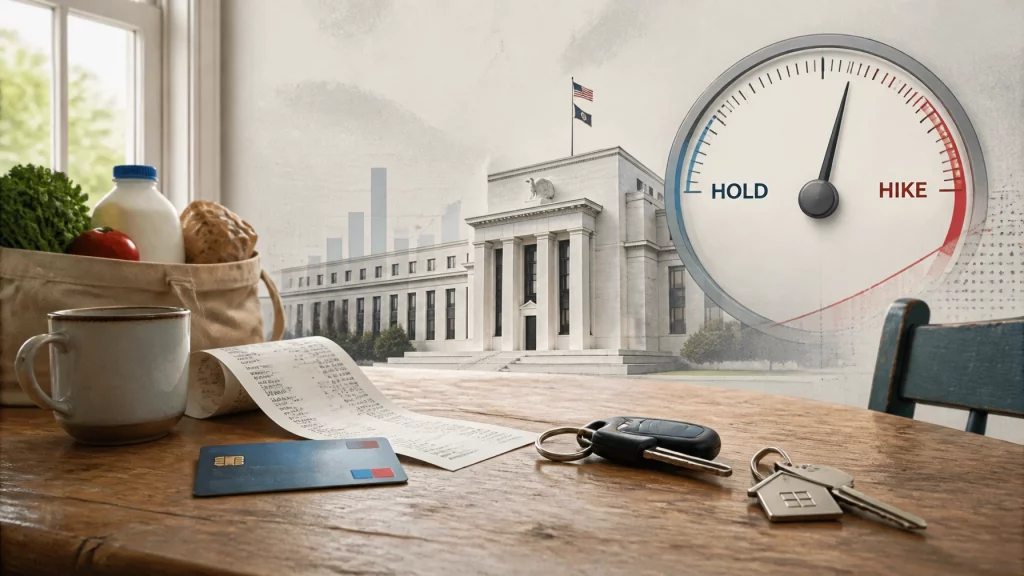
Most Americans have been trained to expect one thing from the Federal Reserve: rate cuts.
That assumption is understandable. Inflation has cooled from its pandemic peak, the Fed cut rates in December, and every market headline seems to ask when borrowing costs will finally come down.
But a rate hike is back on the table.
The federal funds rate has remained in a target range of 3.50% to 3.75% since that December cut. At its July meeting, the Federal Open Market Committee held steady: but the vote was 9–3, with three policymakers preferring a quarter-point increase immediately. Markets have also been assigning roughly a 42% chance of a September hike after the latest inflation data.
That is not a prediction. It is not a guarantee. It is a warning that the “cuts are next” story is no longer the only story available.
And the reason matters because the Fed does not raise rates to punish people personally. It raises rates when policymakers believe the economy is still generating too much inflation: or when they worry that inflation expectations are becoming permanently embedded.
That sounds abstract until it reaches the kitchen table.
Why would the Fed raise rates after holding them steady?
The Federal Reserve has two main jobs: promote maximum employment and maintain price stability.
Those goals usually cooperate. When inflation is high and the economy is overheated, higher rates can cool spending. When unemployment is rising and inflation is under control, lower rates can support borrowing, hiring and investment.
The problem is that the economy does not always cooperate with the neat textbook version.
Inflation may be cooling without returning quickly to the Fed’s 2% target. Businesses may still be raising prices. Energy costs may be pushing transportation and production expenses higher. Meanwhile, economic growth and business investment can remain strong enough to keep demand alive.
That is the uncomfortable middle ground: prices are not accelerating as rapidly as before, but they are still increasing faster than policymakers want.
Fed Chair Kevin Warsh has made price stability the center of his message. At the July press conference, he said the Fed would “deliver price stability” and would “not hesitate to act.” The official July FOMC statement confirmed that rates would remain at 3.50%–3.75%, while the three dissenters argued for a hike.
In plain English, some Fed officials believe rates may not be restrictive enough.
The Fed could also be trying to reestablish credibility. If households and companies begin to assume that inflation will remain above target indefinitely, they may adjust wages, contracts and prices around that assumption. Once that happens, inflation becomes harder to remove without a much harsher economic slowdown.
Nobody wants that sequel.
The end of “forward guidance”
For years, the Fed tried to guide markets by explaining what it expected to do next. This was called forward guidance.
The idea was simple: If markets knew where rates were probably headed, businesses and households could plan ahead. The trouble was that guidance could become a promise in investors’ minds. Then the economy would change, but markets would remain anchored to yesterday’s prediction.
Warsh has moved away from that approach. Rather than provide a detailed roadmap, he has emphasized incoming data. The Fed will react to the economy it actually gets: not the economy it expected six months earlier.
That makes the central bank harder to read, but it also makes the next few economic reports more important.
The next major policy meeting is scheduled for September 15–16. Before then, policymakers will see additional inflation and labor-market data. A hotter inflation report combined with resilient employment could strengthen the case for a hike. Softer inflation or clear labor-market deterioration could give officials a reason to hold.
This is why market odds can swing from “almost certain” to “coin flip” in a matter of days. Traders are not reading the Fed’s mind. They are repricing every new data point.

What a quarter-point hike would do to a credit card
Most credit cards carry variable interest rates. They are commonly priced using the prime rate plus a margin determined by the card issuer.
The prime rate generally moves alongside the federal funds rate. If the Fed raises its target by a quarter of a percentage point, credit card APRs usually rise by approximately the same amount.
Consider a household carrying a $5,000 balance on a card with a 24.99% APR.
A quarter-point increase would raise the APR to roughly 25.24%. If the balance stayed unchanged for a full year, the added interest would be approximately:
- $5,000 multiplied by 0.25%
- About $12.50 more per year
- Roughly $1.04 per month in additional interest at the starting balance
That number does not sound like the end of civilization. It is not. But the payment is only one card, and the balance does not usually remain perfectly still. Add a second card, a personal line of credit, or a household that is already making minimum payments, and the extra cost starts stacking up.
More importantly, a rate hike signals that borrowing costs may remain high for longer. The larger financial damage often comes from the duration of the debt: not from the quarter-point itself.
A card balance that survives for years is a small leak that never gets repaired. Eventually, the floor is wet.
What happens to a car loan?
Existing fixed-rate auto loans generally do not change when the Fed changes the federal funds rate. If the loan contract says 7.2%, the payment remains based on 7.2%.
That is the good news.
New car buyers are more exposed. Lenders price auto loans based on their own funding costs, market interest rates, credit risk, loan term and competition. The Fed does not directly set the rate printed on the dealership paperwork, but its decisions influence the broader cost of money.
A quarter-point Fed hike might not produce a perfectly matching quarter-point increase in every auto loan. It could show up gradually, partly or not at all, depending on lender pricing.
For illustration, suppose a borrower takes out a new $30,000, 60-month loan. A move from 7.00% to 7.25% would increase the monthly payment by only a few dollars: roughly $3 per month, depending on the exact loan terms.
Again, not a catastrophe by itself.
But car buyers face more than the interest rate. Vehicle prices, insurance, taxes, dealer fees and longer loan terms all matter. A small rate increase can become meaningful when the borrower is already stretching a six-year loan across an expensive vehicle.
The practical lesson: A Fed hike is not a reason to panic-sell a perfectly good car. It is a reason to avoid pretending that “only a few dollars more per month” means the purchase is affordable.
What happens to a HELOC?
Home equity lines of credit are usually variable-rate debt. That makes them one of the fastest ways a Fed decision can reach a homeowner.
A HELOC is commonly priced as the prime rate plus a lender-specific margin. When prime rises, the HELOC rate generally rises as well.
Suppose a homeowner has a $50,000 HELOC balance. A quarter-point rate increase would add approximately:
- $50,000 multiplied by 0.25%
- $125 more per year
- About $10.42 per month in interest, before considering payment changes
The exact monthly bill depends on whether the borrower is in the draw period, the repayment period, and how the lender calculates minimum payments.
A homeowner using a HELOC to renovate a kitchen may be able to absorb that change. A homeowner using it to pay recurring bills is in a more dangerous position. Borrowing against home equity can feel cheaper than using a credit card, but it is still debt secured by the house.
That distinction matters. A credit card company can send an unpleasant statement. A lender with a claim on the house can create a much larger problem.

The part nobody puts in the headline
The federal funds rate is an overnight rate between banks. Consumers do not walk into a bank and borrow at 3.75%.
The rate is important because it acts as a starting point for the rest of the financial system. It influences the prime rate, short-term borrowing, business financing and the returns available on cash. Longer-term rates, including mortgages, are driven more by bond yields and expectations for future inflation and growth than by one Fed decision.
That means a hike can affect people unevenly:
- A household with large credit card and HELOC balances feels it quickly.
- A borrower with a fixed auto loan may feel nothing immediately.
- A saver may benefit from higher yields on cash accounts.
- A prospective homebuyer may find that mortgage rates do not move in lockstep.
- A business may delay hiring or investment because financing becomes more expensive.
This is why “the Fed raised rates by 0.25%” is an incomplete sentence. The real question is: Which part of your financial life is variable?
What to do before September
This is not a command to refinance everything or make a dramatic investment decision. It is a reminder to understand the contracts already sitting in the household file cabinet.
Check whether credit cards, HELOCs and personal lines of credit have variable APRs. Look at the margin over prime, not just the promotional rate. Know when a teaser rate expires. If a debt payment is already uncomfortable, a small increase is useful information: not an invitation to borrow more.
For auto buyers, compare the total cost of the loan rather than focusing only on the monthly payment. For homeowners, treat available HELOC credit as borrowing capacity, not as income.
And for everyone, pay attention to the next inflation and jobs reports without treating market probabilities as prophecy. A 42% chance of a hike means the hike may happen. It also means there is still a 58% chance that it will not, based on that particular market snapshot.
The risk people have not priced in is not necessarily a single quarter-point increase. It is the possibility that rates remain higher, inflation stays stubborn, and the hoped-for series of cuts never arrives on schedule.
The Fed may hike. It may hold. Either way, the household that knows how its debt is priced will be in better shape than the household waiting for a television panel to explain it after the fact.
For more plain-English economic analysis, visit the Regular Guy Economics podcast and video archive.
Disclosure: Regular Guy Economics is not a financial advisor, and this content is not investment advice. It is general educational commentary, not a recommendation to buy, sell, refinance or borrow. Personal financial decisions should be based on individual circumstances and, when appropriate, guidance from a qualified professional.
Be mindful, be watchful and good luck.