



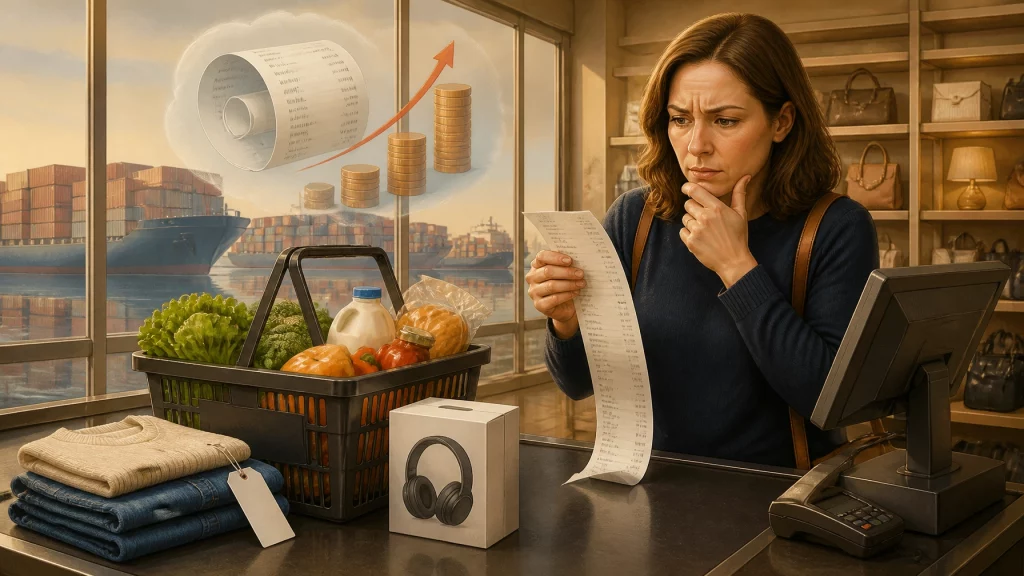
The tariff bill is not sitting in your mailbox.
It does not arrive as a separate invoice from the federal government. There is no line on your grocery receipt that says, “Strait of Hormuz surcharge,” “China tariff,” or “trade-policy tax.” Instead, the cost is folded into the price of the shirt, the laptop, the refrigerator, the tools, and sometimes even the groceries sitting in your cart.
That is what makes tariffs politically convenient. The bill is real, but it is hidden.
According to research from the Budget Lab at Yale, the average effective U.S. tariff rate has reached approximately 11.8% before consumers and businesses change what they buy. That is the highest level since the early 1940s, excluding the unusual tariff episode of 2025.
Depending on how long current tariffs remain in place, Yale estimates the average household could lose between roughly $940 and $1,500 per year in purchasing power. That is not a precise bill delivered to every family. It is an estimate of what higher prices do to household income.
Either way, the number is large enough to notice.
For a household earning $60,000 after taxes, $1,000 represents more than one and a half percent of annual take-home income. That could cover a car repair, several months of utility bills, a medical deductible, or a painful number of grocery trips.
The regular guy does not need a seminar in trade theory. The regular guy needs to know where the money went.
Who actually pays a tariff?
The legal answer is straightforward: the importer of record pays the tariff to the U.S. government when goods enter the country.
That importer might be a retailer, manufacturer, distributor, or another business bringing foreign goods or components into the United States.
But the importer does not necessarily absorb the entire cost. Businesses have payroll, rent, transportation expenses, debt payments, and shareholders who would prefer not to see profits shrink. When the cost of bringing in a product rises, the importer has several options:
- Raise the price charged to wholesalers or retailers.
- Ask the foreign supplier to accept a lower price.
- Accept a smaller profit margin.
- Substitute another supplier or product.
- Pass some combination of those costs to the next buyer.
In many cases, the cost travels down the supply chain until it reaches the checkout counter.
So when someone says, “Foreign countries pay the tariff,” that is usually political shorthand, not household economics. The foreign government does not typically send the tariff check to Washington. The American importer does.
Then the American customer often pays more.

The receipt will not tell you the whole story
A tariff is not a sales tax. It does not appear as a neat percentage at the bottom of the receipt.
Suppose a retailer imports a $100 product and faces a 20% tariff. The importer may owe $20 at the border. That does not mean the shelf price automatically rises from $100 to $120.
The retailer may absorb some of the cost. The supplier may lower its price. The retailer may raise the price by $10, $15, or $25. Shipping, warehousing, currency movements, and ordinary profit decisions also affect the final number.
That is why it is impossible to look at one receipt and identify the exact tariff cost with scientific precision.
But households can still find the pattern.
Start with a product you buy repeatedly. Compare the current price with an older receipt, bank statement, store loyalty record, or online listing. Then ask:
- Did the package get smaller?
- Did the brand change?
- Did the price rise even though the product looks identical?
- Did a retailer stop offering the cheaper option?
- Did the store move the item into a higher-priced version?
- Did the price rise across several competing brands at the same time?
A tariff may not explain every increase. But if the price of imported or import-dependent goods rises across multiple retailers, trade policy may be part of the bill.
Grocery receipts: look beyond the obvious
Food is not affected equally by tariffs. Some agricultural goods may be exempt, while packaging, fertilizer, machinery, transportation equipment, and imported ingredients can face additional costs.
That means the tariff effect on groceries is often indirect.
A cereal box may contain domestic grain but use imported packaging materials. A frozen meal may be assembled in the United States with ingredients sourced from several countries. A grocery store may pay more for refrigeration equipment, shelving, delivery vehicles, or replacement parts.
Those costs do not vanish. They become part of the retailer’s operating expenses.
To track the effect, keep a simple record of ten recurring products:
- Coffee
- Olive oil
- Canned fruit
- Rice
- Chocolate
- Frozen seafood
- Produce that is out of season domestically
- Pet food
- Cleaning products
- Packaged snacks
Record the price once a month. Do not obsess over one week of volatility. Look for a trend over three to six months.
Also watch package size. A product that remains “$4.99” while shrinking from 16 ounces to 14 ounces has increased in price per ounce. The receipt is technically telling the truth. It is simply leaving out the part you actually need.
Electronics are a tariff detective story
Electronics are often built from global supply chains. A device may be designed in one country, assembled in another, and made with components from several more.
That makes electronics especially sensitive to tariffs and trade restrictions.
When comparing an old and new receipt for a television, phone, computer, router, or appliance, do not look only at the model number. Compare the specifications.
A newer product may have:
- Less storage
- Fewer accessories
- A weaker processor
- A shorter warranty
- More expensive replacement parts
- A subscription attached to features that used to be included
This is called “shrinkflation” in some forms, although the product may look technologically newer. The customer pays more while receiving less value in the areas that matter.
The Budget Lab’s analysis estimates that furnishings and durable household equipment could experience price increases above the overall average under current tariff scenarios. That includes the ordinary items people buy when a refrigerator breaks, a washing machine dies, or a home office needs replacing.
Nobody plans those purchases. That is why the cost hurts.

Clothing is where the math gets ugly
Clothing is one of the clearest places to look for tariff pressure because the United States imports a large share of the apparel sold here.
Yale estimates that clothing and footwear are among the categories most exposed to the current tariff structure. Under a scenario in which certain tariffs remain in place, clothing prices could rise substantially more than the overall consumer price level.
The practical lesson is not to assume every expensive shirt is expensive because of tariffs. Fashion brands have plenty of other ways to charge you more.
Instead, compare:
- The same brand and item across different seasons
- The material composition
- The country of origin
- The number of garments in a package
- Whether buttons, zippers, and stitching have changed
- Whether a “sale” price is actually higher than last year’s regular price
Clothing also exposes the sticky-price problem.
Retailers may raise prices when costs rise, but they do not necessarily lower them when costs later improve. Once the consumer accepts the new price, the price becomes the new normal. Businesses may use the extra margin to recover past losses, protect against future costs, or simply discover that customers will tolerate it.
That is why tariffs can create a permanent step up in prices even if the policy later changes.
Why prices do not come back down
This is the part that gets lost in the trade-policy debate.
If a tariff increases the cost of importing a product, the price may rise gradually as existing inventory sells and new shipments arrive. Retailers may delay the increase to avoid shocking customers.
But once the higher price is on the shelf, removing the tariff does not guarantee that the price falls back to its old level.
Businesses may still face higher wages, rent, insurance, energy, transportation, and financing costs. They may have rewritten contracts. They may have changed suppliers. They may have discovered that customers are willing to pay the new price.
Economists call prices “sticky” when they adjust slowly, particularly downward.
This is why inflation slowing does not mean prices return to where they were. It only means prices are increasing at a slower rate. Tariffs can add another permanent bump to a price level that households already consider too high.
The burden is heavier for lower-income households
The tariff bill is not distributed evenly.
High-income households may pay more dollars because they buy more goods. But lower-income households generally spend a larger share of their income on goods that cannot be avoided: food, clothing, household supplies, transportation, and basic equipment.
The Budget Lab estimates that the tariff burden, measured as a share of after-tax income, falls hardest on the lowest-income households. If tariffs expire under the modeled scenario, the burden on the lowest income decile is about three times the burden on the highest decile.
That is the difference between losing $1,000 from a comfortable budget and losing $1,000 from a budget that was already short.
A tariff may be described as a national economic strategy. At the checkout counter, it is a price increase that does not care whether the shopper has room left on the credit card.

How to find your household’s tariff bill
Nobody can calculate the exact amount without access to every company’s supply chain and pricing decisions. But a household can estimate its exposure.
Try this four-step exercise:
1. List imported and import-dependent purchases
Look at clothing, shoes, electronics, furniture, appliances, tools, toys, packaged food, and household supplies.
2. Track prices over time
Use old receipts, online order histories, loyalty apps, and bank statements. Record the price, package size, and product specifications.
3. Separate price increases from quantity changes
A smaller package, cheaper material, fewer accessories, or shorter warranty is a price increase even if the sticker price barely moved.
4. Estimate conservatively
Do not blame tariffs for every increase. Start with products directly exposed to international supply chains, then assume only part of the price change reflects tariffs.
The goal is not to produce a courtroom-quality number. The goal is to see how trade policy enters the household budget.
For more on the difference between official economic averages and personal household math, read “The CPI You Read vs. The Prices You Pay”. The same principle applies here: the national number matters, but the family ledger matters more.
Trade policy deserves an honest receipt
Tariffs may protect certain domestic industries. They may encourage investment in American production. They may be used as leverage in negotiations. Those arguments deserve to be debated honestly.
But honest debate requires admitting the cost.
Tariffs are not free money. They are not paid by an invisible foreign treasury. Importers write the check, businesses adjust their costs, and households often pay through higher prices, reduced product choices, smaller packages, or delayed purchases.
The bill nobody itemizes may cost the average household roughly $940 to $1,500 a year. The exact amount will vary by income, spending habits, product choices, and how long the tariff structure remains in place.
The political slogan may be about foreign governments.
The economic reality is sitting in your cart.
Be mindful, be watchful and good luck.