



Saturday, August 22, 2026
Silver has just delivered a master class in why a shiny object is not automatically a safe investment.
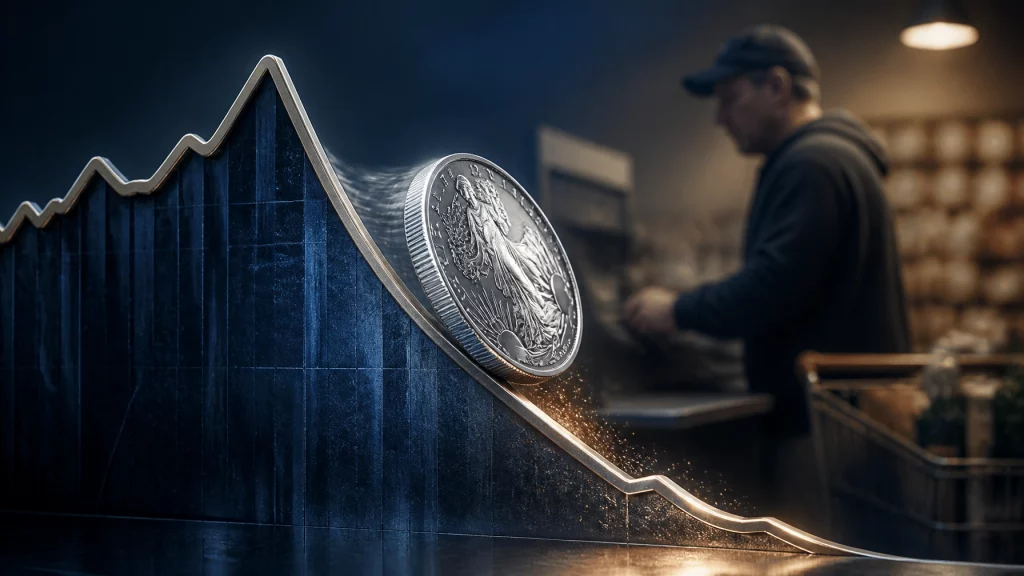
Last September, silver traded around $40 an ounce. By January 28, it had climbed to roughly $116. By late July, it had fallen back near $59. Now it is hovering around $66. Gold, meanwhile, is trading near $4,395 an ounce.
That is not a gentle savings account. That is a roller coaster with a precious-metals brochure taped to the safety bar.
The advertisements are arriving right on schedule. Silver is still well above where it was last year, the headlines are dramatic, and the coin sellers are eager to explain why the next move will be even bigger. The regular guy should be careful here.
The most important question is not whether silver can go higher. Of course it can. The question is whether buying it now, after the dramatic move and the dramatic retreat, makes sense for a household trying to build and protect wealth.
Usually, chasing the chart is how the small investor ends up buying someone else’s victory lap.

First, let’s do the math honestly
The move from $40 to $116 was enormous. Silver gained approximately 190% from the September starting point to the January peak.
Then came the round trip.
From $116 down to $59 is a decline of approximately 49%. That is not a 73% crash, despite whatever dramatic number may be circulating in a sales pitch. The distinction matters because investment decisions should be based on actual arithmetic, not emotional advertising.
A 49% decline still means that someone who bought near the high needed a nearly 96% gain just to get back to even. That is how percentage losses work:
- A $100 investment falls 50% to $50.
- The $50 must then double to return to $100.
- A loss and a gain of the same percentage do not cancel each other out.
At $66, silver is about 43% below the January peak, though it remains roughly 65% above the $40 level from last September.
This is exactly the kind of chart that causes trouble. The seller points to the $40 price and says, “Look how much higher it could go.” The buyer looks at $116 and imagines another jackpot. Neither person may be looking carefully at the price being paid today, the dealer’s markup, the eventual selling price, or the possibility that silver simply goes sideways for years.
Silver is a commodity, not a paycheck
Silver does not pay interest. It does not issue dividends. It does not produce a quarterly report showing growing profits. It sits there, looking impressive, waiting for somebody else to offer more money than you paid.
That does not make silver useless. It makes silver different from productive assets.
A broad stock-market investment represents ownership in businesses that sell products, employ people, generate revenue and, in some cases, distribute profits. A bond lends money in exchange for interest. Cash provides liquidity and stability, even when inflation is steadily chewing on it.
Silver provides exposure to the price of silver.
That exposure can be useful in a diversified portfolio, especially for someone who understands that commodities sometimes behave differently from stocks and bonds. But diversification is not the same thing as safety. A small allocation can reduce dependence on one asset class. A concentrated bet can turn a retirement plan into a weather report.
Silver is also influenced by industrial demand. It is used in electronics, solar equipment, medical applications and other manufacturing processes. That gives it a real-world demand base, but it also means the price can react to economic growth, factory orders and supply-chain expectations. Silver is part precious metal, part industrial commodity and part financial speculation.
That combination is why silver tends to be more volatile than gold.
Gold is generally treated as the monetary heavyweight. Central banks hold it. Investors use it as a hedge against currency and political risk. Silver is the smaller, more excitable cousin who occasionally runs through the house yelling about a shortage.
The coin-seller pitch is not the same as investing
The television or internet advertisement typically follows a familiar script:
- Inflation is destroying your money.
- Governments are spending too much.
- The financial system is fragile.
- Silver has already exploded higher.
- Supplies are limited.
- You must act immediately.
Some of those concerns may be reasonable. The conclusion does not automatically follow.
A concern about inflation does not mean every silver coin is fairly priced. A concern about government debt does not mean a dealer’s “exclusive” coin deserves a 60% markup. A concern about geopolitical risk does not mean moving a retirement account into physical metal is prudent.
When buying physical silver, the price is usually:
Spot price + dealer premium + shipping and other costs
The spot price is the market value of the metal itself. The premium is what the dealer charges above that price. When selling, the dealer may buy the metal back at a lower price than the current spot quote. That difference is the spread, and it is where many buyers discover that they began the transaction in a hole.
Regulators have repeatedly warned investors about excessive markups on collectible, “rare” or semi-numismatic coins. The North American Securities Administrators Association and FINRA both emphasize the importance of understanding premiums, fees, liquidity and dealer practices.
Before buying, ask one simple question:
“What would you pay me for this exact coin if I sold it back tomorrow?”
Do not ask what it might be worth in five years. Ask what the dealer would pay tomorrow. That answer is the financial equivalent of turning on the kitchen light.

A high price does not create an investment thesis
At roughly $4,395, gold is expensive in dollar terms. At roughly $66, silver looks more accessible. That affordability can be deceptive.
A person may say, “I can buy 15 ounces of silver for what one ounce of gold costs.” That is true, but the number of ounces does not determine the quality of the investment. A $66 asset can fall to $40 just as easily as a $4,395 asset can fall to $3,500.
The temptation comes from unit bias. People like owning more pieces. Ten coins feel better than one coin. Fifty ounces feel more substantial than a small position in an exchange-traded fund. But physical bulk is not the same thing as financial security.
Silver also has practical costs:
- Secure storage
- Insurance
- Shipping
- Authentication
- Dealer spreads
- Potential tax complications
- The inconvenience of selling during a panic
The Commodity Futures Trading Commission is blunt about this point: precious metals are volatile and are not guaranteed investments. The metal may be real. The risk is real, too.
What role can precious metals play?
A reasonable portfolio is built around jobs.
Cash handles emergencies and near-term spending. Bonds can provide income and reduce dependence on stock-market prices. Stocks provide ownership in productive businesses. Real estate can provide shelter or income, though it comes with its own costs and risks.
Precious metals, if included, may serve as a small diversifier or a hedge against particular forms of financial and political risk.
That is a much less exciting sales pitch than “silver to $200,” but it is considerably more useful.

There is no universal percentage that works for everyone. A household with high-interest debt, no emergency savings and an underfunded retirement account probably does not need to begin with silver. The first priority is not protecting a fortune. It is building one.
Paying off a 25% credit-card balance is a guaranteed improvement to the household balance sheet. Buying silver and hoping for a 25% gain is not.
Likewise, someone within a few years of retirement should be especially careful about putting essential spending money into an asset that can lose nearly half its value in a matter of months. Retirement portfolios cannot always wait for a commodity to regain its footing.
The regular-guy checklist
If a precious-metals purchase is still being considered, use this checklist before handing over money:
- Check the current spot price independently. Do not rely on the dealer’s chart or television advertisement.
- Calculate the premium. Compare the purchase price with the metal content and spot price.
- Get the buyback price in writing. Ask what the dealer will pay if you sell immediately.
- Avoid urgency. “Act today” is a sales tactic, not an economic principle.
- Be suspicious of rare-coin language. If the value depends on a complicated story rather than weight and purity, get a second opinion.
- Do not borrow to buy metals. Leverage turns volatility into a household emergency.
- Do not liquidate retirement assets after a cold call. Speak with an independent, qualified professional first.
- Keep the position small enough to survive. If a 40% decline would wreck the budget, the position is too large.
The FINRA guidance on physical precious metals is worth reading before buying coins, bars or any metal-backed arrangement. It covers risks that rarely appear in the glossy mailer.
The bottom line
Silver’s trip from $40 to $116 and back toward $60 is not proof that silver is broken. It is proof that silver can move violently when investors, manufacturers, traders and speculators all pull on the same rope.
That volatility is a feature of the asset. It is not a temporary defect that the coin salesman can explain away.
There may be a place for precious metals in a diversified portfolio. But silver should not be confused with an emergency fund, a guaranteed inflation shield or a substitute for owning productive assets. Buying after a spectacular run because an advertisement shows the old low is classic performance chasing. The buyer sees the past and mistakes it for a forecast.
The best defense is simple: know the price, know the premium, know the exit, and never let fear make the investment decision.
For more plain-English conversations about money, visit Regular Guy Economics and browse the podcast episodes.
Be mindful, be watchful and good luck.