



Tuesday, August 18, 2026
There is a number buried inside the latest consumer survey that says more about America’s economic mood than the usual collection of charts, speeches, and cheerful television panels:
Only 8% of consumers expect their incomes to grow faster than inflation over the next year.
That is down from 18% in December 2024.
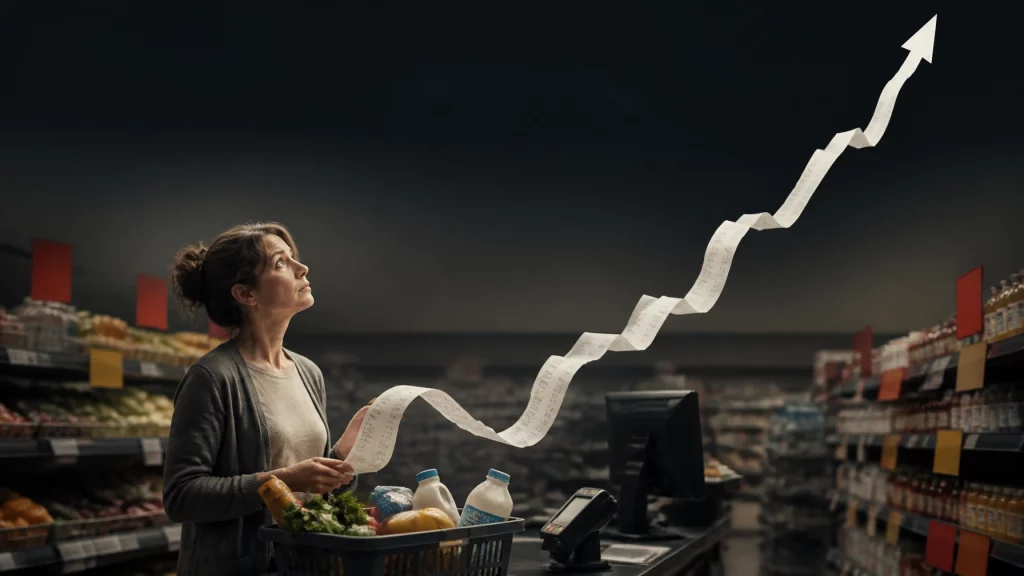
Read that again. In less than two years, the share of Americans who believe their paychecks will outrun rising prices has been cut by more than half.
This is not merely a consumer-confidence problem. It is not a case of Americans being grumpy because gasoline moved up a few cents or because the stock market had a bad Tuesday.
It is an affordability crisis. People are not just struggling with today’s prices. They are losing faith that their incomes will ever catch up.
The headline sentiment number is bad. The buried number is worse.
The University of Michigan’s preliminary August 2026 Survey of Consumers showed sentiment falling to 51.0, down from 55.2 in July. That was a decline of roughly 8% in a single month and ended two consecutive months of improvement.
The expectations index dropped from 55.4 to 50.6. The current conditions index fell from 54.8 to 51.8.
Those numbers are ugly, but an index can feel abstract. A score of 51 does not tell anyone whether the problem is rent, groceries, medical bills, interest rates, or a paycheck that seems to disappear before the month is half over.
The 8% figure does.
It translates the national mood into plain English: most people do not believe their financial position will improve after accounting for inflation.
And the decline is not limited to one political party or one narrow demographic. The University of Michigan reported that sentiment weakened across the political spectrum. The largest declines appeared among older consumers, lower-income households, and people without college degrees : precisely the groups with less room to absorb another increase in food, fuel, housing, or insurance costs.
“Not falling behind” is not the same as getting ahead
There is an important technical distinction here.
The survey says only 8% expect their income growth to exceed inflation. That means the other 92% do not expect to outrun inflation. Some may expect their income to keep pace. Others expect to fall behind. Some may be uncertain.
But from the point of view of a household budget, uncertainty is not exactly a raise.
If a family does not know whether its income will keep up with the cost of living, it will naturally become more cautious. It delays the car repair. It postpones the dentist. It buys the smaller package. It makes another trip to the discount store because buying everything at once is no longer possible.
That behavior may not look like a financial emergency on a national spreadsheet. It looks like smaller purchases, more frequent shopping trips, and less confidence about the future.
The economy can still report growth while millions of people quietly downgrade their lives.

Inflation does not have to be high to remain painful
The happy-talk version of inflation says prices are rising more slowly than they were during the worst of the pandemic recovery. That is technically true and practically incomplete.
A slower increase is still an increase.
If a grocery bill rose from $150 to $210 over several years, a decline in the inflation rate does not return the bill to $150. It only means the bill may rise from $210 to $214 instead of $220.
That distinction is where official economic language loses the regular guy.
Inflation is a rate of change. Household budgets live in price levels.
The latest survey showed one-year inflation expectations rising to 4.3% in August, up from 4.2% in July and well above the 3.4% reading in February, before the Middle East conflict began disrupting energy markets. Long-term inflation expectations held at 3.3%, but that is not much comfort to someone renewing a lease, filling a gas tank, or opening a health-insurance bill this month.
A family does not pay the inflation rate. It pays the price.
The paycheck has a job before it reaches the household
A paycheck is often described as income, but that word hides the order of operations.
First comes housing. Then utilities. Then food. Then transportation. Then insurance, taxes, debt payments, medicine, child care, and every other bill that cannot be ignored simply because prices went up.
Only after those obligations are handled does a household discover whether it has any money left for savings, entertainment, repairs, or a little breathing room.
That is why a modest raise can feel like no raise at all. If a worker receives a 3% pay increase while rent, insurance, groceries, and transportation rise by more than 3%, the worker is technically earning more and functionally getting poorer.
This is also why averages can be misleading. The average inflation rate may not match the inflation rate experienced by a household whose largest expenses are shelter, medical care, gasoline, and food. A retiree on a fixed income and a young family facing child-care costs do not experience the same economy as a high-income professional with a rising stock portfolio.
The average American does not spend the average dollar.
Wall Street can celebrate while Main Street cuts back
The disconnect becomes more obvious when financial markets are doing well.
A strong stock market reflects the value of publicly traded companies, future earnings expectations, interest-rate bets, and investor demand. It does not necessarily reflect whether a cashier can afford a two-bedroom apartment or whether a family can replace a dead washing machine without using a credit card.
Both things can be true at the same time:
- Corporate profits can remain strong.
- Stock indexes can reach record highs.
- Employment can appear reasonably stable.
- Consumers can feel like they are falling behind.
The PNC economic analysis of the August survey pointed to this disconnect directly: consumer spending grew at a 3.2% annualized rate in the second quarter even as sentiment weakened.
Spending is not proof of comfort. People spend because they have to eat, commute, pay rent, and keep the lights on. A household can maintain its spending by drawing down savings, increasing credit-card balances, buying cheaper goods, or abandoning other purchases.
The checkout line does not ask whether the purchase was funded by wages, savings, or debt.
The damage is psychological : and economic
When people believe they cannot catch up, they change their behavior.
They become less willing to buy a home because the down payment feels impossible. They delay having children. They avoid changing jobs because stability matters more than opportunity. They stop contributing to retirement accounts. They take on second jobs. They borrow to cover ordinary expenses.
That is not consumer irrationality. It is a rational response to a system in which the cost of making a mistake has become enormous.
A broken water heater used to be an expensive nuisance. Now it can become a debt event.
A medical bill used to be something a household disliked. Now it can determine whether rent is paid on time.
A grocery increase used to mean sacrificing a restaurant meal. Now it can mean sacrificing fresh food, medication, or savings.
This is how an affordability crisis spreads. It does not arrive as one dramatic collapse. It eats the margin out of ordinary life.

What would restore confidence?
Not another speech telling Americans that the economy is fundamentally strong.
Confidence will improve when households see evidence in their own accounts:
- Pay increases that exceed the cost of essential goods.
- Housing costs that stop consuming an unreasonable share of income.
- Health-care expenses that can be predicted and paid.
- Energy prices that do not swing wildly with every international crisis.
- Interest rates that make borrowing manageable without punishing savers.
- More stable work, rather than a labor market built around temporary jobs and permanent anxiety.
The answer is not to shame consumers for being pessimistic. The survey is not a mood ring. It is a warning light.
People are telling pollsters that they do not expect to get ahead. The responsible response is to ask why : and then examine the prices, wages, taxes, debt, and market structures producing that answer.
The 8% statistic is powerful because it strips away the argument over whether the economy is technically expanding. Growth that does not improve purchasing power is a weak bargain. A recovery that leaves most households unable to outrun rising prices is not a recovery anyone should brag about.
A country cannot build durable prosperity on the belief that almost everyone will be poorer next year.
For more plain-English economic analysis, follow the Regular Guy Economics podcast and explore the company’s shows and broadcasts.
Be mindful, be watchful and good luck.