



Sunday, August 16, 2026
The earnings calendar is about to give America another guided tour of its economic split personality.
Target reports Wednesday, and Walmart reports Thursday. Investors will listen for revenue, profit margins, store traffic, digital sales and guidance. Those are the official measurements.
But the more important question is simpler:
What is happening to the person standing at the checkout counter?
Walmart has noted that households earning under $50,000 are making smaller, more frequent shopping trips tied directly to their payday schedules. That is not merely a retail statistic. It is a household budget speaking in code.
A big monthly grocery run has become a luxury for some families. The new routine is buying enough food to get through Thursday, then returning Friday after the paycheck lands. The shopping cart is smaller. The trips are more frequent. The math is tighter.
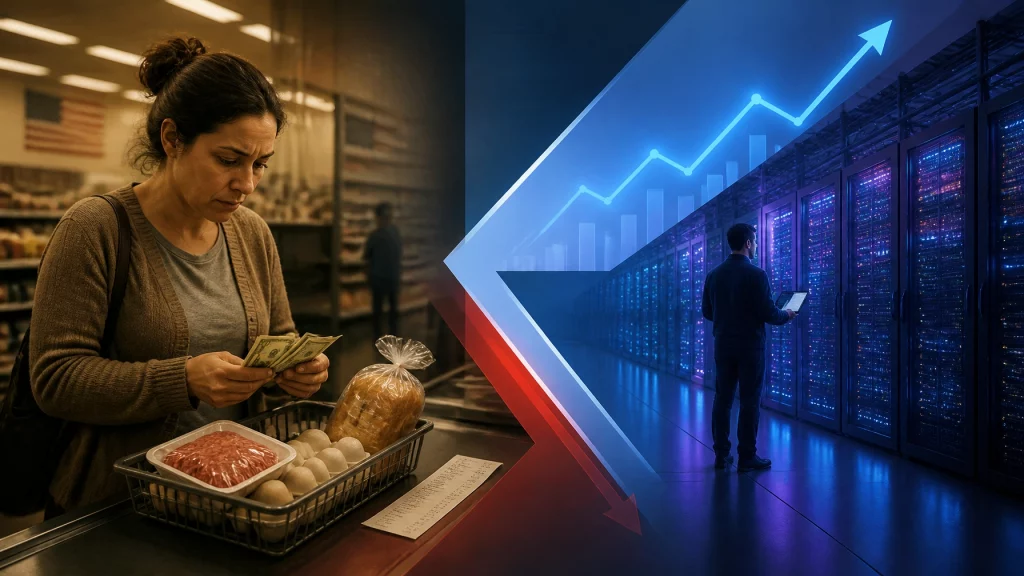
At the same time, the economy’s growth leadership is shifting toward business investment in artificial intelligence, servers and technology infrastructure. The top half of the economy is ordering data centers. The bottom half is budgeting down to the dollar for ground beef.
That is the K-shaped economy in plain English.
The K is not a theory when it is on the receipt
The phrase “K-shaped economy” describes two economic paths moving in opposite directions.
One line points upward. Higher-income households, asset owners and companies with access to capital continue spending, investing and benefiting from rising markets.
The other line points downward or sideways. Lower-income households face high food, housing, insurance and utility costs. They remain employed in many cases, but their paychecks do not stretch as far. They trade down, postpone purchases and make decisions according to the calendar.
The data is not perfectly uniform, and reasonable economists can argue about the exact shape. The Federal Reserve Bank of Minneapolis has reviewed several competing measures and found that the evidence is more complicated than the headline suggests.
But complicated does not mean imaginary.
The New York Fed found that retail spending growth since 2023 has been driven disproportionately by households earning more than $125,000. Its research also showed that real spending among lower-income households declined for part of the period before recovering to its January 2023 level.
That is the distinction often lost in the cheerful economic reports: spending more dollars does not necessarily mean buying more stuff. If the price of groceries rises 10%, a family can spend 10% more while bringing home roughly the same groceries: or fewer.
The register records dollars. The household experiences quantity.
Walmart sees the squeeze before Wall Street does
Walmart is an unusually useful economic instrument because it serves nearly everybody.
A wealthy household may shop there to save money on groceries. A working family may shop there because the store is where the money runs out more slowly. A parent may buy school supplies, tires, medicine and dinner under the same roof because making four separate stops burns gasoline and time.
That broad customer base gives Walmart a view across income levels.
The company’s recent commentary has described a consumer base that is still spending, but not evenly. Higher-income shoppers continue to provide meaningful growth. Lower-income households are more sensitive to price increases and are pulling back on discretionary purchases.
The smaller-trip pattern tells the human story behind the corporate language.
A paycheck-to-paycheck shopper is not necessarily buying less because they suddenly became less interested in life. They are buying less because the timing of the bill matters. A $120 grocery trip may be manageable after payday but impossible three days before it. So the basket becomes $38. Then $44. Then $31.
That pattern creates a strange retail environment. More visits do not automatically mean healthier household finances. They can mean the opposite: the family cannot afford to buy in bulk, even when bulk purchasing would be cheaper per unit.
The person with $200 available today can buy the larger package and reduce the cost per serving. The person with $28 available today buys the smaller package and pays more over time. Poverty is expensive in ways that do not appear in a textbook until someone has to live it.

Target faces a different kind of pressure
Target’s customer and product mix is different. The company is known for groceries, but it also depends heavily on clothing, home goods, beauty products, electronics and seasonal merchandise.
Those categories are vulnerable when consumers become cautious.
A household that needs milk, diapers and laundry detergent still has to buy them. A household that wants new throw pillows, patio furniture or a second television can wait. When budgets get compressed, the “want” category gets pushed out first.
That helps explain why Target’s earnings deserve close attention this week. The company’s official events page lists its second-quarter earnings conference call for Wednesday, August 19. Investors will be watching traffic, average ticket size and digital sales, but regular customers will recognize the underlying story immediately:
Are people still browsing, or are they entering the store with a mission?
The difference between those two behaviors is enormous. Browsing is discretionary. A mission is survival, maintenance or a carefully planned reward.
Target’s digital business and same-day services may help the company adjust to this environment. Convenience matters when consumers are busy and price-conscious. But convenience does not erase affordability. A faster way to buy something is not a substitute for having enough money to buy it.
Target’s challenge is to remain attractive when the middle of the consumer market is being squeezed from both sides: lower-income shoppers are trading down, while higher-income shoppers can choose among more brands and experiences.
Meanwhile, the other economy is buying servers
While households are shrinking their grocery baskets, companies are spending enormous sums on AI infrastructure.
Estimates vary, but recent projections place 2026 spending by major technology companies on data centers, chips and related infrastructure in the neighborhood of $700 billion to $800 billion globally. A Reuters analysis citing Morgan Stanley estimated that Amazon, Microsoft, Alphabet and Meta alone could spend about $630 billion on AI and data centers in 2026.
Goldman Sachs has also examined the assumptions behind a multitrillion-dollar AI buildout.
This investment is real economic activity. It means construction, electrical work, engineering, semiconductor production, networking equipment, power generation and land development. It can raise business investment and create high-paying jobs.
It can also make the economy look much stronger on television than it feels in a kitchen.
A corporation spending billions on servers does not immediately lower the price of rent. It does not reduce a family’s car insurance premium. It does not make a gallon of milk cheaper on Friday afternoon.
The benefits of technology investment may arrive later through higher productivity, better logistics, new products and stronger wages. That is the promise. But promises do not pay this month’s electric bill.
And there is another complication: data centers require enormous amounts of electricity. The country may spend heavily on infrastructure to support artificial intelligence while households pay higher utility costs to support the power demand. The investment can be economically productive and still impose costs on people who never use the technology.
That is how a K-shaped economy can become a neighborhood issue.

What to watch in the earnings reports
The headline numbers will matter, but the details matter more.
At Walmart, watch for:
- Lower-income customer behavior: Are smaller baskets continuing? Are trips becoming more frequent?
- Grocery prices: Is Walmart absorbing costs, passing them along or using promotions to defend market share?
- Higher-income shoppers: Are affluent households still moving more of their spending to Walmart?
- Discretionary categories: Are clothing, electronics and home goods gaining traction or losing momentum?
- Technology investment: How quickly are automation and AI improving inventory, pricing and delivery?
At Target, watch for:
- Store traffic: Are customers visiting less often?
- Average ticket: Are they buying fewer items per trip?
- Digital and same-day sales: Is convenience offsetting weaker physical-store activity?
- Margins: How much discounting is required to move merchandise?
- Consumer confidence: Are shoppers willing to spend on nonessential goods?
The key is not to treat Walmart as the winner and Target as the loser. Their businesses are different, and the economy is not a horse race.
Together, they provide a better picture. Walmart shows where consumers go when value becomes the priority. Target shows what happens to discretionary spending when households begin asking whether a purchase can wait.
The regular-guy conclusion
The economy is not one big machine producing one shared experience.
It is millions of separate household economies operating under different conditions. One family owns a home purchased years ago, has retirement accounts rising with the stock market and can absorb another price increase. Another family rents, carries a credit-card balance, buys groceries in installments and has no room for a surprise $600 repair bill.
Both families are counted in the same consumer-spending report.
That is why corporate earnings can be strong while personal finances feel miserable. The economy may be growing, but the growth is not necessarily reaching the same people at the same speed.
The top half is investing in servers. The bottom half is counting hamburger patties.
This week’s Walmart and Target reports will not solve that divide. They will, however, give us a fresh look at how it operates in real life: in shopping frequency, basket size, delayed purchases and the difference between buying what is useful and buying what is wanted.
The numbers are worth watching. The people behind the numbers are worth watching more.
For more plain-English economic analysis, visit Regular Guy Economics.
Be mindful, be watchful and good luck.