



Saturday, August 15, 2026
Everyone is waiting for the Federal Reserve to cut interest rates.
That expectation has become so baked into the conversation that a rate hike now sounds almost absurd. The economy is slowing. Retail sales fell. Consumer sentiment is weak. July’s jobs report showed a loss of 23,000 jobs. Surely the next move is down, right?
Maybe.
But traders are now putting roughly a 30% chance on a September rate hike. That is not the most likely outcome. It is not even close to a coin flip. But it is far too large to dismiss : especially after three Federal Reserve officials formally voted for a hike at the Fed’s July 29 meeting.
Beth Hammack, Neel Kashkari and Lorie Logan each wanted the central bank to raise its benchmark interest rate by a quarter-point. The final vote was 9–3 to hold rates steady at 3.50% to 3.75%.
That is the part most people are missing. The Fed is not one unified machine patiently waiting to deliver cheaper mortgages and lower credit-card rates. It is a committee arguing over which danger is worse: inflation that refuses to die, or an economy that is beginning to lose momentum.
The Federal Reserve’s official July statement made the tension plain. Economic activity was still expanding, but inflation remained elevated compared with the Fed’s 2% goal. Three voting members believed the answer was more pressure.
The next move may be up.
What does a 30% chance actually mean?
Interest-rate odds sound more complicated than they are.
When traders price a 30% chance of a September hike, they are not claiming to know what the Fed will do. They are effectively saying:
“Given the information available today, a hike is possible enough that we need to protect ourselves against it.”
Think of it like a weather forecast. A 30% chance of rain does not mean it will rain for 30% of the day. It means the conditions are serious enough that leaving the umbrella at home may be a foolish little gamble.
Rate markets work the same way. Traders look at inflation data, employment reports, energy prices, speeches from Fed officials and the prices of futures contracts tied to short-term interest rates. They then estimate the likelihood of a hike, a cut or no change.
The estimate moves constantly because the data move constantly.
A weaker jobs report can push hike odds lower. A hot inflation reading can send them higher. A jump in oil prices can complicate the whole picture because expensive energy raises household costs while also threatening to slow consumer spending.
The market is not offering certainty. It is flashing a yellow light.
Why would the Fed raise rates when jobs are weakening?
Because the Fed has two jobs: pursue maximum employment and maintain price stability.
Those goals usually cooperate. When the economy is overheating and inflation is climbing, higher rates can cool demand. When the economy is weakening and inflation is falling, lower rates can provide support.
The problem is that the two sides can move in opposite directions.
Right now, the labor market is losing energy. Employers added an average of only about 26,000 jobs per month over the past year, compared with roughly 142,000 per month two years earlier. The July unemployment rate fell to 4.1%, but that was not necessarily good news. Some workers have stopped looking for jobs altogether, and people who leave the labor force are no longer counted as unemployed.
That is how a bad situation can produce a superficially pleasant statistic.
At the same time, inflation remains above the Fed’s target. The July statement specifically mentioned supply shocks and energy prices. With Brent crude near $88.50 after a sharp weekly gain tied to conflict and supply fears, the inflation problem is not merely an academic exercise conducted by economists in expensive glasses.
Higher fuel prices affect transportation, heating, manufacturing, groceries and just about anything moved by truck, train, ship or airplane. Consumers feel the effect before it shows up neatly in a government table.
The Fed is looking at a slowing economy and saying, “We may need to ease.”
The inflation hawks are looking at stubborn prices and saying, “Not yet.”
That is the argument.

Three dissenters are not background noise
Central bankers are famous for speaking in carefully sanded sentences. They use phrases such as “data dependent,” “gradual adjustment” and “evolving conditions.” It is the monetary-policy equivalent of saying absolutely nothing while appearing very busy.
A formal dissent is different.
At the July meeting, Hammack, Kashkari and Logan did not merely give a speech suggesting that rates might need to be higher someday. They voted for an immediate quarter-point increase.
That tells markets several things.
First, inflation remains a serious concern inside the committee. The dissenters appear unconvinced that price growth will naturally return to 2% without more restraint.
Second, the Fed’s internal debate is becoming more visible. A 9–3 vote is not a unanimous committee quietly waiting for the perfect excuse to cut. It is a committee with a meaningful minority demanding action in the other direction.
Third, a September hike is not a fantasy invented by nervous traders. There are actual policymakers who wanted it to happen in July.
The official FOMC calendar lists the next scheduled policy meeting for September 15–16. Between now and then, officials will receive more inflation, employment and consumer-spending data. The decision is not made yet.
That uncertainty is the point.
The minutes may reveal how close the argument was
The minutes from the July meeting are scheduled for release on Wednesday, August 19, at 2 p.m. Eastern Time.
The statement tells us how members voted. The minutes may tell us how they got there.
Investors will be looking for clues about the size of the hawkish camp, the strength of concerns about energy prices and whether officials see the labor market as merely cooling or actively deteriorating. They will also look for evidence that a September hike was seriously discussed by more than the three dissenters.
A committee can vote 9–3 while still having a much closer debate behind closed doors. Some members may support a hold today but favor a hike later. Others may be willing to tolerate somewhat higher inflation to avoid damaging employment.
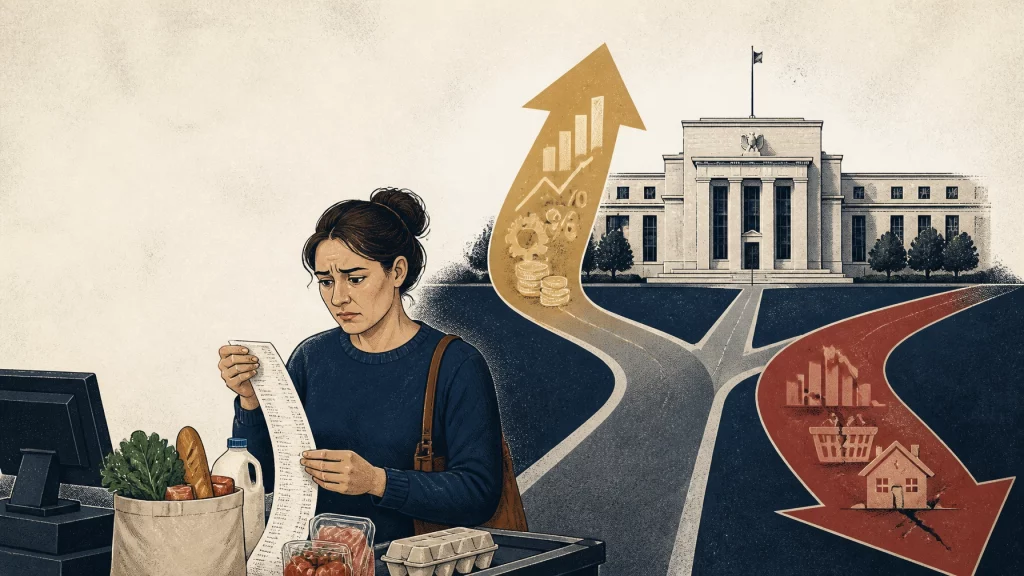
The minutes will not provide a crystal ball. They may, however, show whether the Fed is standing in front of a fork in the road or already leaning toward one path.
Then comes the Jackson Hole Economic Policy Symposium, scheduled for August 20–22 in Wyoming. Central bankers love Jackson Hole because it allows them to discuss big ideas in a scenic location while markets analyze every adjective as if it were a coded confession.
The event may offer another opportunity for officials to signal how they view the balance between inflation and employment. It may also produce nothing dramatic. Central banks are perfectly capable of gathering in the mountains and saying, “We will continue to monitor the data.”
Still, the timing matters. The minutes arrive Wednesday. Jackson Hole begins Thursday. The September meeting is less than a month away.
The market will be listening very carefully.

What a hike would mean for regular households
A quarter-point hike would not instantly destroy the economy. It would not cause every mortgage payment to jump the next morning. Many existing fixed-rate loans would be unaffected.
But a hike would matter at the edges, and the edges are where household budgets are already fraying.
- Credit cards: Most credit-card rates are variable. When the Fed raises rates, borrowing costs generally rise, making existing balances more expensive.
- Homebuyers: Mortgage rates do not move one-for-one with the Fed’s policy rate, but a hike could push bond yields and market expectations higher. That would make affordability worse.
- Auto loans: New-car financing could become more expensive, particularly for buyers already stretching to afford a monthly payment.
- Small businesses: Companies refinancing debt or relying on credit lines would face another increase in the cost of keeping the lights on.
- Savers: Higher rates can benefit people holding cash in high-yield savings accounts, money-market funds or short-term Treasury securities. This is one of the few places where the rate-hike medicine tastes slightly less terrible.
The larger effect would come through expectations. If households and businesses believe rates will remain high or move higher, they delay purchases, hiring and investment. That is how the Fed cools demand: not with a giant switch, but through millions of decisions made a little more cautiously.
Do not build your budget around a rate cut
The sensible response is not panic. It is preparation.
Do not refinance a loan today based on the assumption that rates will fall in September. Do not take on a large variable-rate balance because “the Fed is definitely cutting soon.” Do not make a home purchase work only under the most optimistic interest-rate scenario.
Run the numbers at today’s rates. Then run them again if borrowing costs rise by another quarter-point.
If the budget breaks under that second calculation, the budget was already too tight.
For savers, keep an eye on where cash is held and what it earns. For borrowers, pay down variable-rate debt where possible. For homebuyers, remember that a lower mortgage rate does not make an overpriced house affordable, and a higher rate does not make a reasonably priced one impossible.
The important thing is to stop treating the rate cut as the only possible future.

The uncomfortable conclusion
The market wants a clean story: weak jobs lead to rate cuts, rate cuts support stocks, and cheaper money rescues the consumer.
Unfortunately, the economy is under no obligation to provide a clean story.
Weak employment and stubborn inflation can exist at the same time. Energy prices can rise while consumer spending falls. The Fed can worry about recession and still decide inflation is the more dangerous problem. Three officials can vote for a hike while everyone else holds : and that minority can become larger if prices keep moving higher.
The next few weeks will tell us whether the 30% hike probability fades or grows.
Either way, the risk deserves attention now. The regular guy does not need to predict the Fed perfectly. The regular guy needs a financial life that does not collapse because policymakers made one decision in the opposite direction from Wall Street’s favorite bet.
Nobody is ready for the rate-hike conversation because everyone has been promised the rate-cut conversation.
That is exactly why it is time to have it.
Be mindful, be watchful and good luck.