



For the past few years, Wall Street has been peddling a fairy tale. The pitch was simple, intoxicating, and whispered in every boardroom from Silicon Valley to Manhattan: artificial intelligence is the ultimate software-margin business. It was supposed to print cash like SaaS on steroids: low marginal costs, infinitely scalable code, and a golden ticket to software heaven where physical reality doesn't apply.
Except reality caught up. And it brought a sledgehammer.
Welcome to Part 1 of our deep dive into the fantasy of the AI marketplace. We aren't here to debate the philosophical marvels of large language models or whether silicon chips can write poetry. We are here to look at the cold, unromantic math. Because when you pull back the curtain on the balance sheets, the depreciation schedules, and the creative financing vehicles, you realize something terrifying: the most expensive industrial buildout in human history is being financed like a speculative real estate boom in 2005.
Section 1: What Was Promised vs. The Trillion-Dollar Capex Machine
Remember the 2023–24 pitch? AI companies were software darlings that just happened to rent a few servers. The profit margins would be astronomical.
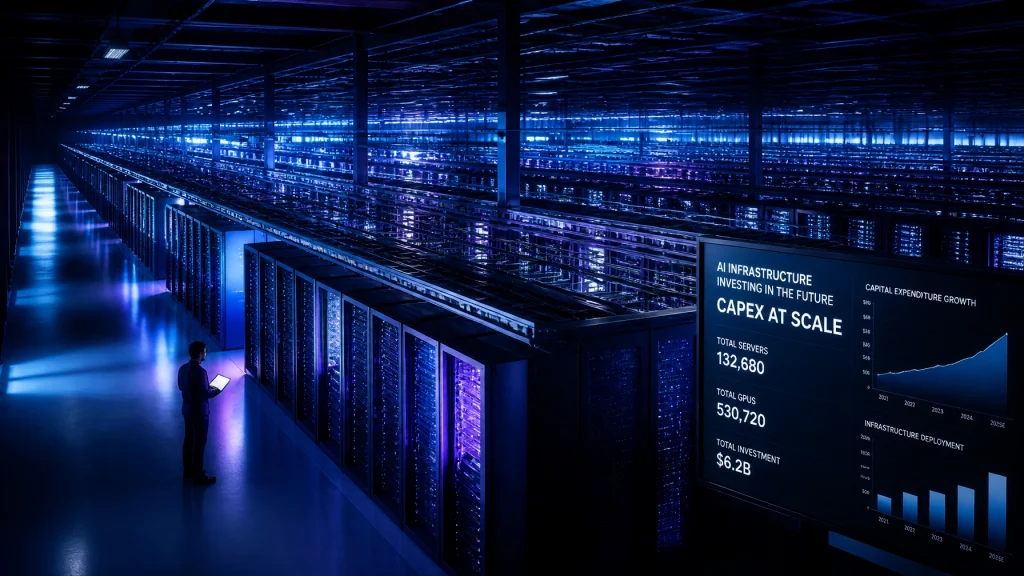
Compare that dream to the actual guidance coming out of corporate boardrooms today. According to Morgan Stanley’s latest revisions, the four big hyperscalers: Microsoft, Amazon, Alphabet, Meta, and let's loop Oracle into the heavy-spending club: have guided to roughly $805 billion in combined 2026 capital expenditures. That is a staggering jump from roughly $410 billion in 2025. They are literally spending every dollar they earn on AI infrastructure, and then borrowing billions more to keep the servers humming.

The concentration risk is historic. The Magnificent Seven account for close to 34% to 35% of the entire S&P 500. That means over a third of the entire United States equity market: including your retirement account, your pension, and your index fund: is hitched directly to an infrastructure buildout that assumes limitless demand for an end product that is still struggling to turn a reliable profit.
Section 2: What’s Actually Coming In
Let’s be fair to the bulls: the revenue numbers are not zero. Microsoft’s AI run rate sits around $37 billion, and cloud growth remains exceptionally robust. The enterprise adoption story has real pockets of muscle.
Against that revenue, however, sits an incinerator of cash. OpenAI reportedly burned $3.7 billion in Q1 2026 alone on $5.7 billion of revenue, with projected 2026 losses hovering around $14 billion on roughly $25 billion of revenue.
And then there are the shifting goalposts. OpenAI's 2030 revenue targets have been quietly hacked down in trackers from a lofty $85 billion to roughly $39 billion, even as management floats wilder numbers to eager late-stage investors. When the business plan requires moving the finish line every six months, you aren't looking at a mature industry; you're looking at a perpetual motion machine fueled by fresh capital injections.
Section 3: The Accounting Question
To understand how tech giants keep their reported profits looking pristine while spending like drunken sailors, you have to understand depreciation.
It’s the magic trick of corporate accounting: cash leaves the building today, but the expense is spread out over several years on the income statement. It’s how you turn an immediate cash hemorrhage into a polite, manageable multi-year drip.

Famed investor Michael Burry has estimated roughly $176 billion of understated depreciation between 2026 and 2028 across the sector, with corporate profits at companies like Oracle and Meta potentially overstated by 27% and 21% by 2028 simply because they tweaked their depreciation assumptions.
Consider the killer illustration of this game: Amazon recently shortened some server useful lives from six years to five and took a $920 million charge. Meanwhile, Meta extended server lives to 5.5 years and booked a $2.9 billion reduction in depreciation expense. Same hardware, same physical copper and silicon, opposite accounting conclusions.
To be clear, there is no evidence of deliberate fraud here. The deeper, more systemic issue is that these tech behemoths have transformed overnight from asset-light software giants into brutally capital-intensive industrial utilities. They are building power plants and cooling towers, but keeping the accounting rules of a Silicon Valley app startup.
Section 4: Off Balance Sheet : The Part Nobody Reads
If you want to find where the real leverage hides, stop reading the income statement and start inspecting the off-balance-sheet footnotes.
Anchor your gaze on Meta’s Hyperion project. Meta formed a massive $27 billion joint venture with Blue Owl Capital to own its Louisiana data center megacampus, with Blue Owl funds taking an 80% stake and Meta holding 20%. The brilliant engineering here isn't in the neural networks; it's in the legal structure. By utilizing four-year non-cancellable lease terms and residual value guarantees, Meta maintains complete operational control while keeping billions in heavy debt completely off its balance sheet.
Across the tech landscape, Meta, Oracle, xAI, and CoreWeave have used Special Purpose Vehicles (SPVs) to move more than $120 billion of data center financing straight to Wall Street investors. Heavyweights like Pimco, BlackRock, Apollo, Blue Owl, and JPMorgan have eagerly supplied the capital. Blue Owl and JPMorgan pumped roughly $13 billion into an SPV holding Oracle's Texas data centers, while Meta prepares a $12 billion SPV backed by BlackRock for an El Paso site.

Who actually holds the underlying risk? Insurers, pension funds, and private credit portfolios. It is a textbook asset-liability mismatch: long-dated capital obligations funding short-lived, rapidly obsolescing hardware assets. If a downturn hits, these long-dated holders could face forced liquidations. That risk isn't locked away in a speculative hedge fund: it's sitting quietly inside your annuity.
History has a cruel sense of humor. In the late 1990s telecom boom, companies laid 80 million miles of fiber optic cable, convinced the internet would consume it all overnight. Four years after the bubble popped, 85% to 95% of it sat completely unused as “dark fiber.” Today, the industry is pouring hundreds of billions into clusters of GPUs that face a similar obsolescence clock.
In Part 2 of this series, we will examine how this machine shifted from cash to credit, the staggering surge in corporate bond issuance, the circular financing loops connecting chipmakers to their own customers, and what all of this means for your 401(k) when the music finally stops.
Be mindful, be watchful and good luck.