



If you look at the headline economic data today, the ivory tower residents will tell you everything is coming up roses. Inflation is "cooling," the stock market is hitting record highs, and unemployment is low enough that your neighbor’s dog could probably get a job in data entry. But then you walk into a grocery store and realize that a carton of eggs and a loaf of bread now require a financing plan, and the "cooling" inflation feels more like a fever that just stopped rising quite so fast.
Welcome to the great disconnect. It’s the gap between what the spreadsheets say and what your checking account feels.
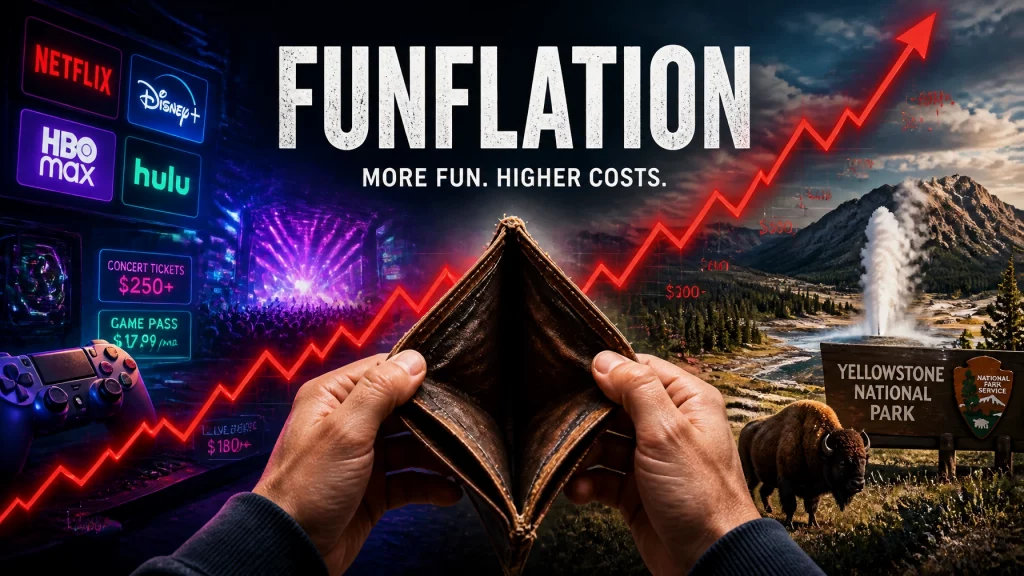
But here is the real kicker: even though 61% of the public is pessimistic about the future, we aren’t exactly living like monks. We are still buying the $100 concert tickets, we are still paying for five different streaming services, and we are still booking flights to Europe. We’ve entered the era of "Funflation": a bizarre economic phenomenon where we are collectively broke, yet we refuse to stop spending on the things that make life tolerable.
The Digital Squeeze: Welcome to Streamflation
For years, the "regular guy" strategy for saving money was simple: cancel the $150 cable bill, stay home, and get a $10 Netflix subscription. It was the ultimate low-cost entertainment hedge.
Those days are officially dead.
In 2026, staying in has become its own luxury line item. According to recent data, the price of subscribing to video and gaming services has rocketed up 53% since 2019. This isn't just a slight adjustment; it’s a systematic re-pricing of our downtime. Netflix now commands $20 a month for the privilege of ad-free viewing. Disney+, Amazon Prime, and Spotify have all followed suit with consecutive price hikes that make your old cable bill look like a bargain.

It’s not just the streamers. The gaming world: once the bastion of "pay once, play forever": has pivoted to the "pay forever, or don't play" model. Xbox Game Pass doubled its price, and Nintendo is prepping for an 11% hike on its hardware by the end of the year.
The madness is that even as these prices climb, we aren't clicking "cancel." These subscriptions have become "sticky." We view them as essentials, right up there with water and electricity. In an world where a night out at the movies for a family of four costs as much as a used sedan, $20 for a month of endless content feels like a "deal," even if it’s 50% more expensive than it was three years ago.
The Great Pivot: From Corporate Drudgery to Yellowstone Seamstress
When the traditional path: work a 9-to-5, save for a house, retire at 65: starts to look like a fairy tale from a bygone era, people start making radical moves.
Take the story of 26-year-old Zoe De La Paz. Earlier this year, she did what millions of burned-out corporate workers dream of: she quit her drafting job in Chicago to move to Yellowstone National Park. Her new gig? Working as a seamstress in the uniform department for $19.25 an hour.

On paper, this looks like a demotion. From a professional corporate role to sewing patches on ranger uniforms for less than twenty bucks an hour? In the old economy, that’s a step backward. But in the Funflation economy, it’s a strategic retreat. By taking a job with subsidized housing and meals inside a national park, Zoe effectively opted out of the "lifestyle inflation" trap. She traded a cubicle and a high cost of living for a sewing machine and a view of the Tetons.
This is the ultimate "I’m done" move. It’s the realization that if the math of the American Dream doesn't add up anymore, you might as well have a job that lets you spend your lunch break watching bison instead of staring at a vending machine. It’s about trading "career growth" for "quality of life" because the former doesn't seem to buy the latter anymore.
The Grocery vs. Grand Canyon Trade-off
One of the most startling statistics we’ve seen recently is that 46% of Gen Z and Millennials are actively cutting back on their grocery budgets just to fund vacations and travel.
Think about that for a second. People are choosing to eat generic cereal and skip the ribeye so they can afford a flight to Rome or a ticket to Coachella. We talked about this in our Angry but Abroad post: this isn't "resilience," it’s a coping mechanism.

Why are we doing this? Because the "big" things have become impossible. When the average home price is a multiple of your annual salary that requires a calculator with extra digits, the idea of "saving for a down payment" feels like trying to empty the ocean with a teaspoon.
If you can’t afford a house, and you can’t afford to start a family, and the world feels like it’s one geopolitical hiccup away from a disaster, you decide to buy the memories instead. You spend the $3,000 you did manage to save on a two-week trip to Japan because that $3,000 wasn't going to get you a front porch anyway. It’s the "I deserve it" economy, born out of the collective trauma of the pandemic and fueled by the realization that life is short and the future is expensive.
Funflation as the Canary in the Coal Mine
As an economics outfit, we look at this and see a massive red flag.
When consumers are willing to pay "all-time high" prices for concerts and events despite being "broke," it tells us that we have moved past rational economic behavior and into a state of "doom-spending." We are treating fun like a drug: a necessary hit of dopamine to mask the underlying stress of a stagnant reality.
Companies know this. That’s why your favorite streaming service can hike prices every six months. They know you won't leave because the alternative: sitting in silence and contemplating your 401(k) or the price of gas: is too depressing.
But this can’t last forever. Funflation is a canary in the coal mine for consumer health. When the percentage of your budget dedicated to "staying sane" (fun) starts eating into the percentage dedicated to "staying alive" (groceries/rent), the foundation of the economy is beginning to fray.
We are seeing a shift from a "stuff" economy to an "experience" economy, but we are doing it on a shoestring budget. We are "Angry but Abroad," broke but gaming, and quitting our jobs to sew patches in the woods.
It’s a beautiful, chaotic, and slightly terrifying protest against an economy that has stopped making sense for the regular guy.
Be mindful, be watchful and good luck.