



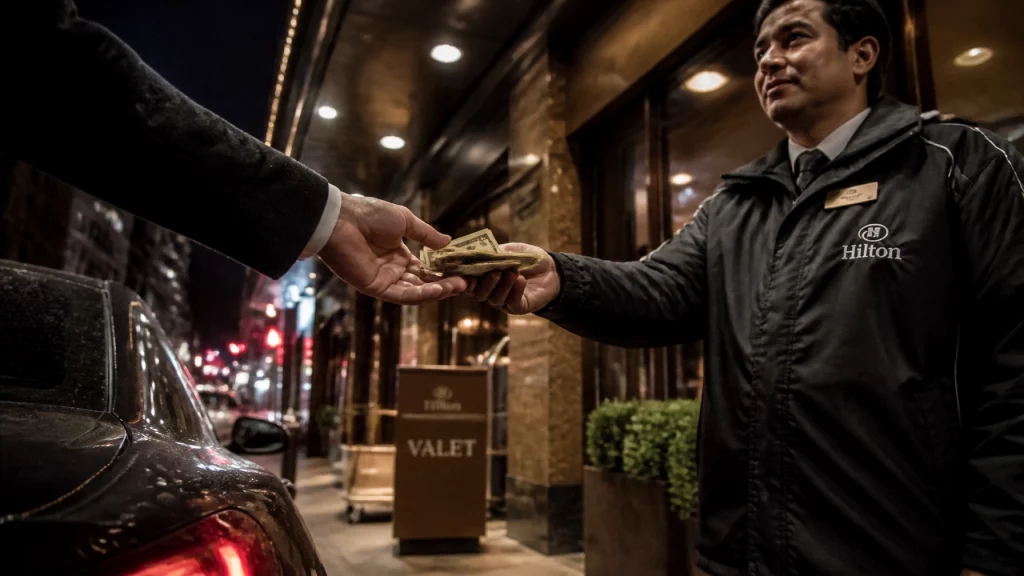
It was 4:00 AM. The kind of hour where the world is quiet, your eyes feel like they’ve been rubbed with sandpaper, and all you want is to get your car and get home. I handed my ticket to the valet, waited the two minutes it took for him to drive my car twenty yards, and reached for my wallet.
I didn’t have a five-dollar bill. I had a twenty.
"Here’s a twenty," I said, handing it over. "Keep five and give me fifteen back."
It seemed like a simple enough transaction. In any other era of human history, that’s a clear instruction. Instead, the valet slowly counted off five singles, handed them to me, and stood there like he was waiting for a round of applause.
"I said I wanted fifteen back," I reminded him. "I'm not tipping fifteen dollars for you to drive my car from one side of the driveway to the other."
He didn't blink. "I only have eight dollars," he said, holding out three more singles and effectively trying to strong-arm me into a twelve-dollar tip.
This wasn’t a service interaction; it was a shakedown. It was an attempt to use the silence of a 4 AM lobby and the social contract of "generosity" to guilt me into paying a 300% markup on a standard gratuity. And while that valet was one individual, his behavior is the symptom of a much larger, much more expensive rot in our economy.
The Linguistic Lie: "To Insure Prompt Service"
Before we get into the math of why you’re feeling "tip fatigue," let’s clear up the biggest myth in the industry. You’ve probably heard that the word "tip" is an acronym for "To Insure Prompt Service."
It’s not. That’s what we call a "backronym": a fake history made up after the fact to make a word sound more official.
The word actually dates back to 17th-century "thieves' cant," the secret slang used by the criminal underworld of London. In that world, to "tip" meant to give, hand, or pass something to another person. It was a word for a transaction that happened under the table, outside the view of the law.
Eventually, it migrated into the coffee houses of England, where aristocrats would toss a few extra coins to servants to show off their wealth. It was never about "prompt service"; it was about status. It was a way for the rich to say, "I have so much money that I can afford to pay you twice: once for the service, and once just because I can."

The Un-American Import
When tipping first crossed the Atlantic after the Civil War, Americans actually hated it. It was viewed as "un-American" and "undemocratic." Critics at the time argued that it created a servile class and allowed employers to dodge their responsibility to pay a fair wage. In the early 1900s, several states: including Washington, Mississippi, and Tennessee: actually passed laws banning tipping entirely.
So, how did we get here? How did we go from banning the practice to being shamed by a valet at 4 AM?
The answer, as always, is the bottom line. After the abolition of slavery, many businesses: particularly railroads and restaurants: hired formerly enslaved people and refused to pay them a wage, telling them they had to rely entirely on the "generosity" of white patrons. The government eventually codified this by creating the "tipped minimum wage," which allowed employers to pay a fraction of the standard minimum wage as long as tips made up the difference.
We essentially turned a tool of aristocratic vanity into a structural subsidy for business owners.
The 66% Breaking Point
Fast forward to 2026, and the system is officially in overdrive. According to recent data, 66% of Americans now report "tip fatigue." We aren't just tired of tipping; we are resentful of it.
The average restaurant tip in the United States still hovers around 18.8%, but the digital screens you encounter at every coffee shop, bakery, and even self-service kiosk are trying to move the goalposts. These screens now default to 20%, 25%, and even 30%. They are designed using "choice architecture": a fancy psychological term for making the "No Tip" button as small and shameful as possible.

When you’re staring at a tablet while a barista watches you, that "25%" button isn't an invitation to be generous; it's a tax on your social anxiety. This pressure is having a real impact on where we spend our money. Roughly 40% of consumers now report that they actively avoid businesses that they know will hit them with frequent or aggressive tip requests.
We are reaching a point where the "guilt trip" is actually bad for business.
The Generational Irony
There is a fascinating irony in the current tipping landscape. The younger generations: Gen Z and Millennials: are the ones most vocally leading the anti-tipping movement. They are the ones calling for "all-in pricing" and the abolition of the tipped minimum wage. They argue, rightly, that workers deserve a stable, livable salary that doesn't depend on whether a customer is having a bad day.
Yet, at the same time, this is the same generation that is manning the front lines of the "tip screen" era. The valet I dealt with at 4 AM was likely a Gen Z or Millennial worker. He represents the friction of this transition. He has been trained by the system to expect a $15 tip for a two-minute task, not because he provided "exceptional service," but because the system has socialized him to believe that the customer is responsible for his take-home pay, not his employer.
When he told me he "only had eight dollars," he wasn't just being bad at math. He was gambling that I would be too tired or too embarrassed to argue over four dollars. He was weaponizing the awkwardness.
The Economic Shift: From Reward to Surcharge
The core problem is that tipping has transitioned from a reward for service to a mandatory surcharge for existing.
If you don’t tip the valet, you’re the "bad guy." If you don’t hit 20% on a muffin that you picked up off the counter yourself, you’re "cheap." But let’s look at the "Regular Guy" economics of this.
When a business asks you to tip for a service that used to be included in the price, they are effectively raising prices without having the guts to change the menu. It’s a hidden inflation. By shifting the labor cost to the customer, the business owner protects their margins while the customer and the employee are left to haggle over singles in a parking lot at 4 AM.

If that valet makes $15 an hour and gets ten people like me to "keep the change" on a twenty, he’s making $150 an hour in tips. That’s more than most engineers, nurses, or teachers make. Is that "fair"? Probably not. Is it sustainable? Absolutely not.
What’s the Move?
So, what do we do? We can’t just stop tipping entirely: not while the legal structure still allows for a sub-minimum wage for servers and bartenders. Those people are working hard, and they rely on that income.
But we can stop participating in the "guilt" economy for non-traditional services.
- Carry Cash: The easiest way to avoid the "guilt screen" is to pay with cash or have exact change for tips. If I’d had a five-dollar bill in my pocket, that valet interaction would have lasted ten seconds.
- Reject the Defaults: Don’t be afraid to hit "Custom Tip" or "No Tip" at a counter-service establishment where no actual service was provided. Pouring coffee into a cup is the job; it’s not a performance.
- Support All-In Pricing: Patronize businesses that pay their staff a full wage and explicitly state "No Tipping Required." This is the only way the market will actually shift.

The $15 valet didn’t get his $15. He eventually found the rest of my change when he realized I wasn’t going to budge. He wasn't happy about it, and frankly, I wasn't happy either. It was a sour end to a long night.
For the record, I did end up tipping him — $5, through Cash App. I wasn't trying to stiff the guy. I was trying to tip him exactly what I said I would, and he tried to turn it into a negotiation.
But until we stop letting social pressure dictate our personal finances, we’re going to keep seeing those tip screens: and those "I only have eight dollars" excuses: everywhere we go.
Be mindful, be watchful and good luck.