



Every time the global economy starts to look like a dumpster fire: which, let’s be honest, is most Tuesdays these days: a certain class of academics and "thought leaders" emerges from their ivory towers to tell us that we need to "fix capitalism." Their solution is always some variation of a theme: make more capitalists.
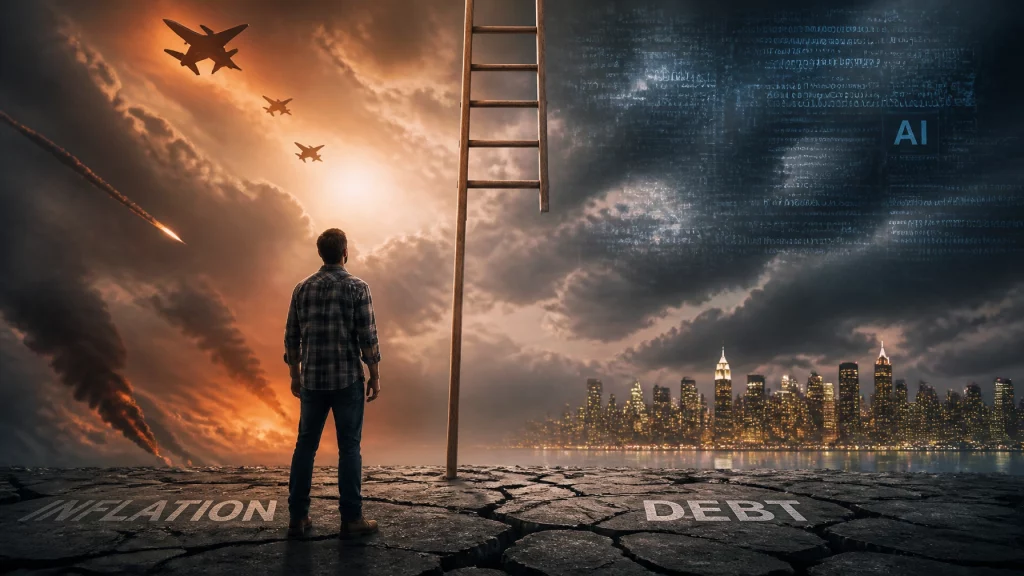
Credit where it's due — the title and the framing belong to Bill Mundell, who gave a TEDx talk on this very idea. Bill's vision is that ownership should be broad, not narrow. But the problem is that the system is sawing off the bottom rungs of the ladder before anyone can climb it.
The idea is seductive. If everyone owned a piece of the pie: shares, property, intellectual property: they’d have "skin in the game." We’d have a more stable, motivated, and prosperous society. It’s a lovely sentiment. It’s also completely delusional given the current state of the world in 2026.
The problem isn't that people don't want to be capitalists. It’s that the system is actively sawing off the bottom rungs of the ladder. We are watching a convergence of crises: war, debt, technological displacement, and a strange war on the food supply: that are making it impossible for a "regular guy" to even get to the starting line, let alone own the track.
1. The Cost of Conflict: A $2.2 Trillion Hole
Capitalism requires stability, or at the very least, predictable chaos. Right now, we have neither. The escalating conflict in the Middle East: essentially a US-Iran proxy war that has gone hot: is doing more than just moving pins on a map. It has physically disrupted the movement of 20 million barrels of oil per day.

With the Strait of Hormuz effectively a no-go zone, oil prices are sitting stubbornly between $90 and $100 a barrel. The IMF is sounding the alarm on a $2.2 trillion loss to global GDP. That isn't just a number on a spreadsheet; it’s a tax on every person trying to start a business or save for a home. When energy costs spike, everything else follows. Fertilizer costs hit the roof, logistics become a nightmare, and that "extra" capital you were going to invest? It just went into your gas tank. You can’t be a capitalist if you’re spending your seed money just to keep the lights on.
2. The $353 Trillion Credit Card
If a regular guy ran his household like a modern government, he’d be in a state-mandated halfway house by now. Global debt has hit a record $353 trillion. Government debt alone accounts for $111 trillion of that. In the US, we are sitting at 126% debt-to-GDP, headed for 142% by 2031.

We’ve talked before about the insanity of data center bonds and the way we leverage the future to pay for the present, but this is a different beast. Interest payments are now "crowding out" everything else. The money that should be going into infrastructure, basic research, or education is being funneled into servicing the "credit card with no limit." This debt is a claim on the future labor of every aspiring capitalist. We aren't creating owners; we are creating a generation of debt-servants.
3. The AI Barrier: Seniorization of the Entry Level
The traditional path to becoming a capitalist used to be simple: get a degree, get an entry-level job, learn the ropes, and eventually move up or start your own thing. That path is now blocked by a silicon wall.
As we noted in our recent breakdown of the AI Job Barrier, 48% of hiring managers would now rather "train" an AI than hire a fresh human graduate. We are seeing a "seniorization" of the workforce. Companies are restructuring so that one senior employee paired with a sophisticated AI replaces three junior roles.

If you can't get that first job: the one we’ve called the $50,000 Bridge Role: you never get the skills or the capital to move to the next stage. With 70% of Americans fearing AI will take their livelihood, the "ladder" isn't just missing rungs; it's being replaced by an elevator that only goes to the penthouse and doesn't stop for new passengers.
4. The War on the Original Capitalist: Farmland vs. Labs
Perhaps the most bizarre element of the current malaise is the government-led push to replace traditional agriculture with "artificial foods." States like Florida, South Dakota, and Wyoming are fighting back with bans on lab-grown meat, but the federal pressure is relentless.

The farmer is the original capitalist: someone who owns land, takes risks, and produces a tangible product. By pushing policies that take farmland out of play in favor of centralized, subsidized lab-factories, the government is effectively liquidating a whole class of independent owners. They tell the farmers to "adapt" while handing billion-dollar subsidies to the tech firms that want to replace them. It’s hard to make "more capitalists" when you’re systematically destroying one of the few remaining sectors where a regular guy could actually own the means of production.
5. The General Malaise and the Broken Social Contract
Finally, there is the "vibe" check: and the vibe is terrible. 95% of Americans say the country is facing an affordability crisis. We are told there are 23.6 million millionaires in the world, yet the average guy feels poorer than he did five years ago.

Unchecked immigration, rising crime in urban centers, and a general sense that the "rules" only apply to people who can't afford a lobbyist have created a profound malaise. The social contract: work hard, play by the rules, and you’ll get ahead: is being shredded. When people feel like the game is rigged, they don't try to become players; they try to survive, or they try to flip the table.
The Bottom Line
Fixing capitalism with more capitalists is a great slogan, but it’s a hollow one if the barrier to entry is a $50,000 degree (which, as The Bell Curve suggested, might just be an expensive IQ filter), a $100/barrel energy tax, and a job market where the entry-level has been deleted by an algorithm.
If we actually want more capitalists, we need to stop subsidizing the monopolies, stop the runaway debt that devalues our labor, and stop the war on the physical world (farms, energy, and labor) in favor of the digital and artificial. Until the ladder has its bottom rungs back, all the "thought leadership" in the world won't save the system.
Be mindful, be watchful and good luck.