



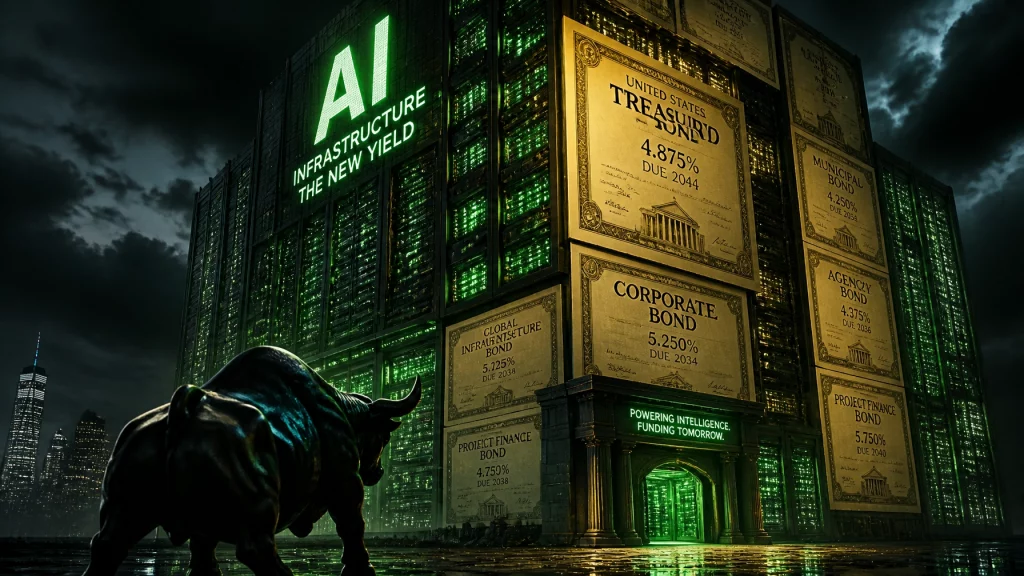
If you have a sense of déjà vu, don't worry: it’s not a glitch in the matrix. It’s just Wall Street doing what it does best: taking a shiny new object, bundling it into a complex financial instrument, and selling it to your pension fund as "safe" income.
In 2008, the shiny object was a suburban house with a white picket fence. In 2026, it’s a nondescript concrete warehouse in Louisiana filled with humming NVIDIA chips. The names have changed, but the math of madness remains the same. We are witnessing the birth of the Data Center Bond, and if you look closely at the plumbing, it looks suspiciously like the mortgage-backed securities (MBS) that nearly melted the global economy twenty years ago.
The Scale of the New Machine
The numbers are, quite frankly, staggering. AI-related debt is projected to hit $570 billion globally by the end of 2026. To put that in perspective, by May of this year alone, over $236 billion had already been raised. We aren't just dipping our toes into the AI water; we’ve built a $1.2 trillion debt machine that now represents the largest segment of U.S. investment-grade credit.
Take the "Hyperion" project in Louisiana as an example. This isn't just a data center; it’s a $27.3 billion financial fortress. Meta (the artist formerly known as Facebook) is the tenant, but the money is coming from a massive private placement bond deal managed by PIMCO and Blue Owl. When PIMCO: the world’s bond king: drops $27 billion into a single campus, it’s not a "bet" anymore. It’s a systemic shift.
Blackstone’s QTS is also in the game, planning another $4.6 billion in bonds. Data center Asset-Backed Securities (ABS) issuance is expected to climb to $30 billion this year. Wall Street has found its new golden goose, and it’s made of silicon and cooling fans.

The MBS Parallel: Bundling the Madness
The structural similarities between 2008 and today are enough to make any "regular guy" reach for a stiff drink.
Just like the old mortgage-backed securities, these data center bonds bundle together leases and loans into tradable slices. They’re being stamped with AAA and A3 ratings by Moody’s and S&P: the same "gold standard" approval that the toxic subprime bundles had back in the day. Because they are often sold as "144A" private placements, they bypass the transparency of SEC registration. It is, quite literally, the return of the shadow banking system.
The "tenants" in these data centers are tech giants like Amazon, Microsoft, and Meta. On paper, they are the world's most reliable borrowers. But remember, in 2006, the "American Homeowner" was considered the world's most reliable borrower, too. The risk isn't that Meta can't pay its rent; the risk is the structure of the debt itself and the underlying collateral.
The Circular Financing Loop (The Nvidia Conflict)
This is where the story gets really weird. In the old days, a bank gave a guy a loan to buy a house, and the bank hoped he’d pay it back. In the AI era, we have "circular financing."
Look at the relationship between Nvidia and companies like CoreWeave. Nvidia invests equity into these "neocloud" companies. Those companies then take that equity: plus a mountain of debt: to buy Nvidia’s own GPUs. CoreWeave recently closed an $8.5 billion debt facility (DDTL 4.0) that is backed entirely by Nvidia GPUs.

Moody’s gave that debt an A3 investment-grade rating. Why? Because it’s backed by the value of the chips and a long-term contract with a big tech firm. But wait: Nvidia has a direct financial interest in keeping this debt machine running. They need these cloud companies to keep buying their chips to keep their stock price in the stratosphere. It’s a self-reinforcing loop where the chip maker is the investor, the supplier, and effectively the insurer of the debt.
When the entity making the product is also the one financing the buyer, you don't have a market; you have a carnival game where the house always wins: until the power goes out.
The Asset Lifecycle Problem: Chips vs. Bricks
Here is the most dangerous part of the math. A house has a useful life of 30 to 50 years. It generally appreciates. An airplane has a 25-year lifecycle. Even a Ford F-150 has a predictable 15-year depreciation curve.
A high-end GPU? Its useful life is about 3 to 5 years before it becomes a very expensive paperweight.
Yet, Wall Street is structuring these data center bonds as 10, 20, or even 30-year instruments. We are backing 30-year debt with hardware that will be obsolete by the time your toddler finishes kindergarten. The bond depends on a "continuous refresh cycle." If AI demand slows down even slightly, or if the next generation of chips makes the current ones worthless, the collateral evaporates.
In the medical industry, we talk about the "math of madness" when costs spiral out of control. Here, the madness is the lifecycle mismatch. You cannot build a 30-year financial skyscraper on a foundation of 3-year technology.

What a Collapse Looks Like for Your 401(k)
You might think, "I don't own data center bonds, so I'm fine." Wrong.
If you have a 401(k), a pension fund, or a life insurance policy, you are likely an owner of this debt. PIMCO, BlackRock, and JPMorgan are the ones buying these bonds, and they manage the "safe" portion of your retirement. State pension funds are diving headfirst into "investment-grade AI debt" because they are desperate for yield in a world of inflation.
The European Central Bank (ECB) has already started waving red flags, estimating that a stress scenario in AI debt could result in 4-6% losses for insurers and pension funds. That might not sound like much until you realize we’re talking about a trillion-dollar asset class.
The "wall of maturity" hits between 2028 and 2030. That’s when all this debt needs to be refinanced or paid back. If the AI "revolution" hasn't started printing massive, realized profits by then: not just "potential" profits: the cash flows backing these bonds will dry up. Unlike the 2008 crisis, there is no Fannie Mae or Freddie Mac to catch the falling knife. There is no government backstop for a data center in Richland Parish.
If these bonds get a "haircut," it’s the retirees who feel the sting. It’s the states that have to raise taxes to cover pension shortfalls. It’s the regular guy who once again pays for the creativity of the guys in the silk ties.
It’s high time we reclassify these "investments" for what they are: high-stakes gambles on the speed of technological obsolescence. We are building a giant financial monument to a technology we barely understand, funded by debt that outlives the hardware it’s built on.
Be mindful, be watchful and good luck.