



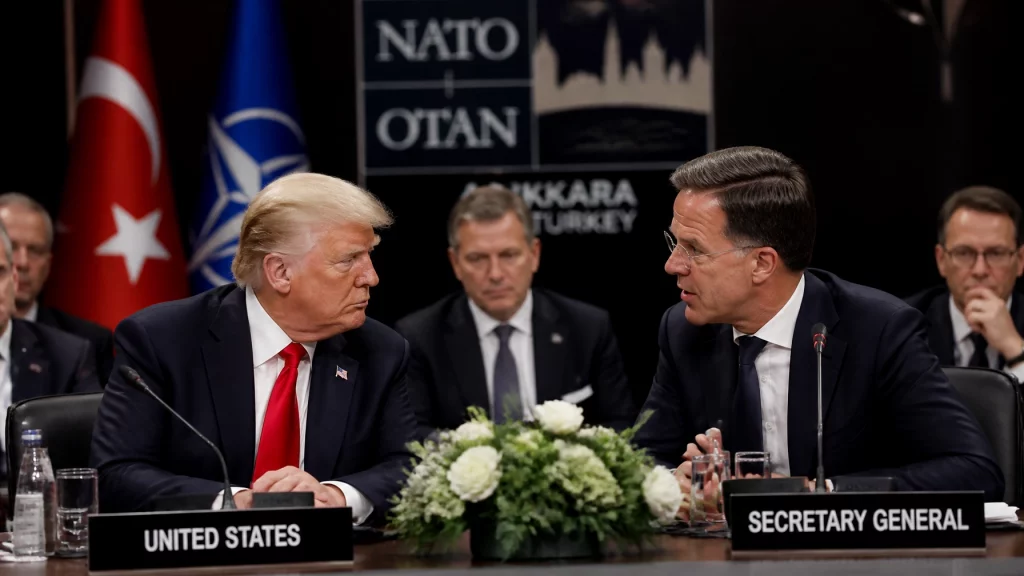
It is July 6, 2026, and the air in Ankara is thicker than a cheap steak. We’re here for the NATO summit, and while the Turkish coffee is strong, the diplomatic tension is stronger. For those of us keeping score back home, the math of global security has officially moved from "confusing" to "downright insulting."
The big headline this morning isn’t the summit itself; it’s the fallout from the Iran ceasefire being declared officially "over." President Trump has authorized strikes on Iranian targets, but here’s the kicker: our "allies" in Europe just blocked US base access and overflight rights for those operations.
Pause for a second and let that sink in. We pay for the house, we pay for the security system, we pay for the guard dog, and when someone tries to break in, the neighbor tells us we aren’t allowed to walk across their lawn to stop them.
If that sounds like a raw deal, that’s because it is. At Regular Guy Economics, we’re all about cutting through the jargon and looking at the receipts. And folks, the NATO receipt is a doozy.
The Math of the "Shared" Burden
Let’s talk turkey, literally, since we’re in Ankara. Currently, the United States carries roughly 62% to 64% of total NATO costs. When you look at the raw numbers, the US is projected to spend close to a trillion dollars on defense this year, while the entirety of Europe is patting itself on the back for hitting a projected $634 billion.
Yes, European spending is up 11% in 2026. Yes, they are finally waking up to the reality that the world is a dangerous place. But for the regular guy in Ohio or Florida, the math still doesn't add up. Why are we paying two-thirds of the bill for a club where the other members won’t even let us use the driveway during an emergency?

Secretary-General Mark Rutte, the new guy at the helm, is doing his best to frame this as a "healthy partnership." He’s a smooth talker, trying to convince us that Europe’s 11% increase is a "quantum leap." But Trump isn't buying the spin, and frankly, neither should you. Trump has already laid down the new gauntlet: 5% of GDP on defense by 2035.
Currently, most of Europe is still struggling to hit the old 2% target. Spain, Belgium, Slovenia, and the Czech Republic are still lagging in the basement. They’re like that friend who always "forgets" their wallet when the check comes, then promises to Venmo you later but only sends five bucks and a "thanks!" emoji.
The Overflight Insult
The real sting in Ankara this week isn't the money, it's the permission. The refusal of European allies to grant overflight rights for Iran operations is a massive strategic middle finger. It forces our pilots to fly longer, more dangerous routes, adding millions in fuel costs and increasing the risk to American lives.
Why the cold shoulder? Because Europe likes the protection of the American military umbrella, but they don't like the responsibility of the American foreign policy that comes with it. They want the benefit of our aircraft carriers parked in the Mediterranean to keep the peace, but they don't want the noise of those same jets flying over their cafes when it’s time to handle business in Tehran.
This is the central friction of the modern alliance. We are treating NATO like a security collective, while many European nations treat it like a premium insurance policy where they haven't paid the premiums in a decade.

Small Steps and Submarines
To be fair, some allies are trying. Canada has finally pledged to modernize its fleet with new submarines, and Germany is cutting checks for more Patriot missile systems. These are "concrete steps," as the diplomats like to say. But in the grand scheme of the $17 trillion GDP of the Eurozone, these are drops in a very expensive bucket.
When Germany buys a Patriot system, it’s great for the defense contractors, but it doesn't change the fact that the American taxpayer is still the primary guarantor of German sovereignty. The "Regular Guy" in the US is essentially subsidizing the social safety nets of Europe. We pay for the tanks so they can pay for the six-week vacations and the free healthcare.
As John Flynn often discusses on our podcast, every dollar has a job. Right now, a huge percentage of your tax dollars are working a "second job" defending countries that won't even give us a shortcut through their airspace.
The 5% Solution
Trump’s demand for 5% of GDP by 2035 is a shock to the system. To put that in perspective, the US currently sits around 3.3%. If Europe actually hit 5%, they would finally be the superpower they pretend to be in UN meetings.
But will they do it? History says no. They’ll offer 2.1% and ask for a medal. They’ll buy a few more drones and call it a "transformation." Meanwhile, the regular guy continues to buy dinner for the whole alliance, watching his own cost of living skyrocket while he protects the borders of people who won't help him protect his own interests.

Why This Matters to You
You might think, "I'm just trying to pay my mortgage, why do I care about overflight rights in Belgium?" You should care because that math directly impacts your wallet. Every billion we spend over-extending ourselves to cover for "allies" who won't pony up is a billion that isn't being used to shore up our own economy, reduce our debt, or lower your tax burden.
Economics isn't just about spreadsheets; it's about leverage. Right now, the US has all the muscle but Europe has all the leverage because they know we won't walk away. Or will we? The vibe in Ankara suggests the "Regular Guy" is getting tired of being the only one at the table who actually reaches for his credit card.
We’ll keep watching the numbers, because someone has to. The world is getting more expensive, and the "protection" business is the most expensive of all. It’s time for the rest of the club to start carrying their own backpack.
Be mindful, be watchful and good luck.