



In 1960, medical costs in the United States were a humble five percent of our Gross Domestic Product (GDP). It was a footnote in the national ledger. Fast forward to 2026, and we are staring down the barrel of a twenty percent GDP share. This isn't just an "economic trend", it is a full-scale invasion of the American household budget.
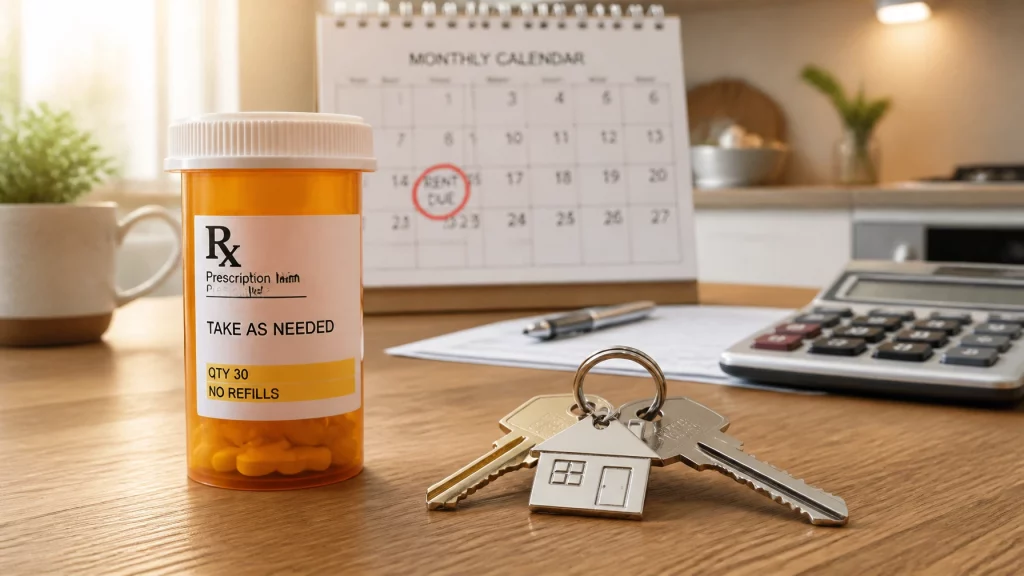
The math for the regular guy has changed. It used to be that rent or a mortgage was the big bad wolf of the monthly expenses, and everything else was just noise. But today, for millions of families, the pharmacy counter is starting to look a lot like a second landlord. When a single monthly prescription for a chronic condition costs as much as a studio apartment in the Midwest, we aren't just looking at a "healthcare issue." We’re looking at a fundamental shift in how we survive.
The New Fixed Cost: The Monthly Pill
For decades, we’ve been told that housing should take up about 30% of gross income. It’s the old rule of thumb, the tidy little budgeting formula. Keep the roof paid for, keep the lights on, and maybe there’s enough left for a small emergency fund and a dinner out that doesn’t come from a drive-thru window. But in 2026, another fixed cost has moved into the neighborhood, and unlike rent, it doesn’t even pretend to be stable. That new landlord is the pharmacy counter.
Prescription drug spending surged 12.7% in 2025 nationally and is projected to rise another 10% to 12% in 2026. Employer reports are showing the same ugly trend. Depending on the survey, pharmacy costs are running roughly 11% to nearly 15% higher year over year, making drugs one of the fastest-growing pieces of the health-cost puzzle. In plain English, this means one thing: next year’s premium, deductible, or paycheck deduction is already sharpening its knife.

The average monthly rent in the U.S. is still one of the largest bills in the household budget, but many families dealing with specialty medications are now staring at a second “rent” every month. Specialty drugs for autoimmune disease, cancer, inflammatory conditions, multiple sclerosis, and advanced diabetes can run $5,000 a month, $8,000 a month, or more at list price. Some newer therapies make even those numbers look quaint. And even when insurance is in the picture, the regular guy rarely gets billed on the manufacturer’s secret net price after rebates. The bill usually gets built off the sticker price, which is how a person ends up insured on paper and financially mugged in practice.
That is the real medicine cabinet math. This is no longer just a health care story. It is a cash-flow story. It is a “do the pills get filled or does the credit card get paid” story. It is a “skip the refill and hope for the best” story. A prescription drug price is now behaving like a rent hike that arrives every January and never asks permission.
How Drug Pricing Went From $10 Prescriptions to $5,000 Monthly Monsters
The road to this madness didn’t happen overnight. In the early 1980s, the average retail prescription in America cost about $10.73. By 1988, it was around $20.78. That was already a painful jump, but the scale still lived in the realm of household annoyance, not household destruction. A monthly medicine for a common condition might have felt inconvenient, maybe insulting, but not life-altering.
By 1990, the average retail prescription was about $22. That was the beginning of the steeper curve. Through the 1990s and early 2000s, brand-name drug prices started climbing hard. By 2000, the average retail prescription price was pushing $46. Brand-name prescriptions were moving even faster, while generics stayed relatively cheaper. Then the industry found its favorite trick: make breakthrough therapies, build a pricing story around innovation, and then let middlemen and insurance structures turn every refill into a scavenger hunt.
That is how America went from “the blood pressure medicine is twenty bucks” to “the specialty injection is $6,400 a month unless the prior authorization, coupon card, plan design, moon phase, and deductible all align.” The old drug market was mostly built around pills for common conditions. The modern market is increasingly built around biologics, injectables, oncology therapies, autoimmune treatments, and boutique miracle compounds with terrifying invoice totals. Some of these treatments truly are medically valuable. That’s not the argument. The argument is that the pricing structure attached to them has escaped all contact with common sense.
Even worse, list prices became less meaningful as actual prices got buried under rebates, formulary deals, exclusions, coupon programs, group purchasing contracts, and PBM gamesmanship. So the public price became fake, but the fake price still matters because that is often the number used to calculate deductibles and coinsurance. It’s like posting a fake steakhouse menu for the customer and a secret cheaper menu for the back office, then charging the family at table seven based on the inflated version.
The Insulin Story: A Perfect Little Horror Show
If anyone wants a clean example of what went wrong in the American drug market, insulin is sitting right there waving both arms.
Insulin is not some shiny new invention. It has been around for a century. This is not a case where a drug company spent ten billion dollars inventing anti-gravity and then asked for a premium. This is a mature, essential medicine that millions of people literally cannot live without.
Back around the early 1990s, insulin was expensive enough to notice but not yet a full-blown national scandal. The larger explosion came later. Eli Lilly’s Humalog launched in 1996 at about $21 a vial. For years, the list price marched upward in ugly little increments until that same vial was around $274.70 before the more recent wave of public backlash and manufacturer price cuts. Lantus and other major insulins followed the same general path: list prices rose, rebate structures thickened, and patients at the pharmacy counter got smashed.
That’s the insult sitting inside the insulin market. On paper, some 2026 patients can now access insulin for around $35 a month through Medicare caps, state reforms, manufacturer programs, or discount channels. That is good news, and credit belongs where credit is due. But that does not mean the system is fixed. It means the system got so absurd that emergency side doors had to be installed.
There is a big difference between “the market became affordable” and “a coupon, a cap, a patient assistance form, or a government rule temporarily saved somebody from the market.”
The insulin story is a microcosm of the whole racket:
- The list price ballooned.
- The net price after rebates told a different story.
- PBMs and insurers preferred products based on rebate economics.
- Patients with deductibles or coinsurance often paid based on the bloated list price.
- Public outrage forced some price cuts and caps.
- Everyone then pretended progress solved the underlying machine.
It didn’t. It just put a bandage over the loudest fire.
PBMs: The Middlemen With Their Hands in Every Pocket
Most regular people do not spend their evenings reading about Pharmacy Benefit Managers, which is understandable because life is short and joy matters. But PBMs sit right in the middle of the prescription drug mess, and their role is too large to ignore.
PBMs, or Pharmacy Benefit Managers, are the middlemen hired by insurers and employers to manage drug benefits. In theory, they bargain with drugmakers, create formularies, process claims, negotiate discounts, and hold down costs. In theory, this is the part of the story where a smart bulk buyer fights for the little guy.
In practice, the system often works backward.
The three giant PBM players have controlled the overwhelming majority of prescriptions in the market, and federal investigators have been increasingly blunt about what that means. The FTC has said dominant PBMs helped inflate drug costs, restrict access to cheaper drugs, and squeeze independent pharmacies. The FTC also sued major PBMs over insulin pricing, alleging that the rebate system rewarded high-list-price insulin products over lower-list-price alternatives.
Here’s the simple version of the rebate game:
- A drug manufacturer sets a very high list price.
- The PBM says, “Fine, but pay a fat rebate if you want preferred placement.”
- The manufacturer agrees because access to the formulary is everything.
- The health plan may get some of that rebate money later.
- The patient at the counter, especially one facing a deductible or coinsurance, gets charged based on the inflated list price up front.
That means the system can actually reward a higher sticker price. A lower-list-price competitor may be less attractive to the PBM if it doesn’t throw off a large enough rebate. So the rebate isn’t always a discount in the way normal people understand discounts. It can be a tollbooth fee embedded in a rigged traffic pattern.
Or said another way: if the car dealer told a buyer that the sedan costs $60,000, but quietly sent a $12,000 kickback to the financing company later, the buyer would not call that savings. The buyer would call that fraud with nicer stationery.
PBMs also make money in other ways: spread pricing, administrative fees, affiliated specialty pharmacies, and markup structures that have drawn major scrutiny. FTC reporting found the biggest PBMs and their affiliated pharmacies generated billions in revenue above acquisition costs on certain specialty generic drugs. So the “cost-control expert” is often profiting from opacity, not simplicity.
Medicare Drug Negotiation: Real Change, But Not a Magic Wand
One genuine shift in 2026 is the rollout of Medicare drug price negotiation. For the first time, Medicare negotiated Maximum Fair Prices for 10 high-cost Part D drugs. That matters. The question is how much it matters to the regular guy outside Medicare, and whether it changes the broader game.
The 10 drugs selected for the first 2026 round were:
- Eliquis
- Jardiance
- Xarelto
- Januvia
- Farxiga
- Entresto
- Enbrel
- Imbruvica
- Stelara
- NovoLog/Fiasp
The negotiated prices come in well below prior list prices, with discounts ranging roughly from 38% to 79% versus 2023 list levels. A few examples tell the story:
- Januvia: about $113 for a 30-day supply, roughly 79% below the prior list benchmark.
- Farxiga: about $178.50, around 68% lower.
- Jardiance: about $197, around 66% lower.
- Xarelto: about $197, around 62% lower.
- Eliquis: about $231, around 56% lower.
- Entresto: about $295, around 53% lower.
- Enbrel: about $2,355, around 67% lower.
- Stelara: about $4,695, around 66% lower.
- Imbruvica: about $9,319, around 38% lower.
- NovoLog/Fiasp: about $119, around 76% lower.
That is not trivial. CMS estimated these negotiated prices would have saved Medicare about $6 billion and beneficiaries about $1.5 billion annually if they had already been in effect. For retirees taking one of these drugs, especially those with significant out-of-pocket exposure, this is real money.
But does it matter for the regular guy who gets insurance from work or buys an ACA plan? Maybe, indirectly. Not immediately, and not cleanly.
The negotiated Medicare prices apply to Medicare, not the private commercial market. Still, they do a few important things:
- They create a public benchmark showing just how inflated prior list prices were.
- They put political pressure on drugmakers and middlemen.
- They may slowly influence commercial negotiations, especially for widely used diabetes and cardiovascular drugs.
- They weaken the old myth that government can never push back on drug pricing.
So yes, it matters. But no, it does not mean the 42-year-old warehouse supervisor with a family plan is suddenly strolling into CVS and getting Stelara at Medicare’s negotiated price. The regular guy still lives in PBM-land, and PBM-land never gives up margin voluntarily.
The Insurance Shell Game: High Deductibles, Coinsurance, and the Great Cost Shift
This is where the regular family gets trapped even when everybody in the system keeps saying the word “coverage” like it’s a magic charm.
Employer insurance used to shield workers from more of the immediate hit. Today, plenty of plans still sound decent in the HR booklet, but the details are where the damage is hidden. The shell game works like this: employers and insurers faced with rising drug costs don’t just absorb them. They redesign the plan so workers absorb more.
There are several favorite moves:
Move one: higher deductibles.
Before many drugs are covered meaningfully, the employee has to burn through thousands of dollars out of pocket.
Move two: coinsurance instead of copays.
A $40 copay is annoying. A 25% coinsurance on a $4,000 specialty drug is catastrophic.
Move three: specialty tiers.
Plans create a premium tier for expensive drugs, which sounds technical and harmless until a patient discovers the “tier” means hundreds or thousands each refill.
Move four: accumulator and maximizer tricks.
Manufacturer coupons may reduce the immediate pain, but some plans don’t credit those coupon dollars toward the deductible or out-of-pocket max.
So when employers say they are “maintaining benefits,” that phrase sometimes deserves the same trust level as a used-car salesman describing flood damage as “a little moisture history.”
The average worker does not experience drug inflation as an abstract line on an actuarial chart. The worker experiences it as:
- a larger payroll deduction,
- a bigger deductible,
- a higher specialty drug coinsurance bill,
- a denied prior authorization,
- or a sudden switch to a “preferred” drug that just happens to be more profitable to somebody in the chain.
The “Pharmacy Trend” and Why Next Year’s Premium Is Already in Trouble
The phrase “pharmacy trend” sounds harmless, like something discussed by men in khakis over stale muffins at an insurance conference. But it simply means the rate at which prescription drug costs are rising, and in 2026 it is one of the hottest fires in the room.
National projections have pharmacy spending up around 10% to 12%. Employer studies are posting Rx-only trends around 11% to 11.3%. Milliman’s 2026 index flagged pharmacy spending growth near 14.8% for the average person, making it one of the fastest-growing components of employer health costs. UnitedHealthcare reported pharmacy costs up 11% in 2025, with specialty medications accounting for roughly 55% of total pharmacy spend. Benefit surveys show brand and specialty drugs make up the overwhelming majority of pharmacy dollars while representing a small minority of prescriptions.
That matters because employers do not leave money on the sidewalk. If pharmacy costs rise 12%, the company responds somewhere:
- higher employee premium contributions,
- narrower formularies,
- more prior authorization,
- higher deductibles,
- tougher specialty tiers,
- or lower wage flexibility because benefit costs are eating compensation.
A family does not need a white paper to understand this. If the employer’s health plan costs thousands more per worker next year, that money comes from somewhere. Maybe the paycheck grows slower. Maybe the premium jumps. Maybe the deductible gets uglier. Maybe all three.
That is why “pharmacy trend” should be translated honestly. It means this year’s drug inflation becomes next year’s household budget problem.
The Medical Bankruptcy Connection: One Prescription Away From the Edge
Medical debt in America is not some rare storm that hits only the uninsured. Millions of insured people are already carrying the wreckage. KFF and Peterson data have estimated about 20 million people owe medical debt, totaling at least $220 billion. Millions owe more than $10,000. That is not a side issue. That is a major household balance-sheet event.
And prescriptions can be the spark.
A regular person can often limp through a single ER bill on a payment plan. It’s ugly, but it can be compartmentalized. A monthly prescription is different because it acts like a repeating financial ambush. It doesn’t arrive once. It arrives every 30 days, with zero regard for job loss, car repairs, school clothes, or whether the checking account already looks like a crime scene.
This is how financial collapse begins:
- A diagnosis creates a new prescription.
- The plan puts it on a specialty tier.
- Coinsurance turns the refill into a four-figure bill.
- The patient uses a credit card.
- Then another refill hits.
- Then a follow-up visit.
- Then lab work.
- Then missed work hours.
- Then interest charges.
- Then one bill spills into the next.
By the time bankruptcy enters the conversation, it is usually not because of one giant dramatic moment. It is the death-by-a-thousand-refills version of collapse.
KFF polling in 2026 found 59% of adults worry about affording prescription drugs, and 43% said they had not taken medicines as prescribed in the past year due to cost. Some skipped doses. Some didn’t fill prescriptions. Some used over-the-counter substitutes. That is not just a health problem. That is the sound of people trying to avoid financial drowning with kitchen-table triage.
The Preventive Hedge: Spending a Little to Avoid Spending a Fortune
This is where the old argument about prevention needs to stop sounding like a wellness poster in a dentist’s office and start sounding like what it really is: capital allocation.
If the medical system charges top dollar once the body breaks, then prevention is not fluff. Prevention is investment. It is yield-producing, disaster-avoiding, balance-sheet defense.
The numbers are not perfect in every case, but the logic is brutal and clear.
A $100-a-month gym membership costs $1,200 a year. Compare that with just one cardiac event, an ER visit, a short hospital stay, imaging, specialists, and follow-up care. A modest heart-related episode can chew through $10,000 without breaking a sweat. A severe one can make that number look adorable.
A $500-a-month commitment to better food sounds expensive until it’s put next to chronic disease treatment. That’s $6,000 a year for dramatically improved nutrition, fewer ultra-processed calories, better metabolic control, less weight gain, and lower long-term inflammation risk. Compare that with a cancer treatment series, surgery, imaging, oncology follow-up, and prescription support that can punch through $50,000 in a hurry. In many cases it goes far higher.
Of course, not every disease is preventable. Not every fit person stays healthy. Not every diagnosis is the result of bad choices. That would be simplistic nonsense. But a shocking amount of chronic disease burden does move with obesity, inactivity, poor sleep, unmanaged stress, and junk nutrition. That means a meaningful chunk of future medical spending can be influenced before it becomes a claim.

This is why employers should be thinking less in terms of “health benefits” and more in terms of “health investments.” A company that helps fund gym access, preventive screenings, smoking cessation, nutrition coaching, sleep support, and stress management is not being charitable. It is defending future cash flow. Healthy workers are not only happier. They are cheaper to insure, more productive, and less likely to get caught in the prescription vortex.
A hundred dollars for exercise, five hundred for quality food, and some time for stress reduction may sound like lifestyle fluff to Wall Street minds. But compared with long-run claims costs, it’s some of the best math on the board.
Practical Survival Strategies for the Regular Guy
Until the system gets rebuilt instead of merely re-labeled, the regular guy still needs ways to fight back. None of these tools fixes the structure, but they can reduce the damage.
1. Check the cash price every time.
Never assume insurance gives the best price. Sometimes the cash price with a discount coupon is lower than the insured copay, especially before the deductible is met.
2. Use GoodRx and similar coupon tools.
GoodRx lets users compare pharmacy cash prices by ZIP code and pull a coupon for immediate local pickup. The same drug can vary wildly between stores. A five-minute search can save serious money.
3. Check Mark Cuban Cost Plus Drugs for generics.
Cost Plus uses a transparent formula: drug cost plus a 15% markup plus a pharmacy fee, generally with mail-order delivery. For many generic maintenance drugs, it can beat traditional pharmacy pricing and sometimes beat insurance copays too.
4. Look for manufacturer copay cards and coupons.
For brand-name drugs, many manufacturers offer copay assistance for commercially insured patients. These programs can slash out-of-pocket costs, though some plans use accumulator rules to block those savings from counting toward deductibles.
5. Apply for patient assistance programs.
If income qualifies, some drugmakers and nonprofit programs provide medicines free or at deep discounts. This is especially important for people facing brand-only or specialty drug costs.
6. Ask about 90-day fills.
Maintenance drugs are often cheaper per month when filled in 90-day supplies instead of 30-day increments.
7. Ask the doctor the most useful question in medicine: “Is there a cheaper therapeutic alternative?”
Not every drug has a substitute, but many do. A prescriber may know which options are clinically similar but much cheaper.
8. Check 340B pharmacies connected to safety-net providers.
Some hospitals and clinics participating in the 340B program contract with pharmacies and may offer meaningful discounts on outpatient drugs. The catch is that 340B is murky and inconsistent. Sometimes the savings reach patients clearly; sometimes they mostly support the covered entity. Still, for some families, these pharmacies can offer lower prices worth checking.
9. Compare insurance use versus cash-pay use.
If a discounted cash price is lower than the insurance price, paying cash may make sense in the moment. The downside is those dollars may not count toward the deductible or out-of-pocket maximum. So it becomes a strategic choice, not an automatic one.
10. Keep records and fight denials quickly.
Prior authorizations, formulary exceptions, and appeals are annoying on purpose. Delay is part of the business model. Paperwork is a weapon. Use it back.
These are not elegant solutions. They are survival tactics inside a crooked maze. But a crooked maze still requires a map.
When a society gets to the point where citizens need coupons, rebate navigation, secret cash prices, mail-order workarounds, and federal negotiation experiments just to afford insulin and heart medicine, the problem is not consumer behavior. The problem is the machine.
Be mindful, be watchful and good luck.
Medicine as a Shareholder Asset
The problem, at its core, is that medicine has been fully absorbed into the machinery of quarterly earnings and investor dividends. As noted in recent discussions here at Regular Guy Economics, medicine should not be a playground for pure capitalism in the way that, say, consumer electronics are. If a new smartphone is too expensive, you wait a year or buy a different brand. If a drug that manages your heart's rhythm doubles in price, you don't have the luxury of "shopping around" for a cheaper heartbeat.
Car insurance works because the value of the car is known, the repair costs are finite, and there is a "totaled" value that establishes a ceiling. Medicine has no such ceiling. There is no "totaled" value for a human life, and the pharmaceutical industry knows it. This is why we see branded drugs: which account for only 15% of prescriptions: taking up 90% of the total drug spending. It is a high-margin, low-volume game played with people’s lives.

The Amazon/Berkshire/JPMorgan Gambit
What took the big players so long to notice? When Amazon, Berkshire Hathaway, and JPMorgan Chase announced they were forming an independent health care company to serve their employees, they weren't doing it out of the goodness of their hearts. They did it because medical expenses are a runaway train that has escaped every other form of corporate cost-cutting.
Over the last thirty years, businesses have optimized everything. Inventories are lean, workforces are variable, and outsourcing is the norm. Yet, medical costs have continued to trend up while every other operational cost has been wrung out. These mega-corporations realized that the only way to protect their bottom line was to "destroy" the current medical industry model and build one "free from profit-making incentives and constraints."
If the titans of industry are trying to exit the traditional medical marketplace to save their own skin, what does that tell the regular guy sitting at home with a $400 co-pay? It tells him the system is broken beyond repair.
Household Budget: The Encroachment
When we look at the household budget in 2026, we see a disturbing trend of "shrinkflation" in our health. We are paying more for less bedside care. We have more cancer per capita, more obesity, and more type 2 diabetes than ever before, despite spending 20% of our GDP on the "fix."

The math of the medicine cabinet is simple:
- The List Price Hike: Over 350 brand-name drugs saw price increases in early 2026.
- The Insurance Shift: Employers are passing more of the "pharmacy trend" onto employees via higher deductibles.
- The Result: The $2,000 you saved for a house downpayment this year just got eaten by an unexpected specialty drug requirement.
Reclaiming the Budget
The medicine cabinet math doesn't have to dictate your rent. While we wait for the "titans of industry" to disrupt the marketplace or for policy shifts like the Medicare drug price negotiations to trickle down to the private sector, the individual's best move is mindfulness.
Watch the trends, understand that your prescription is a profit center for someone else, and look for every opportunity to incentivize your own health. We spend a third of our lives working to pay for the roof over our heads. It’s time we stopped letting the pharmacy counter take the keys.
Be mindful, be watchful and good luck.