



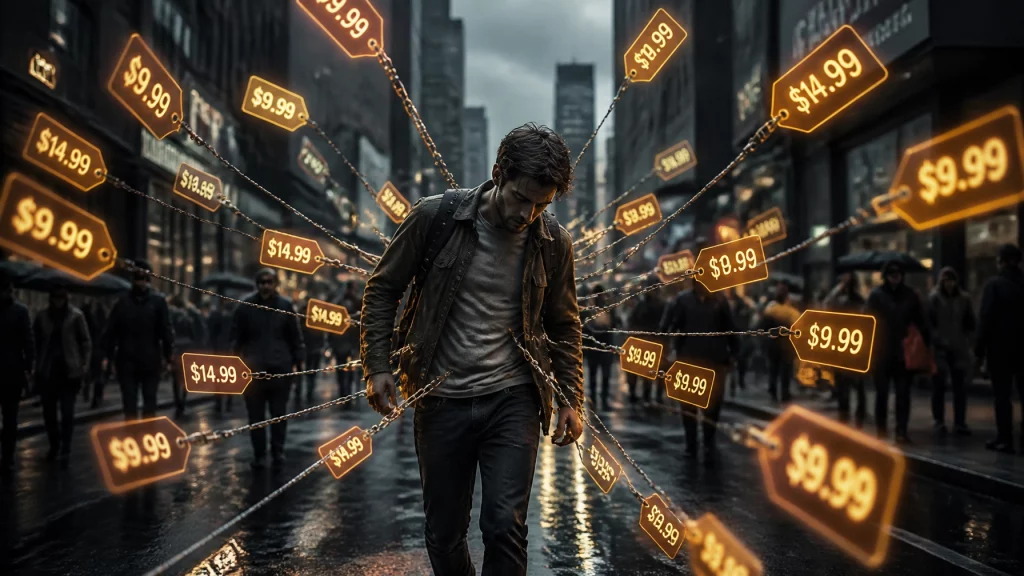
Ownership is dying. Not with a bang, but with a monthly recurring charge. There was a time when a man could walk into a store, lay down some cash for a movie, a piece of software, or a gym pass, and that was the end of the transaction. You owned the thing. It sat on your shelf, or the software lived on your hard drive, and it didn't ask for a dime ever again.
Fast forward to 2026, and the landscape has shifted into a series of digital leashes. We don't own movies; we rent access to a library. We don't buy software; we pay for a "seat" in the cloud. We don't even own the heated seats in some cars: or at least the car companies tried hard to make that the case. This is the subscription economy, and it is quietly strangling the regular guy’s paycheck.
The Invisible Drain: The Perception Gap
The most dangerous part of the subscription model is its invisibility. It’s the ultimate "set and forget" trap. C+R Research found consumers thought they spent about $86 a month on subscriptions, but when they actually itemized the charges the real number came in at $219.
That is a 2.5x perception gap. It means a whole lot of people are strolling around with a $130-a-month budget leak and calling it “normal.” That $130 isn't just fluff money. That is car insurance. That is part of the grocery bill. That is the beginning of an emergency fund.
Other 2026 data tells the same story from different angles. A LendingTree/DepositAccounts analysis reported the average household now carries about 4.5 digital subscriptions. Deloitte’s 2026 Digital Media Trends report found the typical U.S. household has roughly four paid streaming video subscriptions alone. Put those together with music, cloud storage, meal delivery, gaming, software, shipping memberships, and the modern household is very often juggling eight or more recurring payments without even realizing it.
When you look at the full landscape in 2026, including streaming, music, gaming, cloud storage, grocery delivery, meal kits, fitness apps, software, and that gym membership that hasn’t seen a treadmill since February, the total often climbs to $270 or more. In some households, especially affluent ones loaded with premium plans, it crosses $500.
Historical Context: From Buying Stuff Once to Renting It Forever
The subscription economy didn’t show up out of nowhere. It was built on a cultural shift away from ownership and toward access.
Back in 1990, Americans still spent entertainment money in a way that made basic sense. A person bought a CD, a VHS tape, a Nintendo game cartridge, or a software box, paid once, and that was the end of the relationship. The Bureau of Economic Analysis and historical consumer spending data show that in 1990 Americans spent far less on digital and media services because most of the budget was tied to physical goods and occasional purchases, not endless monthly hooks. Today, personal consumption expenditures on categories tied to audio-video, information processing, media, and related services run into the hundreds of billions of dollars annually. The St. Louis Fed’s BEA-linked series shows personal consumption expenditures for video, audio, photographic, and information-processing equipment and media reached roughly $427.6 billion in 2025. Services related to those same worlds added another enormous layer on top.
That is the trick. The old system was lumpy. You spent money in chunks. The new system is smooth. It drains constantly.
A DVD used to cost maybe $15 or $20. A household might build a shelf of movies over time. Same thing with music. Same thing with Microsoft Office. Same thing with Adobe software. Now the shelf is gone, the discs are gone, and the bill never leaves.

That shift matters because ownership created an asset, even if it was a small one. Maybe not a Wall Street asset, but a practical one. The movie could be watched ten years later. The software still worked. The album remained playable. The book stayed on the shelf. In today’s system, stop paying and the doors lock.
This is the biggest economic sleight of hand in modern consumer life: what used to be a one-time purchase has been converted into a lifetime operating expense.
The 1990s Mortgage Comparison
To put this into perspective, look at the math of the early 1990s. In 1992, median monthly mortgage payments in many parts of the country hovered around $300 to $400. That sounds laughably quaint now, but it makes the point. Plenty of families in 2026 are spending something close to a 1990s mortgage payment just to keep the digital lights on.
The problem is that a mortgage builds equity. You eventually own the house. A subscription builds nothing but shareholder value for the companies you’re paying. When the payments stop, the service vanishes. What remains is a stack of old confirmation emails and a vague memory of three different streaming platforms all rebooting the same show.
This shift from "Buy to Own" to "Pay to Play" is a massive wealth transfer from households to corporations. It replaces a one-time capital expense with a permanent, life-long operational expense.
How Many Subscriptions Are We Talking About?
This is where the subscription defenders get slippery. They like to make it sound like the average household just has Netflix and maybe Spotify. Cute story. Not true.
In 2020, the average American household had about 4.0 digital subscriptions according to later comparative surveys cited in 2026 reporting. By 2026, that figure had climbed to roughly 4.5 digital subscriptions per household in the LendingTree/DepositAccounts analysis. And that is a narrow count focused mainly on digital services. Once broader categories are included, C+R-style tracking and newer subscription-spending summaries place the average consumer at about 8.2 active subscriptions.
That means the “average” household can easily be running:
- 4 streaming services
- 1 music service
- 1 cloud storage plan
- 1 software subscription
- 1 shipping/delivery membership
- 1 gaming pass
- 1 fitness or wellness app
- 1 news or sports subscription
That is not a luxury lifestyle anymore. That is just Tuesday.
The crazy part is that even while the count rose, consumers got more fed up with it. Deloitte reported 41% of consumers canceled an SVOD service in the prior six months, and 22% canceled and then came right back. That is the subscription economy in a nutshell: cancel, crawl back, cancel again, repeat until retirement.
The Psychology of the $9.99 Trap
Why $9.99? Because it sits right in the psychological blind spot. It is low enough that the brain files it under “not worth arguing about.” Nobody calls a family budget summit over $9.99. That is why companies don’t charge $47.36. They want the consumer to shrug.
But ten bucks for Netflix, ten for Spotify, ten for iCloud, ten for Disney+, fifteen for YouTube Premium, eleven for cloud backup, twelve for a meal-planning app, and twenty for game access adds up to a real monthly bill in a hurry.
Companies love the model because it creates sticky revenue. Once the credit card is on file, inertia takes over. Human beings are creatures of habit, and businesses know it. That is why cancellation pages are often buried under logins, menu trees, retention offers, and the digital version of a used-car salesman blocking the door.
They are betting on laziness. They are betting on distraction. They are betting on the fact that most people will not spend a Saturday morning auditing a bank statement. Judging by the size of the subscription economy, that bet is printing money.
Subscription Creep: The Free-Trial Ambush
Now comes the grimy little side hustle inside the side hustle: subscription creep.
Subscription creep is what happens when one or two perfectly reasonable services quietly become ten or twelve. It also happens when “free” means “free until forgotten.”
Self Financial’s 2026 subscription survey found 70% of people had forgotten to cancel a free trial at some point. The average wasted cost from that mistake was about $34.31. On top of that, 59.9% said they had at least one paid subscription going unused each month, with an average of 2.6 unused subscriptions. The average monthly value of those unused services was $26.79.
CNET’s 2026 survey found Americans waste about $204 a year on unused subscriptions. That is $17 a month disappearing into the void for services nobody is watching, listening to, reading, or using.
That is the important part. The business model is not just built on value. It is built on forgetfulness.
Free trials are especially devious because they exploit a perfectly normal impulse. Somebody wants to watch one game, one documentary, one show, one course, one recipe plan, one week of meal delivery. The company says, “No problem. First 14 days free.” Then day 15 arrives like a mugger with autopay.
A lot of these firms don’t really want a delighted customer. They want a distracted one.
The Death of Owning Media
This may be the ugliest part of the whole trend. Media used to be something people actually possessed. Movies sat on shelves. Albums sat in binders. Books lined the walls. Even downloaded files felt like property.
Now almost everything is rented.
Movies? Streaming libraries.
Music? Streaming catalogs.
Books? E-book licenses.
Video games? Passes and cloud access.
Sports? Monthly packages, seasonal add-ons, premium tiers, and blackout nonsense.
And what happens when the payments stop? Nothing dramatic. That is the point. The stuff simply evaporates. The playlist vanishes. The cloud library becomes inaccessible. The downloaded movie may not play. The “purchased” digital title can even disappear if licensing changes.
Consumers were sold convenience and got revocable access.
That is a major cultural downgrade dressed up as innovation. A bookshelf never demanded a password reset. A DVD collection never announced a new terms-of-service update. A CD never required biometric verification and a Wi-Fi signal to prove it still exists.
The SaaS Invasion: Pay Forever for What Used to Be a Box
Software used to come in a box. It may have had bugs. It may have had a 900-page manual nobody read. But once it was purchased, it was owned.
Then Silicon Valley discovered the beauty of Software as a Service, which is a lovely phrase meaning “the meter never stops.”
Microsoft Office 2024 can still be bought outright for around $179.99 for a basic one-time license, but Microsoft 365 Personal now runs about $99.99 a year and Family about $129.99 a year. Adobe went even further. Its Creative Cloud Pro pricing in North America moved to roughly $69.99 per month in 2025 for many individual users, or about $780 to $840 a year depending on billing structure.
That means software that once cost a few hundred dollars every several years now quietly eats a household budget forever. Need Word and Excel? Pay yearly. Need Photoshop and Illustrator? Pay yearly. Need cloud backup, PDF editing, password protection, antivirus, and storage? Congratulations, the computer itself now has a cover charge.
This is not just a pricing model. It is a structural rewrite of household expenses. The office, the photo studio, the filing cabinet, and the backup drive have all become monthly landlords.
The Car Subscription Nonsense
If subscriptions for movies and software were not annoying enough, the auto industry decided to try turning the family vehicle into a vending machine.
BMW became the poster child for the backlash after experimenting with charging for features such as heated seats through its “functions on demand” strategy. Public reaction was brutal, and BMW eventually backed away from heated seats specifically. But the larger idea did not die. BMW and others continue to push paid post-purchase features tied to software, driver assistance, parking tech, cameras, remote functions, traffic services, and other add-ons.
Reports in 2025 and 2026 showed BMW still defending subscriptions for certain features, including things like parking assistance, 360-degree camera functions, traffic information, or connected services. Mercedes has also played around with the same basic strategy from the luxury angle, including paid performance upgrades and digital extras. GM charges for Super Cruise after an included period. Toyota has charged for connected remote features. Ford monetizes BlueCruise.

This is the hardware-as-a-service model, and it should bother anyone with a pulse. The hardware is in the car. The sensors are in the car. The seat heater is in the car. The camera is in the car. Yet the buyer gets a partial version of his own machine unless the monthly toll gets paid.
Imagine buying a refrigerator and being told the ice maker only works on the platinum plan.
That is where this logic goes if nobody pushes back.
Grocery and Meal Kits: The Subscription Model Invades the Kitchen
The creep did not stop at screens. It marched right into the pantry.
Meal kits, grocery memberships, prepared-meal services, “save with delivery” memberships, and premium grocery access plans have become another recurring line in the household ledger. The U.S. meal kit market was estimated around $9.1 billion in 2025 by IBISWorld, while broader research placed the market even higher depending on category definitions. Kantar tracking has shown 41% of shoppers report having grocery subscriptions and 37% report meal-kit subscriptions in the broader membership-and-subscription universe.
Online grocery sales have also kept climbing. Digital Commerce 360 reported U.S. online grocery sales were still growing more than 20% year over year through the first quarter of 2026. Walmart, Amazon, Kroger, and delivery platforms have trained consumers to think in memberships, delivery passes, and recurring convenience charges.
That matters because the food budget used to be one of the last truly direct categories. A family bought groceries. End of story. Now the food bill can include:
- grocery delivery memberships
- meal-kit subscriptions
- prepared-meal subscriptions
- warehouse club memberships
- premium shipping passes
- auto-ship pantry items
The danger is overlap. A family can have Walmart+, Amazon Prime, Instacart+, and a meal-kit plan all active in the same month while still shopping in-store. That is how convenience becomes duplication.
The Credit Card Multiplier: 22% Interest on Your TV Shows, Music, and Chicken Parmesan
The subscription leash gets even tighter when these services sit on a credit card balance. And in 2026, that is not some rare edge case. Credit card APRs above 20% are common, and 22% is not unusual at all.
Now here is the regular-guy math.
Suppose a household carries $200 per month in subscriptions on a card and never fully pays it off. At 22% APR, that monthly subscription load creates about $44 a year in interest cost on top of the $2,400 annual subscription spend. Over 10 years, that is about $440 in interest paid for services that were already consumed and gone.
That is the clean version.
The uglier version is what happens if those balances stack and compound with other debt. Then the family is not just paying for Netflix, cloud storage, software, and meal kits. The family is paying interest on last year’s Netflix, cloud storage, software, and meal kits. The entertainment has ended, the meals were eaten, the files were edited, and the interest bill is still hanging around like an uninvited cousin on the couch.
That is a perfect example of how the modern middle class gets bled dry. Not with one giant mistake, but with recurring small ones financed at ruinous rates.
The Dopamine Machine
There is also a psychological layer here that does not get enough attention.
Subscriptions are not just about access. They are about anticipation. New episode Friday. New release Tuesday. New drop, new feature, new content alert, new playlist, new curated recommendation. The platforms are not just selling a service. They are selling the possibility that the next tap will make the evening better.
That taps directly into the dopamine loop. Availability becomes stimulation. Consumers begin paying not just for what they use, but for the comfort of knowing the content is there. Netflix is not always being watched. Spotify is not always playing. The language app is not always teaching. The meditation app is not always calming. But they remain active because they represent future potential.
That is how a subscription turns into a leash. People do not just fear losing the service. They fear losing access to the option.
It is the modern equivalent of stuffing a pantry full of junk food because maybe something good will sound nice later. Only now the junk food auto-renews.
The Subscription Categories You Forgot You Had
It’s not just Netflix. The leash has extended its reach into every corner of the household:
- Software as a Service (SaaS): Microsoft 365, Adobe, cloud backup, editing tools, AI apps, antivirus, and note-taking tools that never stop billing.
- Physical Goods: Razor blades, vitamins, pet food, coffee, snacks, diapers, and every “curated box” some marketing team could dream up.
- The "Pro" Trap: Delivery services that charge a monthly fee for “free” shipping, then nudge bigger orders so the customer feels like the membership is “worth it.”
- Hardware Features: Car companies monetizing remote start, traffic services, advanced cameras, driver assistance, and other features after the car is already purchased.
- Digital Maintenance: Photo storage, premium email, device protection, family location tools, password managers, and identity monitoring.
- Food Convenience: Meal kits, prepared meals, grocery memberships, auto-ship staples, and restaurant delivery subscriptions.
- Media Access: Music, books, audiobooks, movies, sports, games, and “premium” news that all vanish when payment stops.
This is no longer a niche problem. It is a parallel utility system built by corporations and paid for by consumers in tiny bites.
How to Break the Leash
If the goal is to free up $200 or more a month, this cannot be treated like a gentle decluttering project. It has to be treated like pest control. Fast, systematic, and a little mean.
Here is the full audit strategy.
1. Pull 90 days of statements
Bank accounts. Credit cards. App store charges. PayPal. Venmo. Everything. Recurring charges love to hide in alternative payment channels.
2. Make a subscription list
Write down every charge, amount, renewal date, and payment source. Put it in a simple spreadsheet if needed. Most people will find at least three charges they forgot existed before the list is even finished.
3. Sort into four buckets
- Daily or weekly use
- Monthly use
- Rarely used
- Completely unused
Anything in the last two buckets is guilty until proven innocent.
4. Cancel all unused services immediately
No debate. No sentimental speeches about maybe watching that documentary series in the fall. If it was not used in 30 days, cut it.
5. Kill duplicate categories
One music service. One cloud storage plan. One grocery membership. One meal service. One fitness app. One or two streaming services at a time. There is no trophy for carrying six nearly identical subscriptions.
6. Rotate entertainment
Subscribe with purpose. Pick one streamer, watch what matters, cancel, move on. Same goes for premium sports packages and audiobook plans. Consumers do not need permanent access to everything ever made.
7. Downgrade before canceling
Many companies hide cheaper ad-supported or limited tiers. If a service is mildly useful but overpriced, cut it down before cutting it off.
8. Turn off auto-renew when possible
If the service is truly occasional, do not let it self-renew. Make it earn the next payment manually.
9. Move subscriptions off revolving credit card debt
If possible, put keepers on debit, cash-flowed payments, or a prepaid card. Subscriptions and 22% APR are a toxic marriage.
10. Set a monthly subscription cap
Pick a hard number. Maybe it is $100. Maybe $150 for a bigger family. Does not matter. What matters is that once the cap is reached, a new subscription means an old one dies.
11. Use calendar reminders for trial endings
The second a free trial starts, put a reminder in the phone for 48 hours before conversion. That tiny habit alone can save real money.
12. Re-audit every quarter
Subscriptions breed. The problem comes back if it is ignored. Every 90 days, run the list again.

A household that follows that process seriously can absolutely cut $200 a month. That is $2,400 a year. Invested, saved, or used to kill real debt, that money starts working for the family instead of for streaming giants, software firms, carmakers, and meal-kit marketers.
The subscription economy was sold as convenience, but it has morphed into a soft form of financial captivity. It is a second utility bill structure with no equity, no permanence, and no finish line. It trains consumers to rent their entertainment, rent their software, rent their convenience, rent their car features, and in some cases practically rent their own habits.
That is the leash.
And the ugly truth is that most people never agreed to wear it all at once. It was buckled on one “free trial,” one “premium upgrade,” one “family plan,” one “delivery pass,” and one “just $9.99” at a time.
It is time to cut the cord. Not just on cable, but on the entire mindset that says every convenience must become a monthly obligation. Ownership may be old-fashioned, but debt-free old-fashioned still beats digitally handcuffed.
Be mindful, be watchful and good luck.