



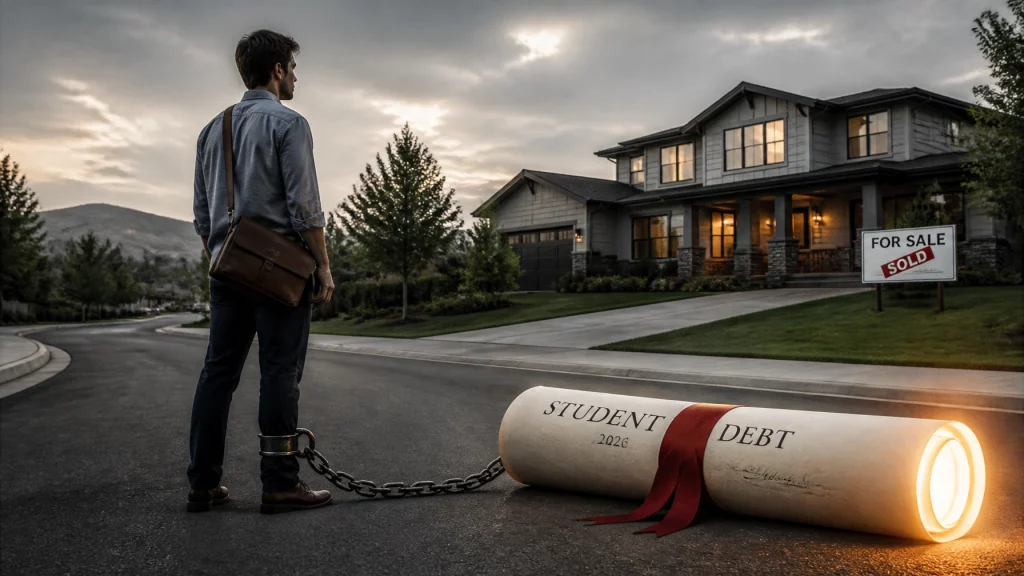
Education is supposed to be the great equalizer. It is the golden ticket, the ladder to the middle class, and the key to a better life. But as we sit in June 2026, that ladder has turned into a $1.66 trillion leash. For millions of graduates, the diploma on the wall isn't just a symbol of achievement; it’s a receipt for a debt burden that is now dictating every major decision they make.
The numbers are staggering. As of this month, total student loan debt in the United States has hit $1.66 trillion. The average graduate is walking off the stage with $39,633 in loans tied to their name. This isn't just a balance on a spreadsheet; it’s a fundamental shift in the American lifecycle. We are witnessing a generation that isn't choosing its own path: the debt is choosing it for them.
The Real Estate Wall: 40 is the New 30
For decades, buying a home was the primary way Americans built wealth. You got your degree, you got a job, and by your late 20s or early 30s, you were signing for a mortgage. In 2026, that timeline has been demolished.
The median age for a first-time homebuyer has officially hit 40 this year. That is a full decade later than the historical norm. When you are carrying nearly $40,000 in debt before you even start your first job, saving for a down payment feels like trying to empty the ocean with a thimble.

The data tells a grim story: 1 in 4 graduates in 2026 are delaying homeownership by a minimum of 10 years directly because of their student loans. It’s hard to qualify for a mortgage when your debt-to-income ratio is already maxed out by the Department of Education. For many, the choice is simple: pay the student loan servicer or pay the mortgage. You can't do both, so they remain in the rental market, further driving up costs for everyone else and missing out on the primary wealth-building tool of the middle class.
The Marriage and Family Tax
It isn't just the "front door" that is being pushed back. The impact of the $1.66 trillion leash extends into the most personal corners of life. Research in early 2026 shows a direct correlation between high student debt and declining rates of marriage and childbearing.

Starting a life together requires a certain level of financial stability: or at least the hope of it. When two people come together and bring $80,000 in combined student debt to the altar, "for richer or for poorer" feels a lot more like "definitely for poorer." Roughly two-thirds of Gen Z report that debt has forced them to delay major life milestones, with marriage and starting a family topping the list.
The economic reality is that children are expensive. If your monthly loan payment is the equivalent of a daycare bill, you have to choose between the loan and the kid. In a world where the cost of living continues to fluctuate, the debt burden acts as a massive "family tax" that the youngest generation is simply unable to pay.
Career Chains: Picking the Paycheck Over Passion
We often tell students to "follow their passion," but the 2026 debt landscape doesn't allow for that. When you have a $500 monthly payment due every 30 days, you don't take the risky job at the exciting startup. You don't work for the non-profit that’s changing the world. You don't start the small business you've always dreamed of.
Instead, you take the safest, highest-paying corporate job you can find, even if it drains your soul. The $1.66 trillion leash has created a "career distortion" where talent is being funneled into specific industries not because of interest, but because of the need to service the debt.

In hindsight, the regret is palpable. 56% of graduates now say they would have borrowed less if they could do it all over again. They are realizing that the degree, while valuable, might not have been worth the loss of agency in their professional lives. Many are looking to side hustles just to keep their heads above water, trying to find some form of independence in an economy that feels rigged against them.
The July 1st Repayment Cliff
The situation is coming to a head on July 1, 2026. For years, various income-driven repayment plans provided a safety net for those struggling to keep up. However, with the recent Supreme Court decision striking down the SAVE plan, a massive repayment overhaul is set to take effect.

This overhaul isn't just a change in paperwork; for many, it represents a significant increase in monthly obligations. As the "on-ramp" period for student loan payments fully ends and new, more stringent rules apply, the financial pressure is going to reach a breaking point. We are likely to see even more people forced back into their parents' basements or into careers they hate just to satisfy the interest rates that never seem to stop growing.
Rethinking the Investment
We have reached a point where the "value" of a college degree must be calculated like any other business investment. If the cost of the degree prevents you from owning a home until 40, marrying the person you love, or starting a family, was the investment successful?
The $1.66 trillion leash isn't just an individual problem; it is a systemic anchor on the entire economy. When an entire generation is sidelined from the housing market and forced to delay consumption, everyone feels the impact. The velocity of money slows down. Innovation stalls because the would-be entrepreneurs are too busy paying off their sociology degrees.
The madness of the medical industry has shown us what happens when an essential service becomes an unsustainable cost center, and the education industry has followed suit. Until we address the fundamental cost of these degrees and the predatory nature of the interest that keeps people tethered for twenty years, the American Dream will remain on hold for those who were told that education was the only way to achieve it.
Be mindful, be watchful and good luck.