



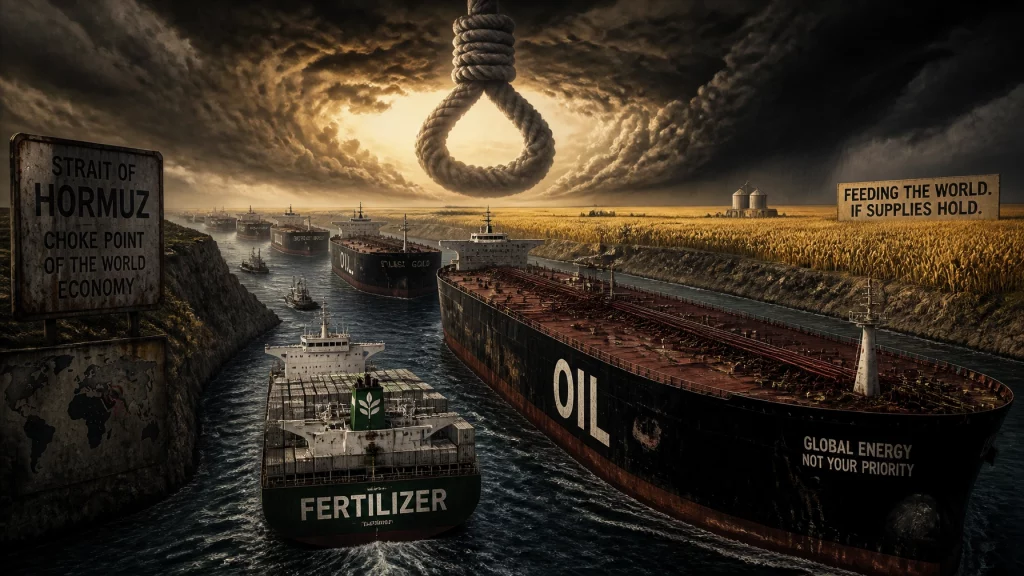
Back in April, we issued a warning that most people didn’t want to hear. In our post, The Nitrogen Noose: The Hidden Crisis on Your Dinner Plate, we laid out the math of a coming catastrophe. We predicted a 46% price spike in fertilizer driven by the chaos in the Strait of Hormuz and warned that the "grocery tax": the inevitable surge in food prices: would hit the regular guy’s wallet by October 2026.
If you’ve been watching the headlines lately, you might think we were overblowing it. You might have seen that urea prices actually dropped about 12% in June. Retail urea is sitting around $764/ton, and New Orleans barge prices dipped into the $340–$350/ton range, down from the April peak of $782.
The talking heads on the news are calling it a "correction." They’re saying the Hormuz crisis is stabilizing. They’re telling you the pressure is off.
They are wrong.
This isn’t a correction; it’s a mirage. And if you stop preparing now because the line on a chart took a temporary breather, you’re going to be the one left hungry when the noose finally pulls tight this fall.
The China Dump and the Illusion of Stability
Why did prices dip? It wasn’t because the world suddenly found a new way to make nitrogen or because the Middle East became a playground of peace and harmony overnight.
It happened because of two very specific, very temporary factors. First, China: ever the tactical player in global trade: decided to dump roughly 2 million tons of extra urea exports onto the market between June and August. This was a calculated move to capture high prices while they lasted, and it flooded the market just enough to take the top off the price spike.
Second, there was a wave of "hope" that the Strait of Hormuz was reopening for business as usual. Markets run on emotion just as much as they run on supply and demand. The idea that ships might start moving again was enough to make speculators breathe a sigh of relief and sell off their positions.
But hope isn't a strategy, and China’s 2-million-ton dump is a band-aid on a gunshot wound.

The Real Situation at Hormuz: The VIP Pass for Oil
While the media focuses on the price dip, they aren’t looking at the ships. Right now, there are over 40 fertilizer vessels: carrying more than 1 million tons of product: stuck in limbo. Weekly exports from the Gulf are down a staggering 90%.
Here’s the reality of how the world works when things get tight: energy gets the VIP pass; food stays in the nosebleed seats. When the partial "reopening" of the Strait was negotiated, the priority was given to oil and LNG tankers. The world can’t function without fuel for more than a few days, so the powers that be made sure the black gold kept flowing.
Fertilizer? It’s at the back of the line. Insurance premiums for fertilizer ships are still 10 times higher than normal. Most major carriers won't even risk the hull without a government guarantee that isn't coming. Experts on the ground don't expect Gulf fertilizer exports to normalize until well into 2027.
We are looking at a structural deficit that a few million tons from China can’t fix.
The Farmer’s Dilemma: Locked in at the Peak
Here is the part that really bites the regular guy. You see a 12% drop in urea prices and think, "Great, the farmers will save money and my corn will be cheaper."
Wrong.
Agriculture doesn't work on a "just-in-time" retail schedule. Many corn and rice farmers: the people responsible for the bulk of our caloric intake: already had to apply their nitrogen for the season. They didn't have the luxury of waiting for a June "correction." They had to lock in their supply at the peak of the madness in April and May.

According to the Farm Bureau, nearly 70% of farmers are reporting that they cannot afford the full amount of fertilizer they need to maximize their yields. They are cutting corners. They are under-applying. They are switching to less nutrient-intensive crops.
The math is brutal:
- Anhydrous Ammonia: Still hovering around $1,092/ton (up 41% year-over-year).
- DAP (Phosphate): Sitting at $909/ton.
- Urea: Even with the "dip," it's still 16% higher than it was last year.
- UAN32: Up 27% year-over-year.
When a farmer pays more for fertilizer (or uses less of it), one of two things happens: the price of the food goes up, or the amount of food produced goes down. Usually, it's both.
The October Grocery Tax is Still Coming
This brings us back to our original timeline. In our April post, we talked about the six-month lag. It takes about half a year for a fertilizer price spike to work its way through the soil, into the harvest, through the processing plant, and onto your grocery store shelf.
The "correction" you're seeing today is for next year's crop, maybe. But the crops that are growing right now: the ones you’ll be eating this winter: were fertilized with the most expensive nitrogen in history.
When you walk into the grocery store in October 2026, the clerk isn't going to care that urea prices dipped in June. They’re going to be busy changing the price tags on the cereal, the bread, and the beef.

What You Should Be Doing Right Now
We aren't here to just doom-scroll. We’re here to help you navigate the madness. If you ignored the advice in April because you thought things would blow over, consider this your second (and probably last) warning.
- Watch the Shipping Lanes, Not the Pump: Don't let a slight dip in fertilizer prices or a stabilization in gas prices fool you. Until those 40+ ships move out of the Gulf and insurance rates normalize, the supply chain is broken.
- Support Local, Low-Input Farmers: The farmers who are going to survive this are the ones who aren't addicted to synthetic nitrogen. Seek out local producers who use regenerative practices, cover crops, and organic inputs. They might be more expensive than the "big brand" stuff right now, but their prices will be much more stable when the October spike hits.
- Stock the Pantry (Again): If you haven't built up a three-to-six-month supply of staples (rice, flour, beans, canned goods), do it now. These are the items most sensitive to nitrogen costs. Buying them today at "high" prices will look like a genius move when they become "impossible" prices in four months.
- Ignore the "Soft Landing" Narrative: The experts are paid to keep you calm so you keep spending. We’re here to tell you the truth so you can keep eating.
The noose is still there. It just got a little slack for a moment. Don't mistake the slack for the rope being removed.
Be mindful, be watchful and good luck.