



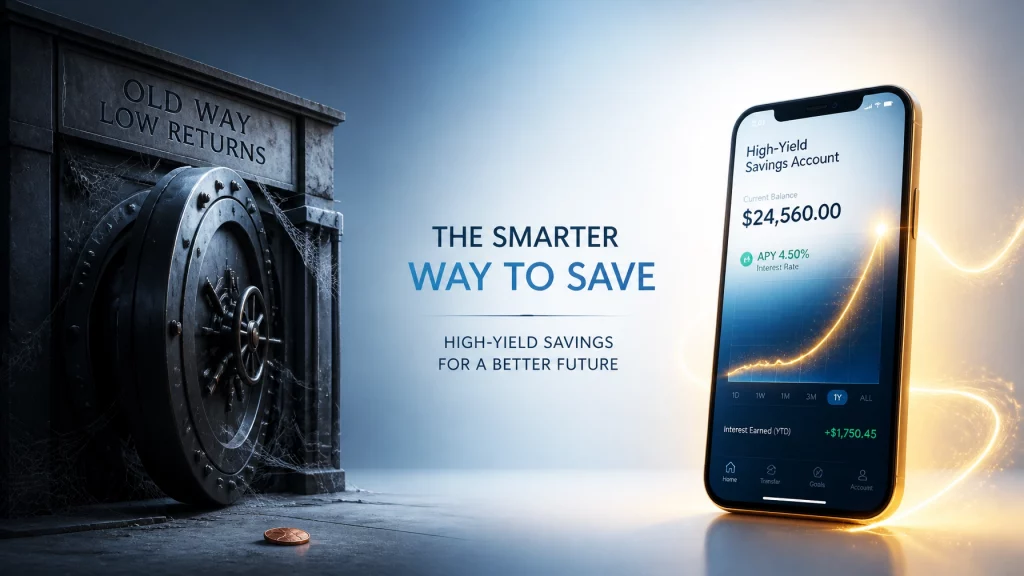
If you’re still keeping your hard-earned emergency fund in a standard savings account at one of the "Big Three" banks, you aren’t just playing it safe: you’re essentially donating your potential wealth to a multi-billion dollar corporation. As of June 19, 2026, the financial landscape has split into two very different worlds: the world of the "Big Banks" that treat your money like a burden, and the world of High-Yield Savings Accounts (HYSAs) that actually pay you for the privilege of holding your cash.
It’s time for a reality check. While you’re out there grinding at your 9-to-5 or managing your latest side hustle, your money is sitting in a vault at Chase, Bank of America, or Wells Fargo, slowly losing value to inflation while returning a microscopic amount of interest. We’re talking about interest rates so low they’re practically an insult.
The Math of the Madness: $1 vs. $400
Let’s look at the cold, hard numbers. As of this week, the average big bank is paying a standard savings rate somewhere between 0.01% and 0.05% APY. To put that into perspective, the national average savings rate is a whopping 0.38%: which is still pathetic, but looks like a gold mine compared to what the giants are offering.

If you park $10,000 in a standard savings account at a big bank paying 0.01%, after one full year of letting them use your money for their own investments, they will reward you with one dollar. That isn't even enough to buy a candy bar in 2026.
Now, look at the other side of the fence. Top-tier High-Yield Savings Accounts are currently paying between 4% and 5% APY. On that same $10,000 balance, you’re looking at $400 to $500 per year in interest. That is a 400x to 500x difference in return for doing absolutely nothing other than changing the digital address of your money. If a friend offered to trade you a dollar bill for four hundred dollars, you’d think they were having a mental breakdown. Yet, millions of Americans make the opposite trade every single day by staying with big banks.
Why Do Big Banks Pay So Little?
You might wonder why these massive institutions, with their marble lobbies and expensive Super Bowl commercials, are so stingy. The answer is simple: because they can be.
Big banks have "sticky" customers. They know that most people are too busy, too tired, or too intimidated by the thought of switching banks to actually move their money. They rely on the convenience of having your checking, savings, mortgage, and credit cards all under one roof. They spend billions on marketing to make you feel like your money is "safer" there, while they use your $10,000 to lend out to someone else at 15% interest on a credit card.
In the world of Regular Guy Economics, we call this the "Convenience Tax." You are paying $399 a year for the "convenience" of seeing a blue or red logo when you log into your app.
The 2026 HYSA Contenders: Who’s Winning?
If you’re ready to stop being a charitable donor to a Fortune 500 bank, you need to know where the yield is hiding. As of June 19, 2026, here are the heavy hitters in the HYSA space:
- Varo Bank: Currently leading the pack with a headline rate of up to 5.00% APY. The catch? That rate only applies to your first $5,000. It’s a great place to start an emergency fund, but once you cross that threshold, you’ll want to look elsewhere for the overflow.
- Axos ONE: A powerhouse for larger balances, offering 4.21% APY. It’s one of the most consistent players in the game right now, providing a high yield without the gimmicky balance caps seen elsewhere.
- CIT Bank: For those with a bit more cushion, CIT is offering 4.10% APY on balances over $5,000. It’s a solid, reliable choice for a fully funded three-to-six-month emergency fund.
- SoFi: Coming in at 3.80% APY, SoFi requires you to have a direct deposit set up to unlock their best rates. If you’re already using them for your primary banking, it’s a no-brainer, but for a pure "park and forget" emergency fund, the 3.80% is slightly behind the market leaders.
Jumping Through the Hoops
Before you go moving your entire life savings, we need to talk about the "fine print." These high rates aren't always a "set it and forget it" situation. The banking world loves its hurdles, and HYSAs are no exception.

Most HYSAs are variable rates. This means if the Federal Reserve decides to cut interest rates next month, your 4.21% could drop to 3.50% overnight. Unlike a CD (Certificate of Deposit), you aren't locking these rates in.
There are also the "Activity Requirements." Some banks, like SoFi, demand a monthly direct deposit of a certain amount. Others, like Varo, have balance caps that drop your interest rate to a measly 0.50% once you exceed a certain limit. And then there are the "Teaser Rates": promotional yields that look great for three months before plummeting back to earth. You have to be watchful. If you aren't checking your statements at least once a quarter, you might find yourself earning "big bank" rates at an online bank.
Is the Switch Worth the Hassle?
Some people argue that for a few hundred dollars a year, the hassle of opening a new account isn't worth it. Let’s dismantle that logic. Opening an online HYSA takes about ten minutes. If it takes you ten minutes to set up an account that earns you an extra $400 a year, you are effectively paying yourself a wage of $2,400 per hour.
Unless you are a world-class neurosurgeon or a professional athlete, that is the most productive ten minutes of your year.
Furthermore, having your emergency fund at a separate bank from your daily checking account creates a "psychological barrier." When your savings are at a different institution, you aren't tempted to "borrow" fifty bucks for a night out just because it’s a quick swipe away in your app. It makes your emergency fund feel like a real insurance policy, not just a backup checking account.
The Final Verdict
The era of loyalty to big banks is over. They have proven, through decades of stagnant rates, that they do not value the "Regular Guy" saver. They value the "Regular Guy" borrower. If you want to build real wealth, you have to stop being the product and start being the customer.
Move your emergency fund. Whether it's Axos, Varo, or CIT, find a place where your money is actually working as hard as you are. The difference between $1 and $400 isn't just math: it's the difference between being a pawn in the financial system and being the person in charge of it.
Check out our latest podcast episodes for more deep dives into how the "big guys" are trying to keep you small, and how you can fight back.
Be mindful, be watchful and good luck.