



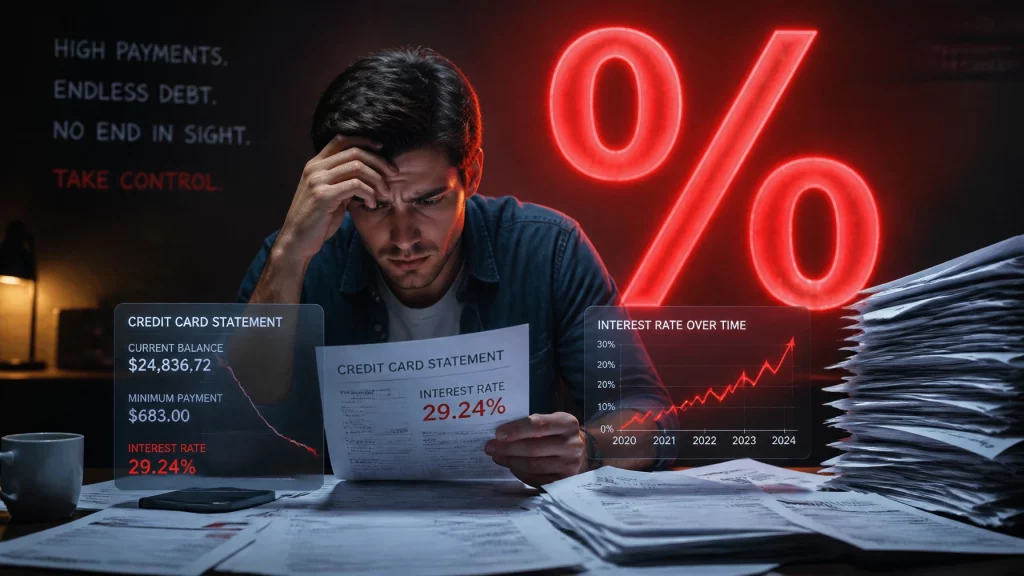
The "free money" era is officially in the rearview mirror. For nearly a decade, the cost of borrowing was so low it felt like a clerical error. But here in June 2026, the landscape has shifted. Interest rates have climbed the mountain and decided to set up camp at the summit. If the debt management strategies being used are still stuck in 2019, money is essentially being set on fire every single month.
Debt isn't just a balance anymore; it’s a living, breathing predator. In a high-interest economy, the math changes. Being a "regular guy" means understanding that the system isn’t designed to help a person get out of debt, it’s designed to keep them paying interest until the heat death of the universe. To break free, the common mistakes that most people are still making need to be addressed with cold, hard logic and a bit of tactical aggression.
Here are the seven most common mistakes people are making with their debt right now, and how to stop the bleeding.
1. Waiting for Rates to Fall
There is a pervasive myth circulating in breakrooms and online forums: "Just hang on, the Fed will cut rates soon, and my credit card interest will drop back to 12%."
This is a dangerous gamble. While the Federal Reserve does occasionally nudge the needle, credit card companies are much faster at raising rates than they are at lowering them. Even if the Fed drops rates by a quarter-point, a credit card sitting at 24.99% APR isn't going to suddenly become "cheap."
Waiting for a macroeconomic miracle is a recipe for stagnation. Every month spent waiting for a rate cut is another month where interest compounds against the principal. In the world of all dollars are debt, time is the most expensive commodity. If action isn't taken today, the debt will be larger tomorrow, regardless of what the Fed Chair says at the next press conference. The best time to kill high-interest debt was yesterday; the second best time is right now.
2. Not Using the "Debt Avalanche" Method

There are two main schools of thought when it comes to paying off debt: the Debt Snowball and the Debt Avalanche. The Snowball focuses on psychological wins by paying off the smallest balances first. The Avalanche focuses on the math by attacking the highest interest rates first.
In a low-interest environment, the difference between the two might be negligible. But in 2026, with some store cards and credit cards hitting 28% or 30% APR, the Avalanche is the only logical choice for anyone who likes keeping their own money.
If there is a $5,000 balance at 24% and a $1,000 balance at 6%, the Snowball says pay off the $1,000 one first. The Avalanche says that $5,000 monster is eating the bank account alive and needs to be slaughtered immediately. By focusing every extra dollar on the highest interest rate, the total amount paid over the life of the debt is minimized. It might take longer to see a "zero balance" on a specific card, but the total net worth will thank the effort much sooner.
3. Not Negotiating with Credit Card Companies

Most people treat their credit card APR like a law of nature. It’s not. It’s a contract, and contracts can be renegotiated.
Banks are currently terrified of defaults. In a high-interest economy, the risk of people simply walking away from their debt increases. This gives the consumer leverage. A simple twenty-minute phone call to the "retention department" can often result in a temporary or even permanent interest rate reduction.
The script is simple: "I’ve been a loyal customer, but my current APR is making it difficult to maintain my payments. I’ve seen offers from other banks for much lower rates. What can you do to help me stay with you?"
If they say no, ask again. If they still say no, ask for a supervisor. The worst-case scenario is they say no and nothing changes. The best-case scenario is a 5% drop in APR, which could save thousands of dollars over the next year. Not making that call is essentially leaving free money on the table for a multi-billion dollar bank.
4. Ignoring 0% Balance Transfer Offers
While interest rates are high, the war for new customers among banks is still raging. 0% APR balance transfer offers are the "Get Out of Jail Free" cards of the financial world: if they are used correctly.
Many people ignore these offers because they don't want "another credit card." This is a mistake. Moving a $10,000 balance from a 24% card to a 0% card for 18 months is an immediate 24% return on investment. Even with a 3% or 5% transfer fee, the math is overwhelmingly in favor of the consumer.
The trap, of course, is using the newly cleared card to buy more stuff. A balance transfer is a tactical maneuver, not a license to spend. It buys 12 to 18 months of breathing room where 100% of every payment goes toward the principal. In a high-interest economy, that kind of leverage is a superpower.
5. Skipping a 401(k) Match to Pay Down Debt

There is a school of "hardcore" debt payoff that suggests stopping all retirement contributions until the debt is gone. In 2026, this is often bad advice: specifically if there is an employer match involved.
An employer match is a 100% return on investment. Even the most predatory credit card at 30% APR cannot compete with a 100% guaranteed return. By skipping the match, the "free money" part of a compensation package is being forfeited.
The strategy should be:
- Contribute enough to get the full employer match.
- Direct every other spare penny to the high-interest debt.
- Once the high-interest debt is gone, ramp up the 401(k) or IRA contributions.
Treat the 401(k) match as a non-negotiable part of the income. It is the only place in the financial system where the "regular guy" actually has the house odds in their favor.
6. Not Having a Small Emergency Buffer

It sounds counterintuitive to put money into a savings account earning 4.5% while carrying debt at 20%. Mathematically, it feels wrong. But behaviorally, it is essential.
The number one reason people fail at debt payoff isn't a lack of math skills; it’s life. A flat tire, a broken water heater, or a sudden medical bill happens. Without a small emergency buffer: even just $1,000 to $2,000: that emergency goes straight back onto the high-interest credit card.
This creates a "one step forward, two steps back" cycle that is psychologically devastating. Having a small pile of cash sitting in a high-yield savings account acts as a firewall. It protects the debt payoff plan from the chaos of everyday life. It’s not about the interest rate on the savings; it’s about the insurance policy against new debt.
7. Adding New Debt While Paying Off Old Balances
This is the "leaky bucket" syndrome. It is impossible to empty a bucket of water if there is a hose at the top constantly filling it back up.
In a high-interest economy, the cost of "lifestyle creep" is magnified. Financing a new truck, putting a vacation on a "Buy Now, Pay Later" plan, or using a store card for a "discount" while carrying a balance elsewhere is financial self-sabotage.
The mindset must shift from "How much is the monthly payment?" to "How much is this actually costing me?" Every new dollar of debt taken on today is a dollar that will be paid back with 2026-level interest rates. If the goal is freedom, the first step is to stop digging the hole. Put the cards in a drawer, delete the saved payment info from the browser, and live on what is actually in the bank account.
The path to financial sanity isn't complicated, but it is difficult. It requires ignoring the marketing, ignoring the "easy" path, and looking at the numbers for what they really are. For more deep dives into the madness of modern finance, check out the Regular Guy Economics podcast.
Be mindful, be watchful and good luck.