



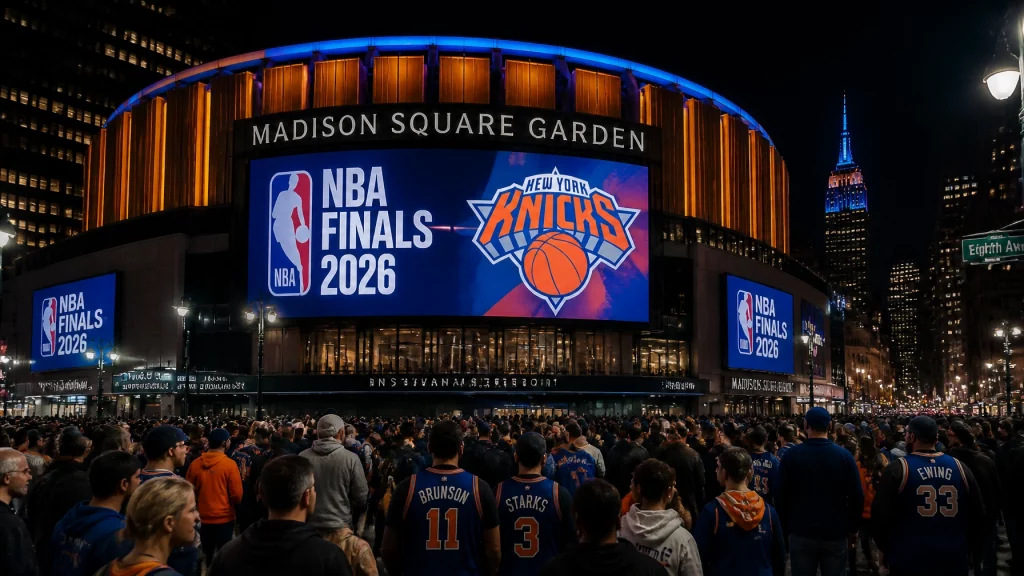
It’s been twenty-seven years. Twenty-seven years of "next year is our year," twenty-seven years of Draft Lottery heartbreak, and twenty-seven years of watching other cities throw parades while we argued about who was the better point guard, Stephon Marbury or Jeremy Lin. But today, Monday, June 8, 2026, the vibe in New York City is different. The air smells like roasted nuts, subway grease, and… victory?
The New York Knicks are in the NBA Finals. If you’re a fan like me, you’ve probably already lost your voice and your bank account balance is looking a little "low fuel light" because of the sheer amount of merchandise you’ve bought. But as we watch Jalen Brunson and the squad take on the Spurs, it’s worth stepping back to look at the madness through the lens of a "Regular Guy" economist.
Because while we see a championship chase, the city sees a giant ATM. Specifically, a $465 million ATM.
The Big Number: Breaking Down the $465 Million
The NYC Economic Development Corporation (NYCEDC) isn't just watching the box score; they’re watching the tax revenue. According to recent projections, if this series goes the distance and we get the maximum number of home games, the Knicks’ 2026 postseason run will generate roughly $465 million in total economic activity for the city.
Let that sink in. A orange ball going through a hoop is responsible for nearly half a billion dollars in movement.
But where is that money coming from? It’s not just James Dolan’s pocket. The postseason had already pumped $202 million into the local economy before the Finals even tipped off. Now that we’re in the big dance, each single home game at Madison Square Garden is estimated to be worth roughly $90 million to the city.

The Ticket Shock: $5,000 for the Nosebleeds?
If you were hoping to snag a seat at the Garden to witness history, I hope you’ve been aggressive with your 401(k) contributions. The "get-in" price, the absolute cheapest, highest, "you-need-binoculars-to-see-the-court" seat, is currently hovering between $4,000 and $5,000 on the secondary market.
To put that in perspective, while we’ve talked about why prices are still so high across the board, the inflation in the sports world is on another planet. Back in 1999, the last time the Knicks were in the Finals, a courtside seat was about $2,000. Today? A comparable courtside seat at MSG for the 2026 Finals can command upwards of $200,000.
For the price of one courtside seat, you could buy a decent house in most parts of the country, or at least a very nice parking spot in Manhattan. This is the "Madison Square Garden Premium" at its most extreme. Even the watch party tickets, where you sit in the arena just to watch the game on the jumbotron, are being resold for over $100.
The Multiplier Effect: Why the Whole City Wins
You might be thinking, "John, I'm not paying five grand for a ticket, so how does this help me?" This is where we talk about the Multiplier Effect.
Economics isn't just about the first transaction; it's about the second, third, and fourth. When a tourist from out of town (or a wealthy hedge fund guy from Greenwich) drops $5,000 on a ticket, that’s just the start. They also:
- Pay for a hotel room near Penn Station.
- Eat a $150 steak dinner before the game.
- Take three Ubers because they don't want to sweat in a jersey on the 1-train.
- Buy a "Finals Edition" hat for $45.

That money then filters down. The hotel needs more staff to handle the influx of guests. The steakhouse buys more beef from its supplier. The Uber driver makes double his usual tips and uses that extra cash to buy a new laptop for his kid or pay off a credit card.
In NYC, roughly 11% of the workforce is in hospitality, that’s over 440,000 people. For them, a Knicks Finals run isn't just a sports highlight; it's a bonus check. Extra shifts, higher tips, and more job security. Even in a year where we've seen headlines about AI taking over jobs, the human element of pouring a beer at a crowded bar or checking someone into a hotel is still the backbone of this $465 million spike.
NYC vs. San Antonio: A Tale of Two Cities
It’s also fascinating to see the economic disparity between the two Finals cities. While a seat at MSG starts at $4,000+, you can "get in the building" in San Antonio for about $700 to $1,000.
Now, I love the Spurs (not this week, obviously), but this perfectly illustrates why New York is the economic engine of the NBA. The density of wealth and the sheer demand for "the experience" of Madison Square Garden creates a pricing floor that is 4 to 6 times higher than almost anywhere else in the world. It’s a supply and demand nightmare for the fan, but a dream for the city’s tax coffers.

The Hidden Cost: The "Vibe" Economy
There’s one more economic factor we have to consider: Productivity.
Let’s be honest, how much work is actually getting done in the five boroughs today? Productivity probably takes a 15% hit every time the Knicks win a series. People are taking longer lunches to talk about rotations, leaving early to catch the pre-game show, and spending half their morning on secondary ticket sites trying to justify a "once-in-a-lifetime" purchase.
But there’s a counter-argument to that. Happy people are more engaged. A city that feels like it’s winning together has a psychological boost that’s hard to put a dollar sign on. It’s the ultimate "feel-good" stimulus package. After 27 years of waiting, the collective joy of New Yorkers might actually be the most valuable part of that $465 million.
The Bottom Line
Whether the Knicks lift the trophy or not (please, basketball gods, let them lift it), the economic reality of the 2026 NBA Finals is a slam dunk for New York. We are seeing a massive redistribution of wealth from high-net-worth individuals and tourists into the pockets of everyday New Yorkers: the bartenders, the transit workers, and the small business owners.
So, if you’re at the bar tonight, buy an extra round. You’re not just celebrating; you’re participating in the multiplier effect. You’re a regular guy doing your part for the macroeconomy.
Go Knicks.
Be mindful, be watchful and good luck.