



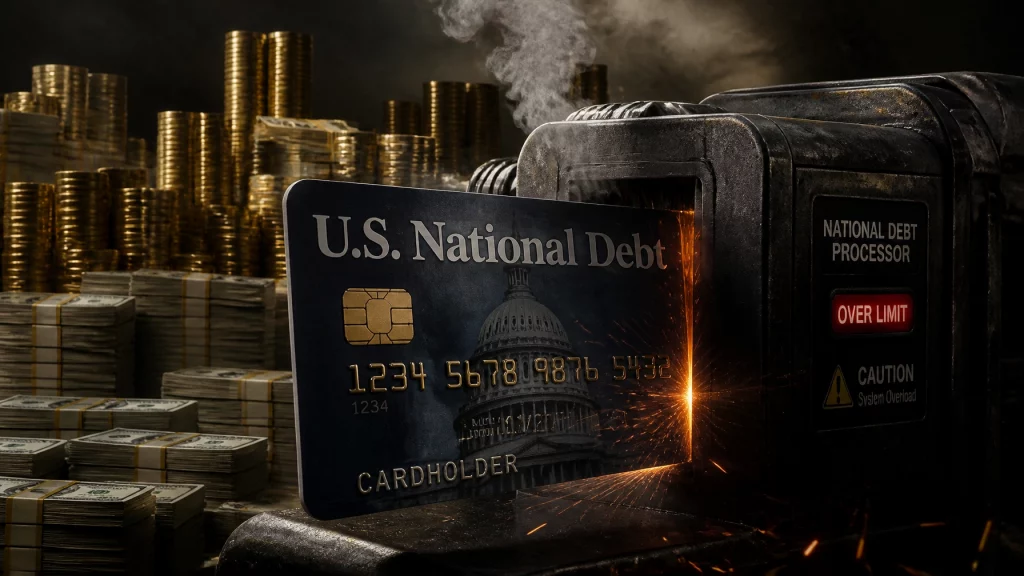
Listen, I know what you’re thinking. “National debt? John, I’d rather watch paint dry in a room full of mimes.” I get it. The mainstream news makes this stuff sound like a graduate-level physics problem where the answer is always “everyone is doomed.”
But here at Regular Guy Economics, we don’t do mimes, and we don’t do boring. We do math on the back of a beer coaster.
The national debt is just a giant credit card. The problem isn’t just how much we’ve swiped; it’s that the "interest rate" on that card just jumped, and the "minimum payment" is starting to eat our lunch.
Let’s break it down in under three minutes before your coffee gets cold.
1. The $34 Trillion Credit Card
Imagine your neighbor, let's call him Uncle Sam. Sam is a great guy, but he’s a shopaholic. For years, Sam has been spending more than he makes. To cover the gap, he pulls out a shiny plastic card and swipes.
As of right now, that balance is sitting at roughly $34 trillion.

For a long time, Sam didn’t care. Why? Because the interest rate on his card was basically zero. It’s like having a million-dollar debt but only having to pay $5 a month in interest. You’d keep swiping too, right?
But the "teaser rate" period is over.
2. The Math: Why $1 Trillion Matters
Here is the "Regular Guy" math you need to know for 2026.
The government doesn’t just "have" debt; it has to service it. That’s a fancy word for making the minimum interest payment so the bank (the bond market) doesn't come for the house.
In 1960, medical costs were five percent of our GDP. Today, interest on the debt is heading toward that same kind of "runaway train" territory. In 2026, the interest payment alone is projected to hit $1 trillion.
Let that sink in. We aren't paying off the $34 trillion. We are just paying the interest on it.
The Quick Math:
- Total Public Debt: ~$30.3 Trillion
- Average Interest Rate: ~3.3%
- Annual Interest Bill: $1,000,000,000,000 (That's 12 zeros, folks).
To put that in perspective, that’s about $2.8 billion per day just to keep the lights on. That is money that isn’t going to schools, roads, or lowering your taxes. It’s just… poof. Gone to the lenders. You can check out more on how these trends affect our daily lives in our General Category.
3. The "Rollover" Trap (The Real Danger)
This is the part that confuses people, but it’s actually simple. The government doesn’t just take out one big loan. It takes out thousands of small ones (Treasury Bonds) that last for different amounts of time, some for 2 years, some for 10, some for 30.
When an old 2-year loan from 2024 expires, the government has to pay it back. But since they don't have the cash, they "roll it over" by taking out a new loan.

Here’s the catch:
The old loans might have had a 1% interest rate. The new loans are being issued at Treasury yields of 4% or 5%.
It’s like your credit card company calling you up and saying, "Hey, that 1% balance transfer you did? It just expired. Your new rate is 5%." Suddenly, even if you don't spend another dime, your monthly bill triples.
That is exactly what is happening to the U.S. budget right now. As the old, cheap debt "rolls over" into new, expensive debt, the interest bill explodes.
4. Why Should the "Regular Guy" Care?
You might think, "Hey, it’s Sam’s problem, not mine." But we all live in Sam’s house.
When the interest payment hits $1 trillion, it starts to crowd out everything else. According to the Peter G. Peterson Foundation, interest is now taking up nearly 20% of all federal revenue.
Imagine if 20% of your paycheck went to interest on your credit card before you even bought groceries or paid rent. You’d have two choices:
- Stop Spending: (The government isn't great at this).
- Print Money: Which leads to inflation (making your groceries more expensive).
- Raise Taxes: (Making your paycheck smaller).
This is why we talk about this on our podcasts. It’s not just a big number on a screen in D.C. It’s a weight on the entire economy.

The Bottom Line
The math of the national debt has shifted from "future problem" to "right now problem." With Treasury yields staying higher for longer, the cost of our national "minimum payment" is now one of the biggest items in the budget.
We don't need to be economists to see that you can't swipe the card forever: especially when the interest rate just quadrupled.
Be mindful, be watchful and good luck.