



We’ve all been there. You’re sitting on the couch, the news ticker at the bottom of the screen announces a major ceasefire: let's say the April 8th one we just saw: and the price of a barrel of crude oil takes a nosedive. You think to yourself, "Great, I can finally fill up the truck without taking out a second mortgage."
Then you drive past the local Shell or Exxon the next morning, and the sign is still screaming $4.45 a gallon. You wait three days. Still $4.45. You wait a week. Maybe, if you’re lucky, it drops to $4.42. Meanwhile, the EIA (Energy Information Administration) is out there promising us $3.00 gas by the end of the year.
It feels like a scam, doesn't it? When tension breaks out in the Middle East or a pipeline gets a sneeze, gas prices jump twenty cents before the news anchor even finishes their sentence. But when things calm down? The price moves with the urgency of a teenager cleaning their room.
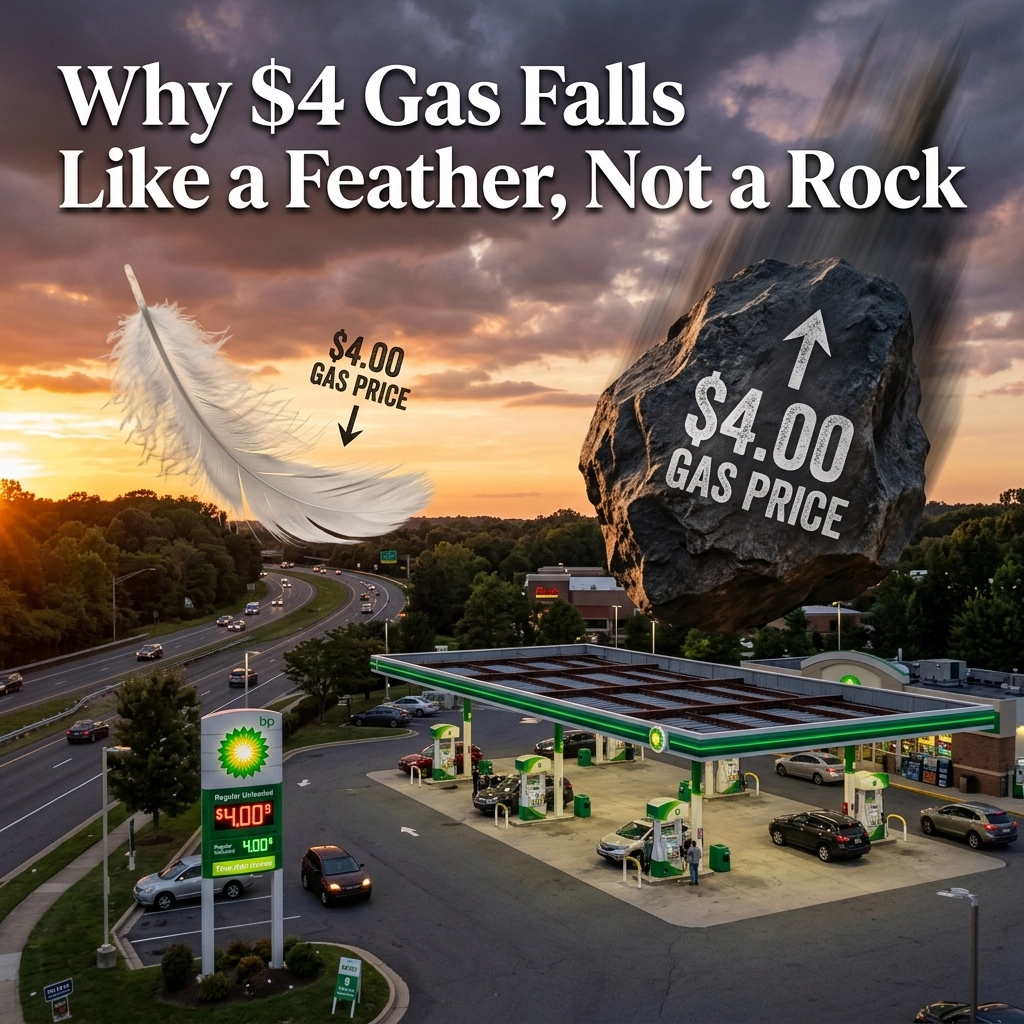
In economics, we call this the "Rockets and Feathers" theory. Prices rise like rockets and fall like feathers. Today, we’re going to look under the hood of your local gas station to figure out why your wallet is still feeling the squeeze even when the "crisis" is technically over.
The Asymmetry of Pain
The "Rockets and Feathers" phenomenon isn't just a feeling you have; it’s a documented economic reality. When input costs (like crude oil) go up, retailers are incredibly fast to pass that cost onto you. Why? Because if they don't, they lose money on every gallon sold. But when crude oil prices drop, that same urgency disappears.
Think about it from the perspective of the guy running the station. If he knows the next truckload of gas is going to cost him more than the last one, he has to raise his prices immediately to make sure he has enough cash to buy that next shipment. If he waits, he’s underwater.
But when the price of the next shipment goes down, he’s in no rush. He’s sitting on an underground tank full of "expensive" gas that he already paid for. Selling it at a lower price would mean eating a loss. So, he waits. He waits until that tank is empty and the new, cheaper gas arrives. And even then, he might wait a little longer just to see if his competitor across the street is going to blink first.

The Inventory Lag: The "Milk in the Fridge" Problem
To understand why $4.45 stays stuck on the sign, you have to understand the journey of a gallon of gas. It isn't a straight line from the oil well to your tank.
Even though we had a ceasefire on April 8th, the Strait of Hormuz: that tiny, vital chokepoint for global oil: is still operating well below pre-war levels. There’s a massive backlog. Just because the shooting stops doesn't mean the tankers immediately start flowing at 100% capacity. There is a physical "slug" of expensive oil that is still working its way through the global system.
Refineries bought that expensive oil weeks ago. They turned it into gasoline and sold it to distributors. Those distributors put it in trucks and delivered it to your local station. Your local station owner paid the high "war-time" price for that inventory.
Imagine you bought a gallon of milk for $5.00 yesterday. Today, the grocery store announces a sale where milk is now $3.00. You aren't going to sell the milk in your fridge to your neighbor for $3.00; you’re going to finish your $5.00 milk first. Gas stations do the same thing. This "inventory lag" usually takes about one to two weeks to clear out, and that's if everything else goes perfectly.
The Search for the "Sweet Spot"
There’s also a psychological component here. As consumers, we are surprisingly "sticky" with our habits. When gas hits $4.45, we grumble, we complain, but we still go to work. We still take the kids to soccer. We adjust our budgets.
The gas station owners know this. If the market has "accepted" $4.45, and the guy across the street is still at $4.45, there is very little incentive for anyone to drop the price to $3.99 overnight.
Retailers use this period of falling wholesale prices to "recoup" their margins. See, when gas prices are skyrocketing, station owners actually make less profit per gallon. They’re trying to keep the price just low enough that you don't riot, which often means they squeeze their own margins. When the wholesale price finally drops, they keep the pump price high for a few extra days or weeks to make up for the money they lost during the spike.
It’s the one time the "Regular Guy" station owner actually gets to see a decent profit margin, and they aren't going to give it up until the market forces them to.
Taxes and Fixed Costs: The Floor Beneath the Feather
Another reason gas won't just "drop like a rock" back to $2.00 is that a huge chunk of what you pay isn't actually for the gas.
No matter how low the price of crude oil goes, the government still wants its cut. You’ve got federal excise taxes, state taxes, and often local county taxes. On top of that, you have the "distribution and marketing" costs. The guy driving the tanker truck didn't get a pay cut just because there’s a ceasefire in the Middle East. In fact, with diesel prices hovering around $5.50 (thanks to refinery constraints), the cost of actually delivering the gas is higher than ever.
When you look at a $4.45 gallon of gas, roughly $0.50 to $1.20 of that (depending on your state) is fixed costs that will never go down. This creates a "floor." Even if oil went to zero, you'd still be paying a couple of bucks just for the taxes and the truck driver.

What Does This Mean for Your Wallet?
The EIA might be projecting $3.00 gas by year-end, but for the average household, that feels like a fairy tale. If you’re driving a standard SUV with a 20-gallon tank, the difference between $4.45 and $3.00 is $29.00 per fill-up. For a family that fills up once a week, that’s over $115 a month.
But here’s the reality check: you won’t see that $115 in "savings" for a long time. Because of the feather-like drop, your "savings" will trickle in. First, it’ll be $2 cheaper per tank. Then $5. By the time you’re actually saving the full $29, something else will probably have happened in the world to send the rocket back up again.
This is why "budgeting for the average" is a trap for the Regular Guy. If you build your monthly budget assuming the EIA's $3.00 projection is coming next month, you’re going to end up short. You have to budget for the $4.45 reality and treat any drop as a surprise bonus, not a guaranteed right.
The Refining Squeeze
We also have to talk about the "Refinery Gap." Even if we have plenty of crude oil, we don't have enough refineries running at peak efficiency. Many US refineries are aging, and others have been converted to "green" fuels or shut down entirely.
When a refinery goes offline for maintenance: which many do in the spring to switch from "winter blend" to "summer blend" gas: the supply of finished gasoline drops, regardless of how much crude oil is sitting in tanks. This switch-over usually happens right around now, adding another layer of "stickiness" to that $4.45 price point. The summer blend is more expensive to produce because it has to be less volatile to prevent smog in the heat. So, just as the "war premium" is leaving the price, the "summer blend premium" is walking in the back door.
How to Play the Game
Since we know the price is going to fall slowly, how do you manage it?
- Don’t Top Off on the Way Down: If you see prices starting to tick down (the feather is falling), don't fill up the whole tank. Buy just what you need for a few days. Why lock in 20 gallons at $4.35 if it might be $4.25 in three days?
- Use the Apps: GasBuddy and other trackers are your best friend during a "feather" period. Because different stations have different inventory cycles, you might find a station three blocks away that just got a new shipment of "cheap" gas and dropped their price by 15 cents, while your usual spot is still holding out.
- Watch the Diesel: If you want to know when your grocery prices might start to ease up, watch the diesel sign. Diesel at $5.50 is the real killer for the economy. It’s what powers the ships, the trains, and the trucks. Even if your gas drops, your bread and milk prices stay high as long as diesel is in the stratosphere.
The "Rockets and Feathers" story is a reminder that the economy isn't a clean, mathematical machine. It’s a messy system full of psychological stand-offs, logistical nightmares, and a lot of people trying to protect their bottom line.
The $4 gas isn't going away tomorrow. It’s going to float down, slowly, catching every breeze of bad news on the way. Don’t wait for the rock to fall: it isn't coming.
Be mindful, be watchful and good luck.