



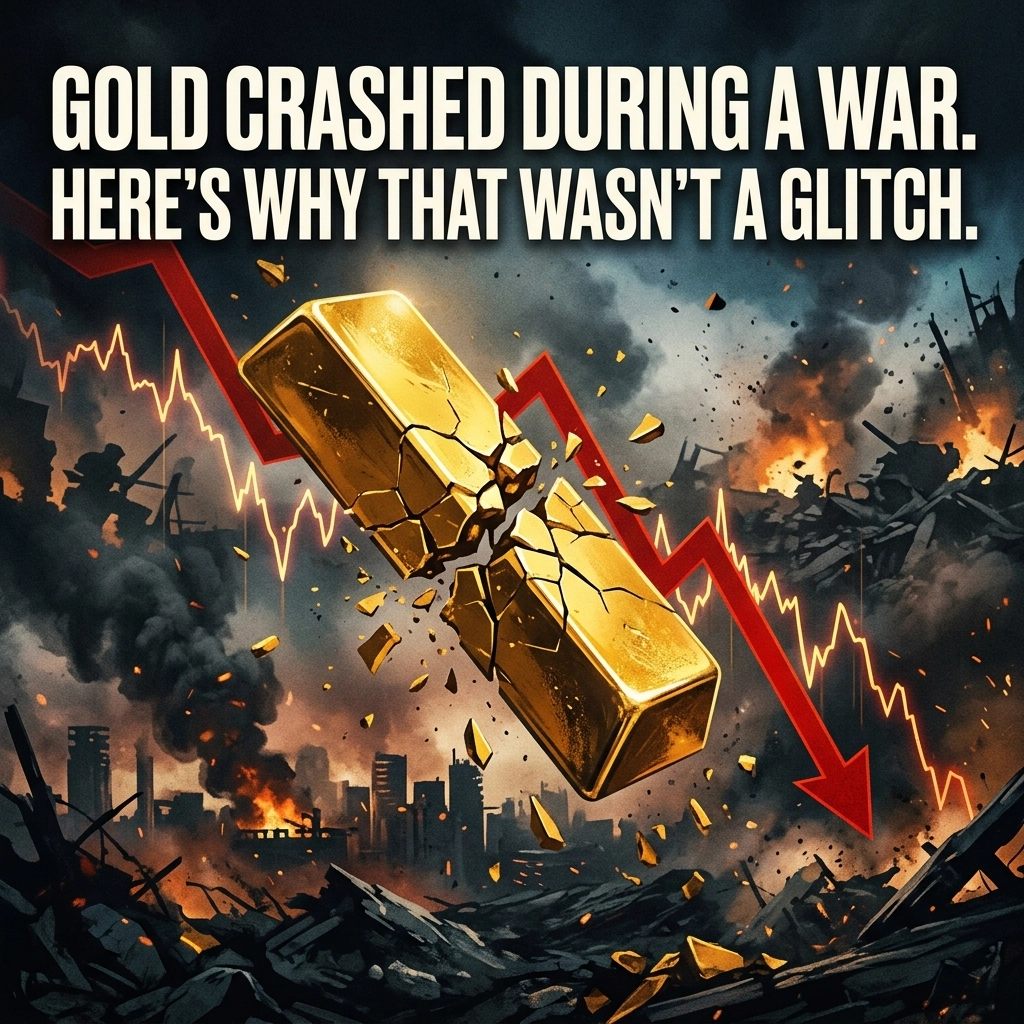
If you follow the "Old School" rules of investing, you probably feel like you just got punched in the gut. The world is currently a powder keg. We’ve seen strikes on Persian Gulf energy facilities, the Strait of Hormuz is essentially a "no-go" zone for half the world's tankers, and gas prices just kissed $4.45 a gallon.
In every financial textbook written since the Nixon administration, this scenario has one inevitable outcome: Gold goes to the moon.
Back in January, it looked like the textbooks were right. Gold hit a staggering record of $5,595 an ounce. People were high-fiving in the comments sections of survivalist blogs. But then, as the war in the Middle East actually intensified and supply shocks became a daily headline, something "impossible" happened. Gold didn’t just dip; it cratered. It fell 25%, sliding all the way down to the $4,100 range.
If you’re a regular guy holding a bit of gold, or even just a target-date fund that allocates a slice to "precious metals" for safety, you’re probably asking: What the heck happened?
This wasn’t a glitch in the Matrix. It was a brutal lesson in how the modern financial plumbing actually works. It turns out that in 2026, "Safe Haven" doesn’t mean what you think it means.
The Oil Paradox: Why Energy Spikes Killed the Gold Bid
To understand why gold failed, you have to look at the gas pump.
Normally, war creates uncertainty, and uncertainty makes people buy gold. But this war is happening in the world’s gas station. When those energy facilities in the Gulf took hits, the price of crude didn't just rise; it exploded. That ripple effect hit everything from your grocery bill to the cost of shipping a vibrator from Amazon.

Here is the chain reaction that broke gold’s back:
- War/Oil Spikes: Energy costs soar.
- Inflation Expectations: Higher oil means inflation isn't "transitory" or "cooling", it’s accelerating again.
- The Fed’s Hammer: The Federal Reserve looks at $4.50 gas and realizes they can’t cut interest rates. In fact, they have to signal that rates are staying "higher for longer" to keep the economy from melting down.
- The Yield Gap: Treasury yields (the interest the government pays you to borrow your money) shot up to 4.5% and higher.
This is where the math kills the gold bug. Gold is a shiny rock. It doesn't pay a dividend. It doesn't pay interest. In fact, if you own physical gold, it actually costs you money for insurance and storage. When you can get a "risk-free" 4.5% or 5% return from Uncle Sam by holding a Treasury bond, the opportunity cost of holding gold becomes too high.
Investors looked at the world and said, "Sure, there’s a war, but I can make 5% in cash while I wait it out." They dumped the gold and chased the yield.
The "Safe Haven" Identity Crisis
We’ve been told for decades that gold is the ultimate insurance policy. But here’s the reality of the 2026 market: Gold isn't a hedge against war; it’s a hedge against low interest rates.
In the financial world, we call this being "rate-sensitive." When interest rates are zero, gold looks like a genius move. When interest rates are high, gold looks like a pet rock that eats your lunch money.
In this crisis, the "Safe Haven" bid didn't go to gold. It went to the US Dollar. Because the US is currently the world’s largest oil producer and sits behind two oceans, the dollar became the ultimate bunker. As the dollar got stronger, gold (which is priced in dollars) naturally became more expensive for everyone else in the world to buy, which further suppressed the price.
Margin Calls: When the "Rich Guys" Get Forced to Sell
There’s another, more mechanical reason gold collapsed: the dreaded Margin Call.
Back in February and March, as the war started hitting the stock market and other sectors, a lot of big-time traders and hedge funds started losing money on their "risky" bets. In the world of high-finance, when you lose money on one trade, your broker calls you up and demands more cash to keep your other trades open.
If you don't have the cash sitting under your mattress, you have to sell whatever you have that’s still worth something. Gold is highly "liquid," meaning you can sell billions of dollars of it in a heartbeat.

We saw a massive wave of "forced liquidation." This wasn't people selling gold because they stopped believing in it; it was people selling gold because they had to pay their bills elsewhere. The CME (Chicago Mercantile Exchange) even hiked margin requirements, making it even more expensive to hold gold positions.
Think of it like this: If your house is on fire and you need to pay the firemen to stay, you’re going to sell your wedding ring first because it’s the easiest thing to turn into cash. That’s exactly what the global markets did to gold.
The 401k Reality Check
For the regular guy looking at his retirement account, this is a wake-up call about "Passive Investing." Most of us own target-date funds or S&P 500 trackers. Those funds often have a tiny sliver of gold or "commodities" tucked away for a rainy day.
When that rainy day: a literal war: finally arrived, that "insurance" failed. Why? Because the algorithms that run the modern market are programmed to prioritize yields and liquidity over historical sentiment.
If you’re holding gold as a "doomsday" hedge, it might still have value in a world where the electrical grid goes down and we’re bartering for goats. But in a world where the financial system is still standing, gold is just another line on a spreadsheet. And right now, that line is competing with 4.5% Treasury yields.
The Lesson: Don't Buy the Hype, Buy the Math
The takeaway here isn't that gold is worthless. It’s that you have to understand the environment you’re in.
If we were in a war AND the Fed was printing money like crazy to fund it (causing rates to drop), gold would be at $7,000 right now. But we are in a war where the Fed is fighting inflation with high rates. That is a toxic environment for gold.

The "Regular Guy" lesson is simple:
- Safe Haven doesn't mean "Always Goes Up." It means it behaves differently than the stock market.
- Watch the 10-Year Treasury Yield. If that number is going up, gold is likely going down, no matter what’s happening in the news.
- Liquidity is a double-edged sword. The fact that gold is easy to sell means it's the first thing to get dumped when the big players panic.
We’re living through a weird era where the old rules are being rewritten in real-time. The $153 billion in additional 2026 funding the Pentagon is asking for means the government needs to borrow more money. To get people to lend them that money, they have to keep interest rates high.
As long as those rates stay high, that yellow rock in your safe: or in your ETF: is going to have a hard time catching a breeze. It’s not a glitch; it’s just the new math of the 2020s.
Be mindful, be watchful and good luck.