



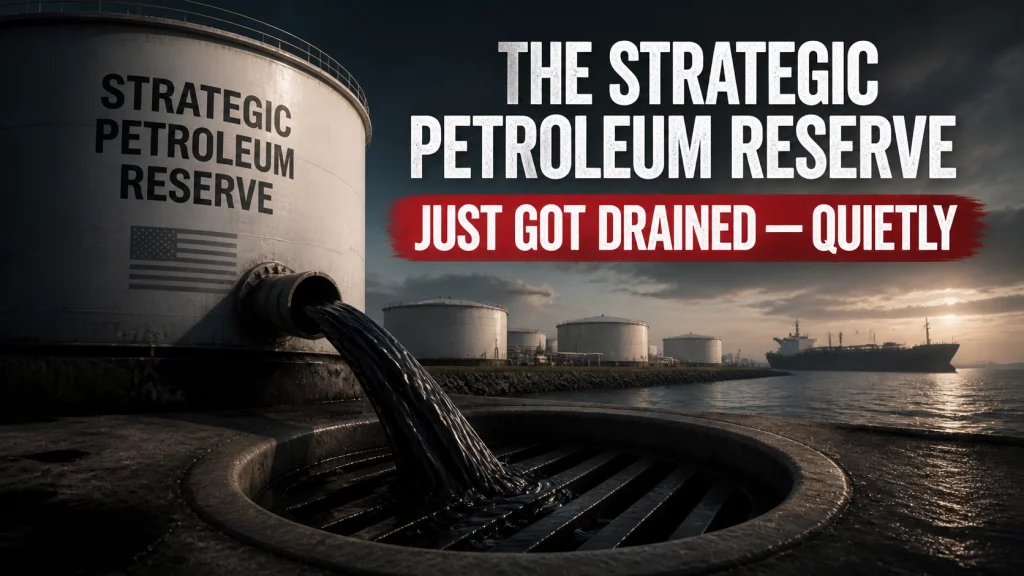
The dust is finally starting to settle after the April 8 ceasefire, but if you’ve pulled up to a Sunoco lately, you know the "peace dividend" hasn't exactly hit your wallet yet. Gas was sitting at a nasty $4.45 last weekend. While the talking heads on the news are celebrating the end of the latest Middle East flare-up, there’s a much quieter, much more dangerous story unfolding in the background.
Between March 20 and April 24, while everyone was glued to the headlines about the Strait of Hormuz and Tomahawk counts, the Department of Energy (DOE) quietly tapped the keg. They released 17.5 million barrels of oil from the Strategic Petroleum Reserve (SPR).
To the average guy, "17.5 million" sounds like a number made up for a sci-fi movie. But in the world of global energy, it’s a desperate move. It’s the equivalent of selling your emergency generator to pay the electric bill. We need to talk about why this happened, why it’s being done "quietly," and why your personal "emergency fund" math is about to get a whole lot more complicated.
What is the SPR, Anyway?
Think of the Strategic Petroleum Reserve as the nation's ultimate "Break Glass in Case of War" box. It’s a series of massive salt caverns deep underground in Louisiana and Texas. Since the 1970s, it’s been the security blanket that ensures if the world goes crazy and the oil stops flowing from overseas, the U.S. has enough crude to keep the lights on and the trucks moving for a while.
In its prime, this thing held over 700 million barrels. It was the envy of the world. But lately, the government has been treating it less like a strategic asset and more like a political slush fund.
When gas prices spike and voters get grumpy, the easiest lever for a politician to pull is an SPR release. It floods the market with a little extra supply, brings the price down a few cents for a week or two, and makes it look like "something is being done." But here’s the kicker: that oil doesn't just reappear by magic.

The 17.5 Million Barrel Band-Aid
The recent release of 17.5 million barrels was a calculated move to keep the national average from crossing the psychological $5.00 mark during the height of the recent conflict. The Strait of Hormuz is still operating well below its pre-war levels, and even with the ceasefire, the "risk premium" on oil is baked in.
The EIA is out here projecting $3.00 gas by the end of the year, which sounds great on a PowerPoint slide in D.C. But out here in the real world, fuel prices "rise like rockets and fall like feathers." Even if oil prices drop tomorrow, it takes 1-2 months for that relief to hit your local pump because of refinery inventory cycles and distribution lags.
By draining 17.5 million barrels now, the government is trying to force the "feather" to fall a little faster. But they’re doing it from a position of extreme weakness. We were already at 40-year lows because of the massive drawdowns in 2022. We’re essentially trying to fight a 2026 fire with a bucket that’s already three-quarters empty.
The Household Emergency Fund Analogy
Let’s bring this down to "Regular Guy" terms. Imagine your family has an emergency fund. You’ve worked hard to save $10,000 for "The Big One", the roof caves in, the transmission dies, or a medical emergency hits.
But then, the price of eggs goes up. You don't want to change your lifestyle, so you take $200 out of the emergency fund to cover groceries. Then the cable bill goes up, and you take another $300. Then your kid wants a new gaming PC, and you justify it by saying, "Well, I'll just put the money back later when things are cheaper."
Before you know it, your $10,000 safety net is down to $2,500.
Then: and this is the part that should keep you up at night: a hurricane actually hits. Your roof is gone. You go to the bank, and there's nothing left. You’ve spent your "survival money" on "convenience problems."
That is exactly what the U.S. government is doing with the SPR. They are using "survival oil" to fix "inconvenience prices" at the pump. The 17.5 million barrels they just let go weren't used to fuel a war effort; they were used to manipulate the CPI (Consumer Price Index) and keep the headlines from looking too scary.

The Math of the "Quiet Drain"
Here’s where it gets really ugly for the taxpayer. When the government drains the SPR, they are selling oil. Usually, they sell it when prices are high (to "lower" them). But they eventually have to buy it back to refill the caverns.
If you sell your emergency stash at $80 and then have to refill it at $95 because the world stays unstable, you’re losing billions of taxpayer dollars. It’s the ultimate "buy high, sell low" strategy.
Furthermore, the physical infrastructure of the SPR is taking a hit. These salt caverns weren't designed to be cycled like a local gas station tank. Every time you pull oil out and push water in (which is how the extraction works), you risk damaging the integrity of the cavern. Reports are already circulating about structural damage requiring hundreds of millions in repairs.
We are literally breaking our safety net to save twenty cents a gallon for a month.
What Happens if a Real Shock Hits?
The April 8 ceasefire is a relief, sure. But look at the map. The Middle East is a tinderbox. If another "bad night over Tehran" happens: or if a major refinery on the Gulf Coast gets hit by a Category 5 hurricane this summer: we are walking into the storm with no umbrella.
If we had a full SPR, we could weather a total cutoff of Middle Eastern oil for months. With the reserve at these levels, we’d be lucky to last a few weeks before we’re looking at $8.00 gas and rationing.
This isn't just "economics." This is national security. When you hear the phrase "energy independence," remember that it’s not just about how much you pump; it’s about how much you keep.
The "Quiet" Part is the Problem
The reason this was done "quietly" is that nobody wants to defend it. It’s hard to stand on a podium and say, "We’re emptying the emergency vault because we’re afraid of the June inflation numbers."
Instead, they release the data in Friday afternoon DOE reports, hoping the "Regular Guy" is too busy thinking about the weekend to notice that his country’s insurance policy just got canceled.
Most Americans are living paycheck to paycheck right now. Over 60% of us don't have $500 for an emergency. We are a nation of people with no safety net, being led by a government that is systematically dismantling the nation's safety net.

The Bottom Line for Your Wallet
So, what does this mean for you?
- Don't trust the "fall." If gas prices dip this month, don't assume the "crisis" is over. It’s an artificial dip fueled by the SPR drain.
- Watch the refill. Keep an eye on whether the DOE actually starts buying oil back. If they don't, it means they’re betting everything on nothing going wrong for the rest of the year. That’s a bad bet.
- Check your own SPR. If the government isn't going to maintain an emergency fund, you absolutely have to. The "Strategic Petroleum Reserve" for your house is your savings account and a full pantry.
We’re living in a "just-in-time" economy where the margin for error has been erased. The government just used 17.5 million barrels of our collective margin for error to buy a few weeks of quiet.
It was a bad trade.
Be mindful, be watchful and good luck!