



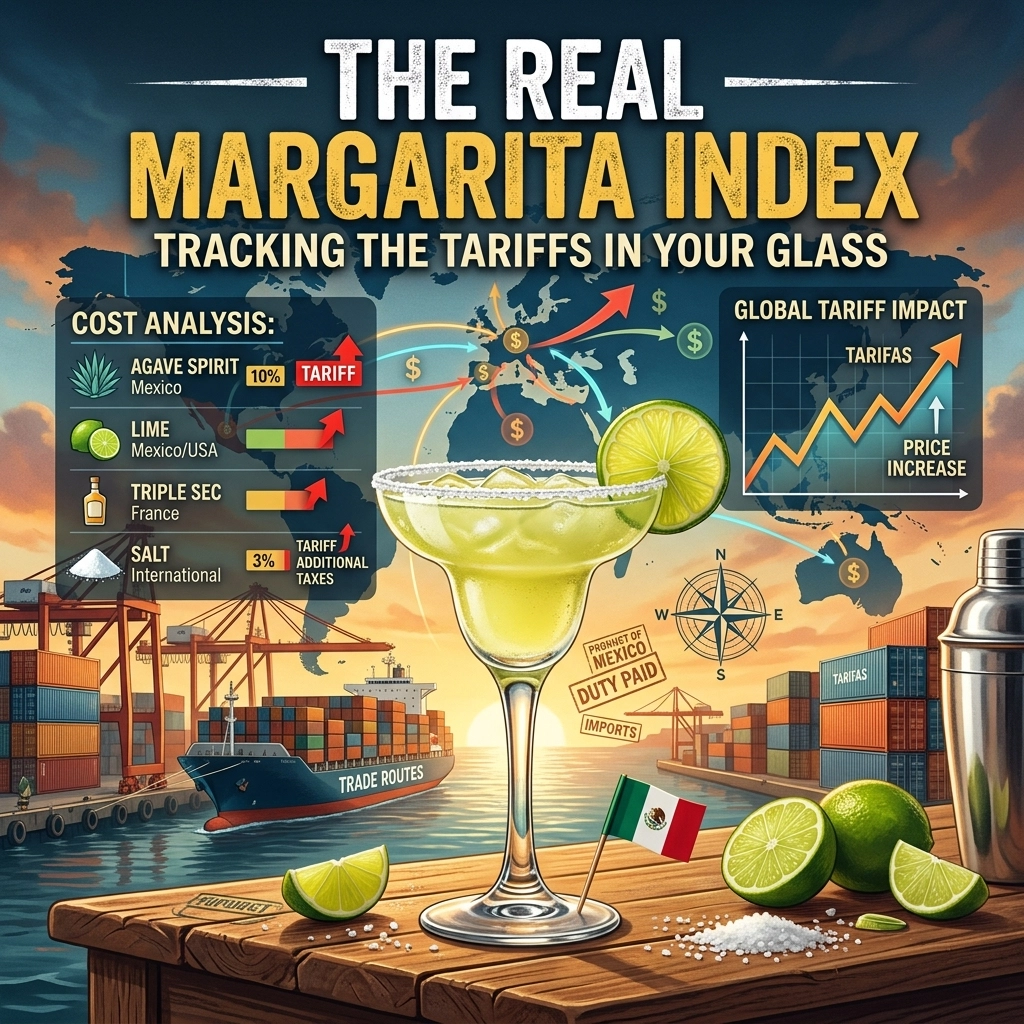
Hope everybody had a fun Cinco de Mayo yesterday. Now it’s the morning after, the confetti is in the trash, the credit card alerts are rolling in, and that innocent-looking margarita is still one of the best little case studies in the American economy.
Last year, you might have grumbled that your margarita cost $14. This year, if you saw $18 or $20 on the menu, don’t just blame the bartender or the trendy lighting. Blame the math. The 25% tariff, the roughly 10% drop in the dollar, and the July 1 USMCA review are all sitting in that glass whether you ordered them or not. The "Margarita Index" is still flashing a big red warning light about the state of the economy.
So now that the party is over, let’s break down the economic ingredients of that drink and see why the tab from this year’s fiesta packed such a punch.
The Tequila Trap: A 25% Surcharge and a 10% Weakness
The soul of a margarita is tequila. And by law, tequila has to come from Mexico. There is no "domestic substitute" for the blue agave plant grown in the volcanic soils of Jalisco. If you want the good stuff, you have to import it.
Here is where the math gets ugly. Back in March 2025, a 25% tariff was slapped on Mexican imports. Now, when the government puts a 25% tax on a bottle of tequila coming across the border, the tequila company doesn’t just say, "Oh well, I guess we’ll make less money." They pass that cost directly to the distributor, who passes it to the bar, who passes it to you.
But wait, it gets worse. While that tariff was hitting the books, the U.S. Dollar was busy losing its "king of the hill" status. From January 2025 through April 2026, the dollar dropped roughly 10% in value. According to Morgan Stanley, this is the biggest first-half drop for the greenback since 1973.

When your dollar is 10% weaker, it means you need more dollars to buy the same amount of Mexican agave. So, you’re not just paying a 25% tariff; you’re paying it with a currency that has 10% less "umph" than it did a year ago. It’s a double-whammy that turns a premium bottle of Reposado into a luxury asset. Bars that used to stockpile 100 cases to hedge against price hikes are now just trying to keep the lights on as their inventory costs skyrocket.
The Perishable Problem: Why Limes Can’t Wait for a Trade Deal
You can stockpile tequila in a warehouse. You cannot stockpile a lime. Limes are the "just-in-time" inventory of the cocktail world. Most of the limes we consume in the U.S. come from Mexico, and they are subject to those same 25% tariffs.
Because limes are perishable, they reflect price volatility almost instantly. When there’s a hiccup at the border or a new "enforcement surge" that slows down trucking, the price of a case of limes can double in a week. That "free" lime wedge in your drink? It’s not free. It’s a high-stakes commodity.
We’ve got one weird silver lining this morning after the festivities: avocado prices are still sitting near a 4-year low thanks to a massive harvest in Michoacán. Nice for the guac crowd. But don’t let the cheap chips-and-dip moment fool you. The lime in your glass is still fighting the uphill battle of a weakened dollar and a border that has become a choke point for trade.
The July 1st "Boogeyman": USMCA and Headline Risk
If you think prices are high now, keep your eyes on the calendar. July 1, 2026, is the scheduled review of the USMCA (the United States-Mexico-Canada Agreement). In the world of economics, we call this "headline risk."
Basically, the "headline risk" means that because nobody knows if the trade deal will be renewed, tweaked, or torn up, businesses start hiking prices now just to build a cushion for the potential chaos. It’s the "sadder summer" that economists have been predicting. As tax refunds from Q1 dry up: refunds that were about 10% bigger this year and propped up our spending: we are heading into a June and July where consumer income is shrinking in real terms.

When you combine a shrinking paycheck with the uncertainty of the July 1st trade review, you get a recipe for a very expensive summer. The "Margarita Index" isn't just about the drink; it’s a proxy for how much the average guy is being squeezed by policies that sound good in a press release but hurt at the cash register.
Capitalism, Tariffs, and the "Invisible Tax"
Like we’ve said before about the medical industry, medicine (and by extension, the things we consume to stay sane, like a good margarita) has become part of a capitalist machine that often ignores the "Regular Guy."
We see this same pattern in health care. In 1960, medical costs were 5% of our GDP. Now we’re looking at 20% by the end of 2025. We spend more, yet we aren't getting healthier. In fact, for the first time in history, our kids might not live longer than we do. Why? Because the "spirit of the thing" has been replaced by profit incentives and constraints that don't benefit the end-user.
The same thing is happening at your local cantina. The "invisible tax" of a 10% currency drop is like a pay cut that nobody sent a memo about. You didn't do anything wrong. You worked the same hours. You did the same job. But because the currency you’re paid in is worth 10% less on the global stage, your Cinco de Mayo celebration costs 10% more before you even factor in the tariffs.
It’s high time we reclassify these expenses. We need to look at our household budgets with the same scrutiny that a CFO looks at a Fortune 500 company. If your "entertainment and relaxation" budget (your Margarita Index) is up 35% year-over-year, something has to give.
The Nearshoring Winner Turned Target
For the last few years, Mexico has been the darling of the "nearshoring" movement. Companies moved manufacturing from China to Mexico to be closer to the U.S. market. It made sense. It was supposed to lower costs and stabilize supply chains.
But now, Mexico has turned from a "nearshoring winner" into a "tariff target." The very success of the Mexican manufacturing base has made it a bullseye for trade negotiators. For the "Regular Guy," this is confusing. We were told moving things closer to home would make them cheaper. Instead, we’re paying more for the tequila, more for the lime, and more for the gas to drive to the bar.

How to Survive the "Sadder Summer"
So, what do we do? Do we stop drinking margaritas? Not necessarily. But we have to be smart.
- Watch the Currency: When the dollar drops 10%, your buying power for anything imported (Costco runs, electronics, tequila) takes a hit.
- Budget for the "Refund Cliff": If you spent your tax refund in Q1, realize that the "sadder summer" is coming in June. The extra cash is gone, but the higher prices are staying.
- Mind the USMCA: July 1 is a pivot point. Expect volatility in prices for everything from cars to avocados as that date approaches.
Economics isn't just about charts and numbers; it’s about the price of the things that make life worth living. Whether it’s the $10,000 you save on cardiac care by spending $100 on a gym membership, or the $5 you save by knowing why your drink costs so much, knowledge is the only way to protect your wallet.
Cinco de Mayo has come and gone, but the bill stuck around. So if you’re looking at the leftovers from yesterday’s celebration and wondering why a simple night out feels like a luxury purchase, remember this: that margarita was never just tequila, lime, and ice. It was a 25% tariff, a 10% currency devaluation, and a July 1 trade review hanging over the whole summer.
Be mindful, be watchful and good luck.