



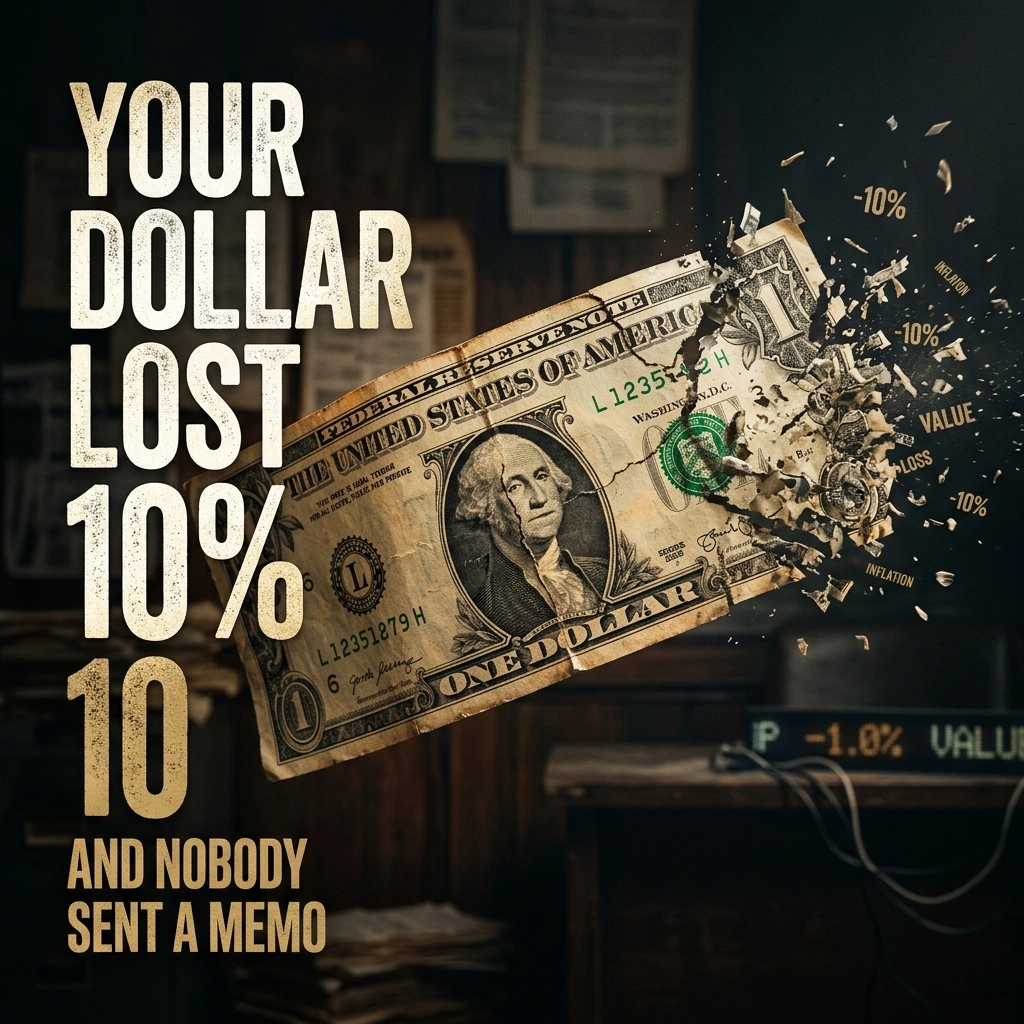
You probably woke up today, May 4, 2026, checked your bank account, and saw the same number of dollars you had last week. Maybe you even felt a little good about it. But here’s the cold, hard truth that nobody put in a push notification: while you were sleeping, your money got smaller.
Between January 2025 and April 2026, the U.S. dollar took a 10% nose dive against other major currencies. According to the folks over at Morgan Stanley, this is the biggest first-half drop we’ve seen since 1973. For those of you who weren't around then or don't spend your nights reading history books, 1973 was the year Nixon officially pulled us off the gold standard and the world changed forever.
In short, we are living through a "turning point" moment, and most regular guys are just wondering why their Costco bill feels like a car payment.
The 10% Ghost Tax
Think of it this way: if you had $1,000 in your savings account in January of last year, it still says $1,000. But that $1,000 now has the "buying energy" of $900. It’s like someone came into your house and shaved an inch off every chair leg. You might not notice it at first, but eventually, you’re going to realize you’re sitting closer to the floor.
Why did this happen? It wasn’t one single event. It was a slow-motion car crash caused by a mix of massive federal deficits, trade tensions that won't quit, and a lot of global investors looking at the U.S. economy and saying, "Eh, maybe I'll put my money somewhere else."
For years, the U.S. dollar was the "safe haven." When the world got scary, people bought dollars. Now? People are looking at our mounting debt and our trade wars and they're starting to hedge their bets.

Why Your Summer Vacation Just Got "Scaled Back"
If you’ve been planning that "bucket list" trip to Italy or Japan, I have some bad news. A weaker dollar is essentially a 10% surcharge on everything you do outside the U.S. border.
When the dollar is strong, your money goes further abroad. You feel like a king in a bistro in Paris because your dollars convert into more Euros. But when the dollar drops 10%, that $200-a-night hotel room is suddenly $220. That $80 dinner is now $88. Multiply that by a ten-day trip, and you’re looking at hundreds, if not thousands, of dollars in "invisible" costs just because our currency lost its muscle.
It’s not just the fancy stuff, either. It makes the world smaller. When it’s more expensive to travel, people stay home. And when people stay home, they realize that staying home is getting expensive, too.
The Costco Connection: Why the "Bargain" is Vanishing
We all love a good bulk-buy. But have you noticed the price of olive oil lately? Or those imported electronics? What about the avocados or the out-of-season fruit?
A huge chunk of what we buy at stores like Costco or Walmart comes from overseas. When the dollar loses value, it takes more of those dollars to buy the same amount of goods from Mexico, China, or Vietnam. The companies importing this stuff: the ones filling those massive shipping containers: are paying 10% more for the same inventory than they were 16 months ago.

They aren't going to just eat that cost out of the goodness of their hearts. They’re going to pass it on to you. This is why you’re seeing "shrinkflation" (where the bag of chips gets smaller) or just straight-up price hikes at the register. The "Regular Guy" ends up paying the tab for currency devaluation every time he taps his credit card.
The Gas Pump Double Whammy
This is the part that really stings. Most people don't realize that oil is priced in U.S. dollars globally. It’s called the "Petrodollar" system.
Because oil is sold in dollars, when the value of the dollar goes down, the people selling the oil (countries like Saudi Arabia or groups like OPEC) want more dollars to make up for the loss in value. It’s a direct correlation. If the dollar drops 10%, oil prices often see a corresponding spike just to keep the "real" value of the oil the same for the seller.
So, while we’re already dealing with supply chain issues and domestic energy policy headaches, the weak dollar is acting like a gust of wind on a house fire. You’re paying more at the pump not just because of the price of oil, but because your money is literally worth less to the person selling the oil. It’s a double whammy that hits the guy with the 40-minute commute the hardest.
Why Nobody Sent a Memo
You might be asking, "If this is the biggest drop since 1973, why isn't it on every news channel?"
The truth is, currency talk is boring to the average news producer. It’s easier to talk about the stock market or what a politician said on Twitter. The stock market can stay "high" even while the dollar is falling: in fact, sometimes a weak dollar makes the stock market look better because multinational companies (like Apple or Google) see their foreign earnings look bigger when converted back into weak dollars.
It’s a giant game of smoke and mirrors. The billionaire class sees their asset prices go up, while the guy working a 9-to-5 sees his purchasing power disappear.

The "Sadder Summer" is Coming
This dollar drop is hitting right as the "Tax Refund Cliff" is appearing in the rearview mirror. Earlier this year, refunds were about 10% bigger than usual, which kept people spending through the winter. But that sugar high is wearing off.
Economists are now calling for a "sadder summer" because that extra cash is gone, and the 10% loss in dollar value is finally starting to bake into the retail prices of everything we buy. We’re looking at a situation where consumer income is shrinking in "real terms": meaning even if you got a 3% raise at work, you’re still 7% behind where you were last year because of the currency slide.
What Can You Do?
I’m not here to tell you to go buy gold bars and hide them in your backyard (unless that’s your vibe). But you do need to be aware of the "invisible tax."
- Watch your imports: If you’re planning a big purchase of something manufactured abroad (cars, high-end electronics, appliances), keep an eye on those prices. They are likely to climb higher as the current inventory runs out and is replaced by "expensive dollar" inventory.
- Rethink the big trip: If you haven't booked your international travel yet, maybe look at domestic options or countries where their currency has struggled even more than ours.
- Tighten the belt now: Don't wait for June or July to realize your budget doesn't stretch as far as it used to. The "bill" for this 10% drop is coming due in the next few months as retailers refresh their pricing.
The dollar is the foundation of our entire economic life. When the foundation shifts 10%, the whole house creaks. You didn't get a memo because the people in charge don't want you to panic, but the numbers don't lie.
We’re in a new era of "Regular Guy Economics," and the first rule of this era is simple: your money isn't what it used to be.
Be mindful, be watchful and good luck!