



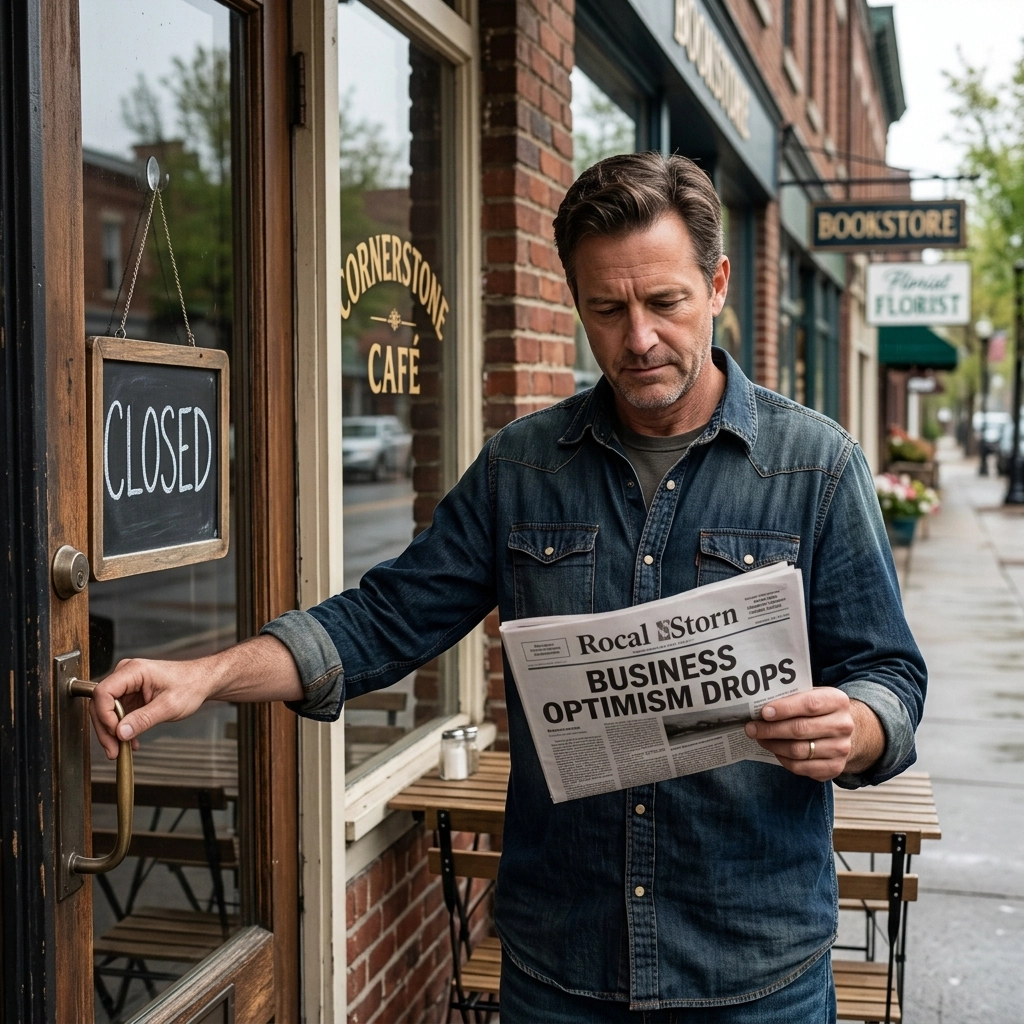
If you’ve been hanging out with us here at Regular Guy Economics for a while, you know we don’t get distracted by the shiny objects on Wall Street. While the S&P 500 is busy doing victory laps at all-time highs, the folks actually running the engines of this country: the small business owners: are waving a giant, neon-red flag.
The latest numbers from the NFIB Small Business Optimism Index just hit the wire, and they aren't pretty. In March, the index dropped 3 points to 95.8. Now, if you aren't a data nerd, that might just look like a random number. But here’s the kicker: the 52-year historical average for this index is 98.0.
For the first time since April of last year, we have officially broken below the long-term average. This isn't just a "bad month." This is a signal that the "Regular Guy" at the helm of the local machine shop, the neighborhood bakery, and the independent HVAC company is feeling a chill that hasn't been this persistent in a long time.
When small business owners lose confidence, the rest of the economy eventually catches the flu. Let’s break down why this is happening and what it actually means for your wallet.
The Profit Plunge: Where Did the Money Go?
The biggest driver behind this drop wasn't just a general sense of "meh." It was a cold, hard hit to the bottom line. The frequency of reports showing positive profit trends plummeted 11 points to a net negative 25%.
Think about that for a second. A quarter of small business owners are essentially saying, "I’m working harder, but I’m making less."

In our world, we talk a lot about "sticky prices." You see it at Kroger every time you buy a pack of steaks or a gallon of milk. But for the small business owner, the stickiness works against them. Their costs: rent, labor, electricity, and raw materials: have all climbed. But they’ve reached a point where they can’t just keep hiking prices on their customers without losing them.
When your expenses go up and your ability to raise prices hits a ceiling, your profit gets squeezed into a tiny little corner. That’s what a net negative 25% looks like on the shop floor. It looks like the owner skipping their own paycheck so they can cover the warehouse lease. It looks like putting off that new delivery truck purchase for another year.
The Uncertainty Monster
The most alarming part of this report isn’t even the headline number. It’s the "Uncertainty Index." This sub-index jumped to 92. To give you some perspective, the historical average for uncertainty is 68.
Being at 92 is like trying to drive a semi-truck through a thick fog with no headlights and a GPS that keeps saying "recalculating."
Uncertainty is the silent killer of growth. If you’re a regular guy running a business, you can handle high interest rates if you know they’re going to stay high. You can handle high taxes if you know what the rate is. But when you don’t know what the Fed is going to do next, when you don't know if a new tariff is going to double your material costs next month, or when you don't know if the DOJ's latest investigation is going to flip your industry upside down: you do the only logical thing: you stop moving.

At 92 on the uncertainty scale, business owners aren't hiring. They aren't signing new leases. They aren't innovating. They are in "bunker mode." They are waiting for the fog to clear. The problem is, when everyone stops moving at once, the whole economy grinds to a halt. This is why we pay attention to the "regular guy" indicators. They see the ground-level reality months before the "experts" in D.C. realize there's a problem.
The Main Street vs. Wall Street Divide
There’s a massive disconnect happening right now. If you look at the Buffett Indicator: which measures the stock market cap against the GDP: it’s sitting at a staggering 232%. That’s nearly a sixth above what Warren Buffett himself considers the "roasting zone."
Corporate profits for the big boys are at 12% of GDP, way above the 7-8% historical norm. The big corporations have the scale to absorb shocks, the lobbyists to tilt the scales, and the cash reserves to weather the storm.
But the small business owner? They don't have a "Chief Risk Officer" or a government bailout waiting in the wings. They just have their gut feeling and their bank balance. When the NFIB index drops like this, it tells us that the "trickle-down" isn't trickling. The top of the mountain is sunny, but the valley where we all live is getting flooded.

Three Moves for the Regular Guy This Quarter
So, the red flag is waving. What do you actually do about it? You don't panic, but you do prepare. Here are three moves a regular guy should consider making right now:
1. Build Your Personal "Liquidity Moat"
If small businesses are reporting negative profit trends, that means the local economy is tightening. Now is not the time to be "all-in" on illiquid assets or high-risk moonshots. In a period of high uncertainty (that 92 score we talked about), cash isn't just "trash": it's an insurance policy. Whether you run a business or a household, try to widen the gap between what you make and what you spend. If the "Uncertainty Monster" bites, you want to be the one with the bandages.
2. Audit Your Efficiency (The Sniper Approach)
At Regular Guy Economics, we’re big fans of the "Snipers Don't Use Shotguns" philosophy. When times are good, businesses get fat. They buy subscriptions they don't use, they over-order inventory, and they stop watching the "little" expenses.
If you’re an owner, or even if you’re just managing your family budget, do a "zero-based" audit this month. If an expense doesn't directly contribute to your health, your wealth, or your peace of mind, cut it. Efficiency is your best defense against a profit squeeze.
3. Lean Into "Local Loyalty"
When the big meatpackers are under investigation and the global supply chains are twitching, the value of a local handshake goes up. If you're a business owner, double down on your local customer base. Give them a reason to stay with you that isn't just about price. If you're a consumer, try to keep your dollars in your community. Small businesses are the ones feeling the heat right now; your local hardware store or coffee shop needs that "Regular Guy" support more than the mega-corporations do.

The Bottom Line
We’ve spent 52 years tracking this index, and breaking below that average matters. It’s a reminder that while the talking heads on the news are arguing about policy and "macro" trends, the actual people who make this country run are feeling the squeeze.
A 95.8 optimism score isn't the end of the world, but it is a wake-up call. It’s time to stop looking at the record-high stock market as a sign that everything is "fine" and start looking at the shop floor. The "Uncertainty Index" at 92 tells us that the road ahead is going to be bumpy.
Don't wait for a NAR press release or a Fed announcement to tell you things are changing. The small business owners are already telling you. They are the canary in the coal mine, and right now, that canary is looking for the exit.
Stay sharp, keep your overhead low, and watch the data that actually hits home. We’ll be right here in the trenches with you, keeping it simple and calling it like we see it.
Be mindful, be watchful and good luck.