



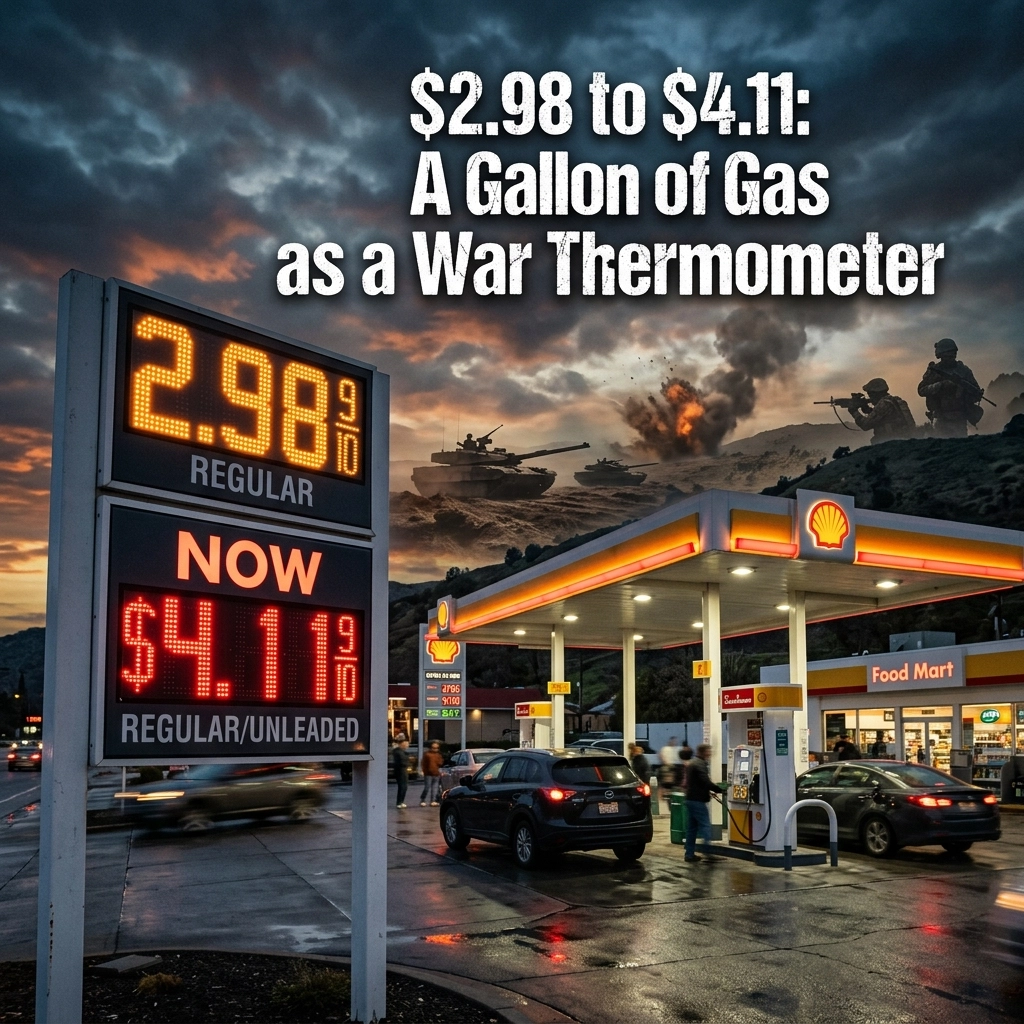
You know that feeling when you pull into the Sunoco on a Tuesday morning, half-awake, holding a lukewarm coffee, and you look up at the big plastic sign? For most of us, that sign isn’t just a price tag anymore. It’s a scoreboard. It’s a pulse check. It’s a giant, glowing thermometer telling us exactly how much the world is currently on fire.
Back on February 28, life felt a little different. Sure, the news was getting twitchy, and the headlines were starting to look a bit "doom-and-gloom," but at the pump? The national average was sitting at a manageable $2.98. You could fill up a mid-sized sedan for fifty bucks and still have enough left over for a Slim Jim and a lottery ticket.
Then came the strikes. Then came the tension in the Strait of Hormuz. And just like a fever spiking during a flu, that number on the sign started climbing. Today, we’re staring down a national average of $4.11.
That’s not just a "slight increase." That’s a 38% jump in less than two months. If your boss told you that you were getting a 38% pay cut, you’d be throwing chairs. But when the gas pump does it? We just stand there, watching the little digital wheels spin faster than our bank accounts can keep up with.
The Most Honest Number in Economics
Economists love to talk about "Consumer Price Indexes," "Real GDP," and "Core Inflation (minus food and energy)." But let’s be real: for the regular guy, those numbers are mostly noise. You don’t feel a 0.2% shift in the federal funds rate when you’re walking the dog.
But you feel $4.11.
You feel it in your chest when the pump clicks off at $85 and you realize you haven’t even hit a full tank yet. Gas is the "War Thermometer" because it’s the only commodity that reacts in real-time to every missile launch, every diplomatic breakdown, and every naval blockade. It is the most honest indicator of global stability because it doesn’t wait for a quarterly report to tell you things are going south.

When the Feb 28 strikes hit, the market didn't wait for a "thought piece" from a think tank. It panicked. Oil traders started pricing in the worst-case scenario. And because oil is the lifeblood of literally everything, from the plastic in your sneakers to the diesel in the truck delivering your Amazon packages, the price of gas became the first casualty of the conflict.
The K-Shaped Reality: Why $4.11 Hurts Some More Than Others
Here is the part the talking heads on the news usually gloss over. They’ll say, "Higher energy prices act as a tax on the consumer." Which sounds fancy, but it hides a ugly truth. This "tax" isn't applied equally.
We’re living in what economists call a K-shaped recovery, and now, a K-shaped crisis.
If you’re pulling in $250,000 a year working from a home office, a jump from $2.98 to $4.11 is an annoyance. You might complain about it at brunch, but it’s not going to change your life. You aren't deciding between a full tank of gas and a full bag of groceries.
But for the regular guy, the plumber, the teacher, the delivery driver, the guy commuting 45 minutes each way because that’s where he could afford a house, that $1.13 difference is a sledgehammer to the budget.

Think about the math for a second. If you’re driving a truck that gets 15 miles per gallon and you commute 40 miles a day, you’re using about 13 gallons a week just for work.
- At $2.98, that’s $38.74 a week.
- At $4.11, that’s $53.43 a week.
That’s nearly $60 extra a month just to get to work. And that doesn't count school drop-offs, grocery runs, or visiting your parents. For a household living paycheck to paycheck, that $60 isn't "discretionary income." That’s the electric bill. That’s the kid’s new shoes.
Lower and middle-income households spend a significantly larger percentage of their take-home pay on energy and fuel. When the "War Thermometer" spikes, it’s these folks who feel the burn first and hardest.
The "Transitory" Trap and the Shell Game
Remember when "they" told us inflation was transitory? Well, they’re using the same playbook now. They’ll tell you that the Strait of Hormuz reopening (which happened just last night) means everything is going back to normal. They’ll say the 9% dive in oil prices overnight is the "end of the crisis."
Don't buy it.
The price at the pump is a "rocket and feather" phenomenon. Prices go up like a rocket the second there’s bad news, but they drift down like a feather once the news gets better. Even if oil stays lower, the "sticker shock" of $4.11 is going to linger. Why? Because the uncertainty hasn't left the building.

Refiners, distributors, and station owners are all looking at the same map. They know that even if the Strait is open today, it could be closed tomorrow. They’re keeping their margins high because they’re scared. And who pays for that fear? You do. At the pump.
The Hidden Gas Tax in Your Grocery Cart
The $4.11 on the sign is only half the story. The other half is what happens after the gas goes into the tank of a semi-truck.
Almost everything you touch was once on a truck. When diesel prices follow the lead of the $4.11 "War Thermometer," the cost of moving goods skyrockets. This is why your gallon of milk, which was already too expensive, just took another jump. The grocery store isn't going to eat that extra shipping cost: they’re passing it right to you.
This is the "stealth" part of the war thermometer. You might try to drive less to save money, but you can’t exactly stop eating. So the war in a distant part of the world follows you from the gas station right into the checkout line at Kroger.

Why the SPR Wasn't There to Save Us
A lot of guys ask, "What about the Strategic Petroleum Reserve? Isn't that what it's for?"
Great question. The SPR is basically the nation’s "emergency stash" of oil, tucked away in underground salt caverns. The problem is, we’ve been dipping into that stash for years to try and keep prices low for political reasons, rather than waiting for a true wartime emergency.
When the Feb 28 strikes happened, the pantry was already looking pretty bare. We went into this conflict with the SPR at its lowest levels in decades. It’s like heading into a blizzard knowing your backup generator only has twenty minutes of fuel left. It’s bad planning, and it leaves the regular guy exposed to the whims of global dictators and shipping blockades.
Looking Ahead: Is the Fever Breaking?
As of today, April 18, 2026, the news of the Strait reopening is a breath of fresh air. Wall Street is celebrating, and the oil markets are finally seeing some red (the good kind of red). But if the last two months have taught us anything, it’s that the "War Thermometer" is incredibly sensitive.
We might see that $4.11 start to tick down. Maybe it hits $3.85 by next week. But the "new normal" is still much higher than that $2.98 baseline we had just a few weeks ago.

The world is a jittery place right now. The supply chains are fragile, the reserves are low, and the geopolitical tensions are still simmering just below the surface. As a regular guy, the best thing you can do is stop listening to the "experts" who say everything is fine and start watching that glowing sign on the corner.
It’ll tell you the truth long before the politicians do.
We’re not out of the woods yet, but we’re watching the numbers. Keep an eye on your budget, maybe put off that cross-country road trip for another month, and keep your head on a swivel.
Be mindful, be watchful and good luck.