



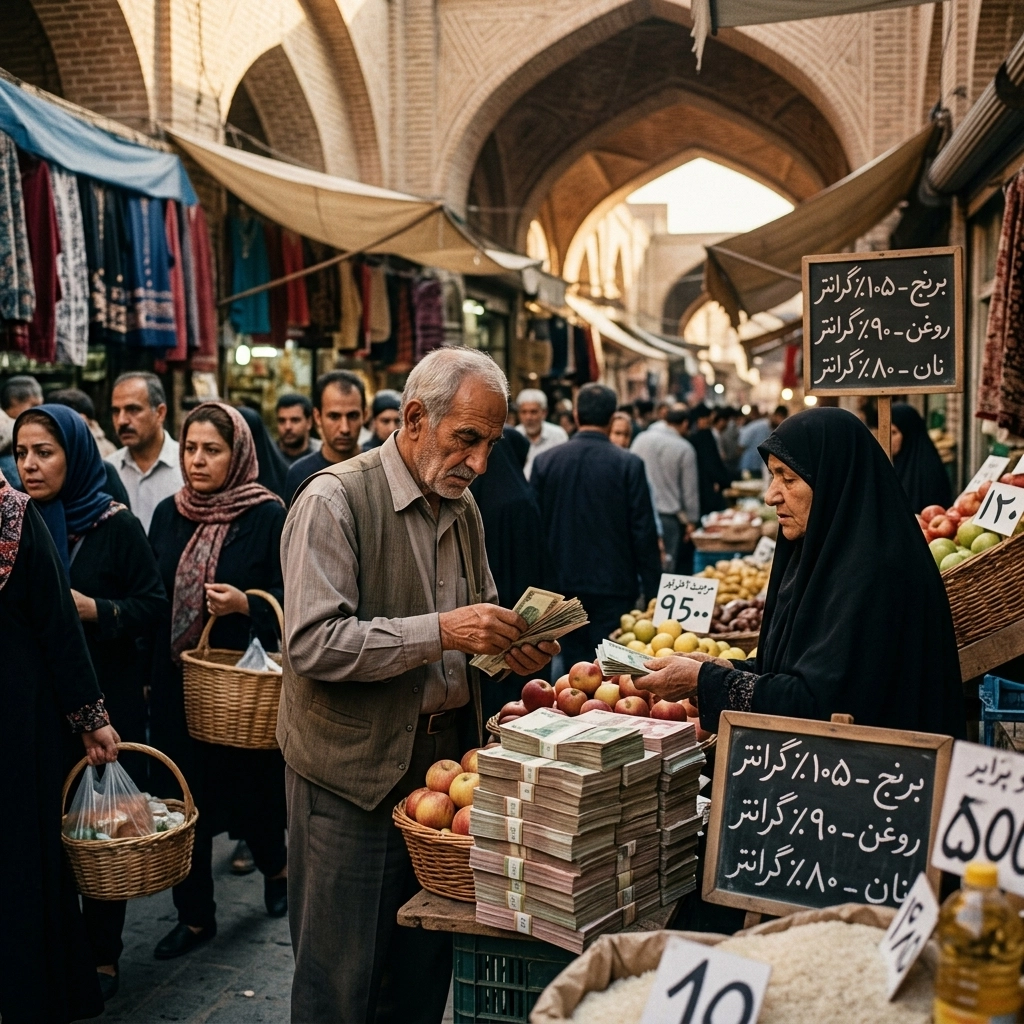
Hey there. It’s Saturday, April 18, 2026, and while the headlines over the last few hours have been buzzing about Iran reopening the Strait of Hormuz and oil prices taking a much-needed 9% dive, I want to take a minute to look at what’s happening on the ground in Tehran.
We talk a lot about "inflation" here in the States. We grumble when the gas pump jumps from $2.98 to $4.11: which, let’s be honest, is a massive hit to the wallet for any regular guy trying to make ends meet. But if you want to see what happens when an economy truly loses its grip on reality, you have to look at the numbers coming out of Iran right now.
Iran’s food inflation just hit 105%.
Think about that for a second. That isn't a typo. It isn't a "high" number; it’s an economic death spiral. While we’re debating whether the Fed should cut rates by a quarter-point, people on the other side of the world are watching the price of a loaf of bread double while they’re standing in line to buy it.
The Grocery Store as a War Zone
For the regular guy in Iran, the grocery store isn't a place to pick up dinner; it’s a place where you watch your life savings evaporate in real-time. Let’s break down what that 105% actually looks like on the shelf:
- Bread is up 140%.
- Meat is up 135%.
- Cooking oil is up 219%.
Imagine walking into your local shop. Last year, a bottle of cooking oil cost you $5. This year, it’s over $15. Last year, a steak was a weekend treat at $20; today, it’s $47. This is what economists call "hyperinflationary pressure," but for a father trying to feed three kids, it’s just called a disaster.
When food prices move this fast, the currency becomes a hot potato. Nobody wants to hold it. You get paid, and you immediately run to the store to turn that paper into something useful: flour, rice, oil: because by tomorrow morning, that paper will be worth 5% less than it is tonight.

The 10-Million-Rial Note: The Ultimate White Flag
The surest sign that a government has lost control of its money is the "Big Note."
Recently, Iran issued a 10-million-rial note. This is the largest in the country's history. Just a month prior, they had introduced a 5-million-rial note. When you start adding zeros to the currency every few weeks, you aren't fixing the economy; you’re just making the math easier for people to count their losses.
In the world of "Regular Guy Economics," we have a simple rule: when the government starts printing bills with too many zeros to fit comfortably on the paper, the trust is gone. And once trust in a currency dies, the currency dies with it.
We’ve seen this playbook before. We saw it in Weimar Germany, we saw it in Zimbabwe, and we saw it in Venezuela. Iran is now the latest cautionary tale. They are printing money to pay for a conflict and a lifestyle they can’t afford, and the regular guy at the bottom is the one handed the bill.
Why This Matters to You (The "It Can't Happen Here" Fallacy)
I know what you’re thinking. "John, that’s Iran. They’re under sanctions, they’re at war, and their central bank is a mess. We’re the United States. We have the reserve currency of the world."
You’re right. We do. But the laws of physics: and economics: don’t care about your flag.
Look at what’s happened here since the February 28 strikes. Our national gas average went from $2.98 to $4.11 in a matter of weeks. That’s a 38% jump. For a guy making $50,000 a year, that isn't just "unfortunate." That’s the difference between a family vacation and staying home. It’s the difference between buying the good ground beef and the stuff that’s 30% fat.
The lesson from Iran isn’t that we’re about to hit 105% inflation. It’s that monetary discipline is the only thing standing between us and chaos.
When Jerome Powell, the Fed Chair, stands up and says "Nobody knows" what the economic impact of the war will be, he’s admitting that the experts are flying blind. When the government spends money it doesn't have: and we’ve seen plenty of that lately: it puts pressure on the system.
If we don't protect the value of the dollar, we are just a few bad policy decisions away from our own version of the "Big Note."
The K-Shaped Reality
Inflation is the ultimate regressive tax. It hits the poor and the middle class way harder than the rich.
If you’re a billionaire and the price of eggs goes up 200%, you don’t even notice. But for the regular guy, food and fuel represent a massive chunk of the monthly budget. When those two things spike, everything else has to give.
In Iran, the middle class is essentially being wiped out. They are being pushed into poverty because their wages: even if they get a "raise": can't keep up with 105% food inflation.

We see a "K-shaped" hit here in the U.S. too. While Wall Street is celebrating the reopening of the Strait of Hormuz today because "oil is down 9%," the guy at the pump is still paying $4.11. The market reacts in seconds; the prices at the pump and the grocery store take months to come back down (if they ever do).
A Cautionary Tale of Empty Cupboards and Half-Empty SPRs
There’s another layer to this. Before this war kicked off, the U.S. Strategic Petroleum Reserve (SPR) was sitting at historic lows. We didn’t refill the cupboards when things were quiet.
Now, we’re watching a global energy crisis play out in real-time. Iran is a mess because of their own internal failures, but they are also a reminder of what happens when a country doesn't have a "rainy day fund." When you run your economy on the edge of a knife, any little push: a strike, a closed strait, a failed harvest: sends you over the cliff.
The regular guy needs to be paying attention to "monetary discipline." It sounds like a boring term from a college textbook, but it’s actually the most important thing in your life. It’s the promise that the $100 in your pocket today will still buy $100 worth of groceries next month.
Iran broke that promise. Now, their citizens are paying 219% more for cooking oil.
What Should You Do?
When the world gets weird, you have to get smart.
- Watch the "War Thermometer": Don’t just look at the stock market. Look at the price of gas and the price of a gallon of milk. Those are the real indicators of how the economy is treating you.
- Understand the "Nobody Knows" Factor: If the Fed Chair admits he’s guessing, you should probably be a little more conservative with your own bets.
- Appreciate Monetary Discipline: It’s easy to complain about high interest rates or "tight" money, but the alternative is a 10-million-rial note and a 140% jump in the price of bread.
We live in a global economy. What happens in a bakery in Tehran eventually echoes in a gas station in Ohio. The 105% inflation in Iran is a loud, screaming warning to the rest of the world: Respect the currency, or the currency will destroy you.
The Strait of Hormuz might be open today, and the markets might be "happy," but the underlying pressure on your wallet hasn't gone away. The war on your purchasing power is still being fought every single day at the checkout counter.
Be mindful, be watchful and good luck.