



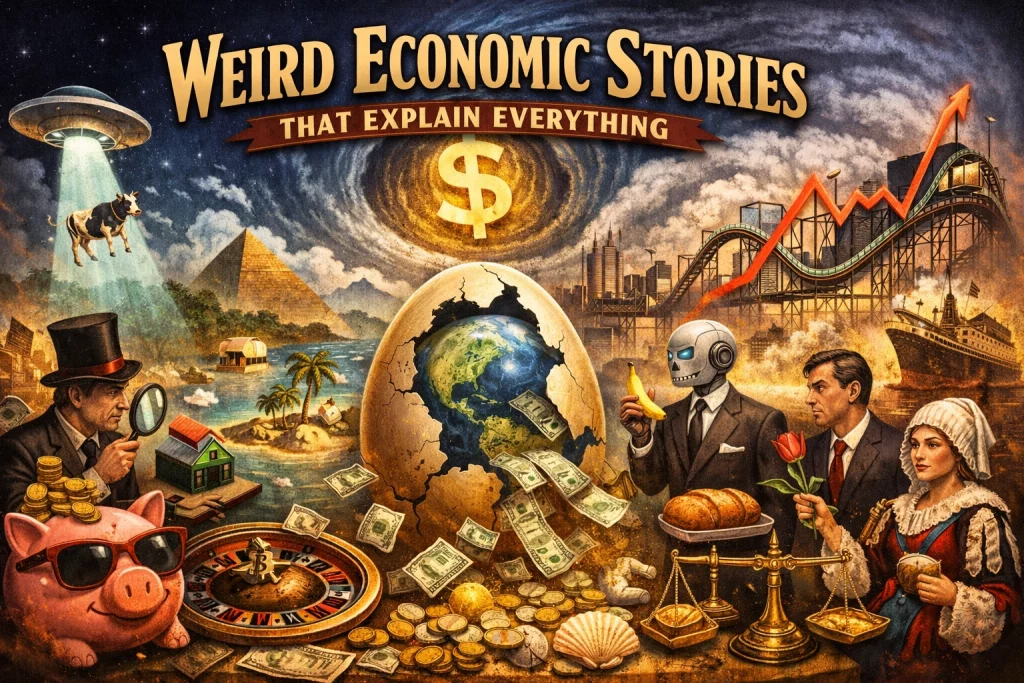
Economics usually shows up wearing a suit and speaking in acronyms. But the real economy? It’s a messy group chat. The best way to understand it isn’t always a chart, it’s often a weird headline that makes you go, “Wait… what?”
So here’s a collection of strange-but-true-ish economic stories and “indicators” that help explain the bigger picture: incentives, pricing power, supply chains, narratives, and how people actually behave when money gets tight.
1) The Lipstick Index: Recession… but make it affordable
Weird story: During downturns, lipstick sales can rise.
This idea got famous when Estée Lauder’s Leonard Lauder noticed that in hard times, people cut big luxuries but keep small ones. The fancy vacation gets canceled. The $18 treat survives.
What it teaches:
- People don’t stop spending. They trade down.
When budgets shrink, consumers substitute: store brand instead of name brand, “a little treat” instead of a big purchase. - Not all inflation feels the same.
A person might “buy less” overall but still see certain categories hold up because the emotional value per dollar is high. - Consumer psychology matters.
Economics isn’t just “maximize utility” on a whiteboard. Sometimes it’s “I need one nice thing this week or I’m going to lose it.”
If you want a modern version, look at “small luxury” categories that pop during stress: premium coffee at home, skincare, streaming subscriptions. Not because people are thriving, because they’re coping.

2) The Men’s Underwear Index: The economy, but unglamorous
Weird story: Former Fed Chair Alan Greenspan popularized the idea that men delay buying underwear in recessions. When things improve, underwear sales bounce back.
It’s funny, but it’s also a clean example of how economists think about spending:
- Underwear is a basic good with replacement cycles.
- If people are worried, they stretch replacement cycles on anything they can.
What it teaches:
- Recessions aren’t just about “less spending.” They’re about delayed decisions.
Big purchases (cars, appliances) obviously get delayed. But so do a bunch of small “eh, it can wait” purchases. - Confidence is an economic variable.
If people think layoffs are coming, they hoard cash. If they think they’re safe, they spend.
In other words: sometimes the economy turns not when everyone becomes rich again, but when everyone becomes less scared.
3) Baked beans and coupon redemptions: The “we are not fine” dashboard
Weird story: In the UK, baked bean sales jumped during the 2008–2009 crisis. In the U.S., coupon usage surged, billions of coupons redeemed in 2009 as households tried to protect cash flow.
This is the economy’s version of sweatpants:
- People shift from restaurants to groceries.
- From fresh to shelf-stable.
- From convenience to savings.
What it teaches:
- Inflation hurts differently depending on where you shop.
If you’re already value-shopping, there’s less room to trade down. That’s why “the CPI says inflation is cooling” can feel like a joke if your household is already optimized. - Households run their own “risk management.”
When uncertainty rises, families become mini-CFOs: cutting optional spend, building pantry inventory, hunting deals.
And yes: when the “coupon redemption index” is ripping higher, that’s not “smart shopping culture.” That’s households under pressure.
4) The Big Mac Index: The world’s funniest exchange rate calculator
Weird story: The Economist compares currency values using the price of a Big Mac in different countries.
It’s partly a gimmick, but it’s also a surprisingly sticky way to teach:
- Purchasing Power Parity (PPP): what money buys locally matters more than what the FX market says it’s worth.
- Tradable vs. non-tradable costs: a Big Mac price includes local rent, local wages, local utilities, and local supply chains.
What it teaches:
- A currency can be “cheap” while life is still expensive.
If housing, energy, and food are high relative to wages, “cheap currency” doesn’t help the average person much. - Globalization is not symmetrical.
Two countries can import the same inputs, but local market structure (competition, regulation, labor power) shapes the final price.
So yes, a burger can teach you why “strong dollar” headlines don’t automatically mean “good economy.”

5) The Skyscraper Boom: When building tall means the cycle is peaking
Weird story: Skyscraper construction booms have sometimes lined up with big market tops. The Great Depression era famously saw multiple record-setting towers underway (Chrysler Building, Empire State Building, 40 Wall Street).
It’s not that tall buildings cause recessions. It’s that they can be a symptom of late-cycle behavior:
- Easy credit
- Optimism bordering on delusion
- Status projects
- Developers and banks feeling bulletproof
What it teaches:
- The cycle is financial as much as it is “economic.”
Credit availability and asset prices can run ahead of real demand. - Big projects get approved at the top because they’re planned at the top.
Long timelines mean by the time the ribbon is cut, the world has changed.
A modern version isn’t just skyscrapers. It’s “peak confidence” projects: stadium deals, luxury condo towers, speculative office builds, anything that assumes tomorrow’s demand will look like today’s spreadsheet.
6) The Super Bowl Indicator: A joke that teaches real randomness
Weird story: An old market superstition says if an NFC team wins the Super Bowl, the S&P 500 will rise; if an AFC team wins, it will fall. It’s been “right” a suspicious amount historically.
It’s also nonsense. But useful nonsense.
What it teaches:
- Humans are pattern machines.
If you show us two lines that kind of match, we’ll invent a story. - Narratives are an economic force.
People trade, vote, and spend based on stories about what’s happening, sometimes before the actual data shows anything. - Correlation ≠ causation, but correlation does shape behavior.
If enough people believe a signal, they act on it, and the acting can move markets.
This is how financial Twitter works, by the way.
7) Heel heights, fashion, and “vibes”: The economy you can’t spreadsheet
Weird story: There are claims that heel heights track economic cycles, higher heels in booms, lower heels in busts (or vice versa, depending on who’s telling the story).
Is it precise? No. Is it interesting? Yes, because it points to a real thing: when conditions change, culture changes, and culture changes spending.
What it teaches:
- Economic data is slow. Mood is fast.
A jobs report lags. A vibe shift doesn’t. - Status spending is cyclical.
When people feel secure, they signal. When they feel insecure, they protect.
If you want a cleaner “vibes” indicator in 2026: watch resale markets, discount retailer traffic, and how aggressively people are using “buy now, pay later.” Those are the modern heel heights.
8) Google searches as an economic indicator: The panic before the press release
Weird story: Google Trends can track economic stress, searches for “unemployment benefits,” “food banks,” “debt consolidation,” or “late rent” often spike before official stats fully reflect the pain.
This is one of the more legit “weird indicators,” because it captures real-time behavior.
What it teaches:
- Official stats are delayed and revised.
Jobs numbers get revised. Inflation baskets update slowly. Meanwhile, people are searching today. - Economic stress shows up first as information seeking.
Before a layoff becomes a statistic, it becomes a search query.
This also explains the disconnect people feel: the economy can be “fine” in aggregate while certain groups are already sliding. Google Trends can see the slide early because people ask for help before they show up in a chart.
9) Orange juice costs more than gas: Weird price relationships reveal power
Weird story: Sometimes you’ll see headlines like “Orange juice is more expensive than gasoline.” It sounds like a joke until you realize it’s a supply chain lesson.
Gasoline is a globally traded commodity with huge scale and (usually) intense competition. Orange juice is agricultural, weather-sensitive, disease-sensitive, and processed through a narrower pipeline.
What it teaches:
- Not all prices reflect “inflation.” Some reflect fragility.
A crop disease, a drought, a shipping disruption, food supply can kink fast. - Market structure matters.
If a product is dominated by a small number of processors, shippers, or retailers, they can have pricing power, even when demand softens. - Substitutes are limited.
People can drive less (to a point), but if you’ve got kids who drink juice every morning, demand can be annoyingly sticky.
The deeper lesson: when you see weird relative prices, don’t just blame “greed” or “government.” Ask: Where is the bottleneck? Who has leverage? How many alternatives exist?
10) Corporate towns are back (just with better logos)
Weird story: “Company towns” sound like 1890, coal mines and scrip. But modern versions exist when a major employer becomes the de facto provider of housing, healthcare, transportation, security, and even local politics.
This isn’t a single headline. It’s a pattern:
- Employers buying large housing blocks near campuses
- Hospitals as the largest regional employer (and political force)
- Tech hubs where city policy bends around one industry’s needs
What it teaches:
- Institutions shape the economy as much as markets do.
- When one buyer dominates labor (monopsony), wages can lag even in “good times.”
- Public systems get replaced by private rules.
If your health insurance is tied to your job, your “freedom” is conditional.
And now we arrive at the weird story that should not be weird at all: healthcare.
11) Time to Destroy the Medical Industry (yes, that headline is deliberate)
In 1960, U.S. medical costs were about 5% of GDP. Today, we’re around 17–18% and have flirted with ~20% projections depending on the measure and year. That is an economic takeover. Healthcare isn’t just a sector anymore, it’s a gravitational field.
And here’s the punchline: despite all that spending, we don’t lead the world in outcomes. U.S. life expectancy is lower than many peer countries, and chronic conditions (obesity, diabetes) are widespread.
This is where weird economic stories become the whole story, because healthcare behaves unlike “normal markets”:
Why healthcare doesn’t work like car insurance
Car insurance has constraints:
- A car has a known market value.
- Repairs have semi-known price ranges.
- If it’s too expensive, it’s totaled.
Healthcare doesn’t “total out.” There is no maximum value on keeping a person alive, and pricing can be opaque to the point of satire.
So we get:
- Third-party payer problems (you don’t pay directly, so price signals break)
- Information asymmetry (patients can’t shop like they shop for TVs)
- Inelastic demand (you don’t price-compare during chest pain)
- Administrative bloat (billing complexity becomes its own industry)
What happens when capitalism meets medicine
You end up optimizing the wrong thing:
- Not “health outcomes”
- Not “prevention”
- But billable events
That’s how you get a system where a $100/month gym membership is “optional,” but a $30,000 procedure is “covered,” even if the gym membership would reduce the probability of needing the procedure.
The corporate workaround (and why it’s happening)
When Amazon, Berkshire Hathaway, and JPMorgan once announced a joint effort to improve employee healthcare (Haven), it wasn’t because executives suddenly became angels. It was because healthcare inflation is a business threat.
Big employers are slowly reinventing healthcare as health expense management:
- onsite clinics
- direct primary care
- negotiated drug pricing
- incentives for healthier behavior (with all the privacy and fairness questions that come with that)
You can criticize it (and you should, in places), but the economic logic is clear: if healthcare keeps absorbing a larger share of compensation, wages feel stuck even when payroll rises. People think, “I got a raise,” but their wallet says, “No you didn’t.”
That is a weird economic story that explains everything:
- why households feel broke in “good” economies
- why labor markets can look strong while morale looks weak
- why “inflation is down” doesn’t mean “life is affordable”

The takeaway: Weird stories are the truth in disguise
The economy isn’t a single number. It’s a pile of incentives, bottlenecks, power dynamics, and coping strategies. Weird headlines are useful because they accidentally reveal the mechanics:
- what people cut first (and what they refuse to give up)
- where supply chains snap
- who has the leverage to raise prices
- how narratives steer decisions before data catches up
If you want to understand economics like a regular person, stop asking, “What does the CPI say?” and start asking, “What are people doing to survive this month?”
Be mindful, be watchful and good luck.