



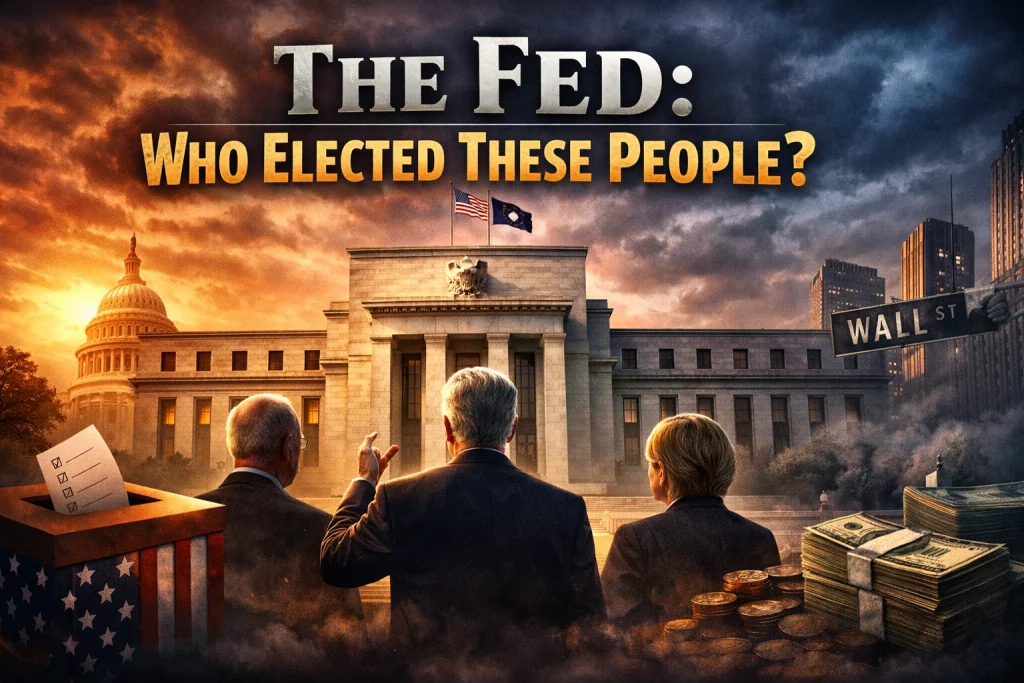
If you walked down to your local polling station last November, you probably saw a ballot full of names. You picked your favorite candidate for President, maybe a Senator or two, your local Mayor, and perhaps even the person in charge of the county water board. We love the idea of "one person, one vote." It makes us feel like we’re in the driver’s seat of this massive machine called America.
But here’s the kicker: the people who have the most direct, daily impact on the thickness of your wallet, the ones who decide if you can afford a mortgage, if your credit card interest rate is going to skyrocket, and if your groceries are going to cost 20% more next year, aren't on that ballot. You didn't vote for them. Your neighbor didn't vote for them. In fact, if you saw them in line at a Dunkin' Donuts, you wouldn’t have a clue who they were.
I’m talking about the Federal Reserve. Or, as the cool kids call it, "The Fed."
We’re told the Fed is this independent, mysterious body of economic geniuses who keep the ship steady. But for the regular guy trying to make ends meet, the Fed feels more like a secret club where the rules are written in a language nobody speaks, and the bill always seems to land on our table.
The Mystery Meat of Government
So, what exactly is the Federal Reserve? Think of it as the "bank for banks." It’s the central bank of the United States, and its job is basically to manage the country’s money supply. They have two main goals, often called the "dual mandate": keep prices stable (inflation) and make sure as many people have jobs as possible (employment).
Sounds noble, right? But here’s where the "Regular Guy" alarm starts ringing.
The Fed is led by a Board of Governors. There are seven of them. They are appointed by the President and confirmed by the Senate. Okay, so there’s some connection to the people we voted for. But here’s the catch: these governors serve 14-year terms. Fourteen years! That’s three and a half Presidential terms. By the time a governor finishes their stint, the President who picked them is probably retired and writing their memoirs in a beach house somewhere.
This is by design. The idea is that the Fed should be "independent" from politics. We don’t want a President demanding lower interest rates just so the economy looks good right before an election, right? But "independent" is often just a fancy word for "unaccountable." If they mess up: if they let inflation run wild or accidentally trigger a recession: you can’t fire them at the ballot box.
The Twelve Disciples of Interest Rates
It gets even weirder when you look at the regional level. There are 12 Federal Reserve Banks scattered across the country: places like New York, Chicago, and Dallas. Each one has its own President.
Now, surely these people are elected by the public, right? Nope.
According to the rules, these regional presidents are chosen by their own board of directors. And who is on those boards? A mix of local business leaders and, get this, bankers. While the Fed has rules to prevent "Class A" directors (who are actually bankers) from directly voting for the regional president to avoid the most obvious conflicts of interest, the whole thing still feels like a group of buddies picking the guy who’s going to oversee their industry.
The Board of Governors in D.C. has to give the final "okay," but for the guy working a 9-to-5 in Scranton or Omaha, this process is about as transparent as a brick wall. We are talking about a system where the "referees" of the economy are picked by the "players" and a handful of political appointees.
What Do They Actually Do (And Why Should You Care)?
You might be thinking, "John, why does this matter to me? I’m just trying to pay my truck note."
It matters because the Fed has its hands on two massive levers: The Money Supply and Interest Rates.
Imagine the economy is a car. The Fed is in the passenger seat with a second set of pedals. If they think the car is going too slow (recession), they slam on the gas by lowering interest rates and pumping more money into the system. This makes it cheap for you to borrow money for a house or for a business to expand.
If they think the car is going too fast and might overheat (inflation), they slam on the brakes by raising interest rates. Suddenly, that credit card balance you’re carrying gets more expensive. That mortgage you were eyeing? The monthly payment just jumped $400.
The problem is that these "experts" often have a delayed reaction. They tend to keep the gas pedal floored for too long, creating "bubbles" (like the housing bubble in 2008), and then they slam on the brakes so hard they send everyone through the windshield. And when the crash happens, who gets hurt the most? It’s not the guys in the silk suits in Lower Manhattan. It’s the regular guy whose job just got "downsized" because the Fed decided the economy needed to "cool off."

Who Actually Benefits?
This is the core question. If the Fed isn't accountable to the voters, who are they looking out for?
When the Fed keeps interest rates at near-zero for a decade: which they did after 2008: who wins?
- The Government: It’s a lot cheaper to manage that massive multi-trillion-dollar national debt when interest rates are low.
- Big Banks and Wall Street: They get to borrow money for next to nothing and invest it in assets that go up in price (like stocks and real estate).
- Big Corporations: They can borrow billions to buy back their own stock, making their executives rich while not necessarily creating a single new job.
Who loses? The Saver.
If you’re a regular guy who worked hard, stayed out of debt, and put your money in a local savings account or a CD, the Fed basically spent a decade punching you in the gut. With interest rates near zero, your savings earned nothing. Meanwhile, the cost of the things you actually need: health care, education, and a roof over your head: kept climbing.
It’s a massive transfer of wealth from the people who work and save to the people who borrow and speculate. It’s capitalism for the poor and socialism for the rich. When the big banks gamble and lose, the Fed is there with a "backstop" (a fancy word for a bailout). When you gamble and lose on a bad business idea or a high-interest loan, you’re on your own.
The Narrative Machine
The Fed is also the master of the "Economic Narrative." They use a lot of "Fed-speak": purposefully boring and confusing language designed to make you tune out. They talk about "transitory inflationary pressures" and "quantitative easing" because if they said, "We’re going to print $4 trillion and hope the price of eggs doesn't double," people might actually get angry.
They want us to believe that economics is a hard science, like physics or chemistry. It’s not. It’s a series of choices. And when those choices are made by people who have never had to worry about the price of a gallon of milk, those choices tend to favor the ivory towers over the front porches.
We’ve seen this kind of institutional drift in other places, too. Look at the medical industry. In 1960, medical costs were about 5% of our GDP. Today, we’re staring down the barrel of 20%. We’re spending more than ever, yet we’re not getting healthier. Why? Because the system shifted from "helping people" to "managing a marketplace for profit."
The Fed has undergone a similar shift. It started as a way to prevent bank runs and panics. Now, it has become the central planning hub for the entire American way of life. They are trying to micromanage the world’s largest economy using outdated tools and a "wait and see" attitude that usually results in the regular guy getting left behind.
The Silent Tax
At the end of the day, the Fed’s biggest power is the power to tax you without you ever seeing a bill. It’s called inflation.
When the Fed increases the money supply too much, the value of every dollar you have in your pocket goes down. You didn't vote for a tax hike. No law was passed in Congress. But suddenly, your $100 grocery bill is $140. That $40 difference is a "Fed Tax." It’s the price we pay for their "management" of the economy.
The Fed likes to say they want 2% inflation. Think about that. They are literally telling you that their goal is to make your money worth 2% less every single year. Over a 30-year career, that’s a massive chunk of your purchasing power gone: poof: into the ether of "economic stability."
What Can We Do?
Since we can’t vote the Fed governors out, the best thing we can do is be aware. Stop listening to the "everything is fine" headlines and start looking at the mechanics. When you hear the Fed is "pivoting" or "holding steady," understand that they are making a bet with your money and your job.
We need to demand more transparency. Why are these meetings shrouded in such secrecy? Why is the selection of regional presidents a "closed-door" affair for the banking elite? Economics shouldn’t be a mystery intended only for the high priests of finance. It’s about how we live, how we work, and how we provide for our families.
The "Regular Guy" deserves a seat at the table: or at the very least, a clear view of what’s being cooked up in the kitchen. Until then, we’re just the ones expected to wash the dishes after the feast is over.
Be mindful, be watchful and good luck.