



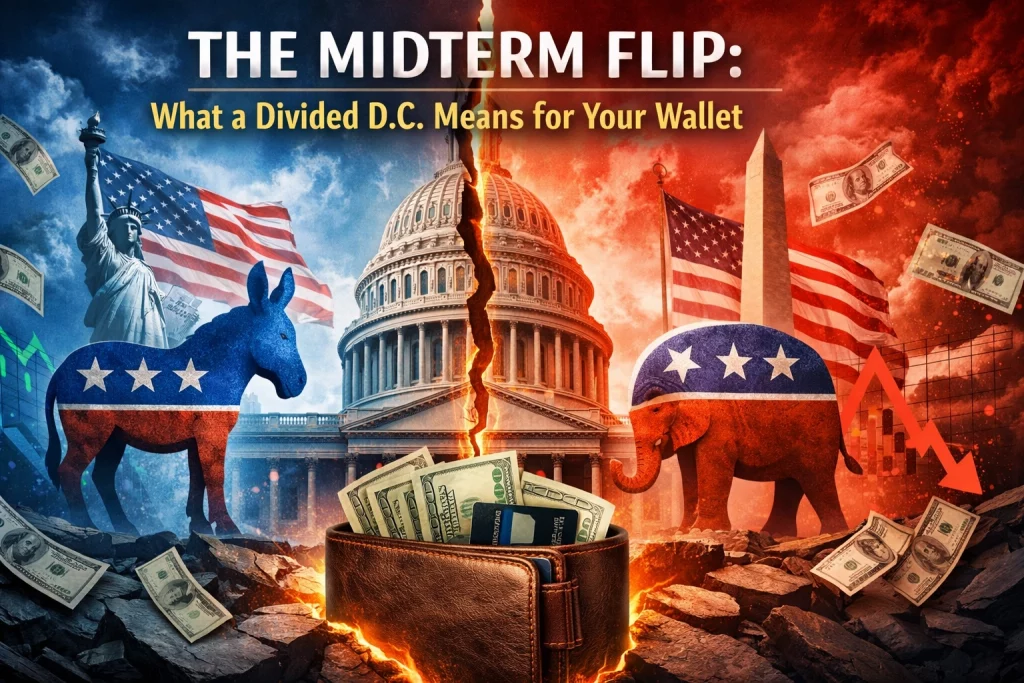
Here we are in March 2026, and the political temperature is already hitting a boiling point. If you’ve tuned into any news station lately, you know the narrative: the midterm elections are right around the corner, and the stakes couldn't be higher for the current administration.
For the "Regular Guy" just trying to balance a checkbook and keep gas in the truck, the noise from Washington D.C. usually feels like background static. But this time, the static is meaningful. If the House and the Senate flip to Democratic control this November, the political landscape won't just shift: it’ll slam into a brick wall. We’re talking about a total legislative stalemate that could render the Trump agenda inert for the next two years.
But what does that actually mean for your bank account? Does a deadlocked Congress help or hurt the working class? Let’s break down the economic ramifications of a potential "Midterm Flip" and what policies might come crawling back out of the woodwork.
The Great Gridlock: Why Nothing Will Get Done (And Why That Matters)
If the Democrats take both chambers, the most immediate effect is "The Halt." Any major piece of legislation the President wants to pass: whether it’s further deregulation, aggressive trade tariffs, or specific border funding: will be DOA (Dead on Arrival).
In political science, we call this "Divided Government." In Regular Guy terms, we call it a "Standoff." While it sounds frustrating, historically, the stock market sometimes likes gridlock because it means no radical new laws are going to mess with the status quo. However, for the working class, gridlock can be a double-edged sword. It means no new tax hikes, but it also means no new relief packages or infrastructure spending that actually reaches your neighborhood.

When the legislative branch and the executive branch are at each other's throats, the only way the President can move the needle is through Executive Orders. These are powerful, but they are also temporary and often get tied up in court for years. For the average worker, this means a lot of uncertainty. Uncertainty is the enemy of investment. If a small business owner doesn't know what the tax code will look like in eighteen months because Congress and the President are in a fistfight, they don't hire. They wait.
The Resurgence of the "Tax the Top" Narrative
With a Democratic-controlled Congress, expect the conversation to shift back to tax reform. While they won't be able to pass a massive tax hike with a Republican President holding the veto pen, they can block any extensions of current tax cuts.
We’re likely to see a push for:
- Higher Corporate Tax Rates: The argument will be that big tech and big oil are making record profits while the "Regular Guy" struggles with the price of eggs.
- The Wealth Tax: Expect a lot of talk about taxing unrealized gains or high-net-worth individuals to fund social programs.
- Expanded Child Tax Credits: This is one area where there might actually be a weird sort of bipartisan "accident," but Democrats will push for a much more robust version than what we see now.
For the working class, the impact is indirect. If corporate taxes go up, companies often pass those costs down to consumers or cut back on local hiring. On the flip side, if those taxes actually fund things like vocational training or childcare subsidies, the "Regular Guy" might see a net benefit. The problem is that in a divided government, the tax stays as a "talking point" rather than a "law," leaving us all in a state of economic limbo.
The Green Push vs. The Gas Pump
Another major shift will be in environmental policy. A Democratic Congress will almost certainly try to put the brakes on "Drill-Baby-Drill" initiatives and pivot back toward green energy subsidies.

For your wallet, this usually plays out at the pump. When the government signals a move away from fossil fuels, the markets react. Supply-side investment in oil might slow down, which can keep gas prices stubbornly high. Conversely, if you’re in a blue-collar trade related to renewable energy: like HVAC, electrical work, or specialized construction: you might see a surge in demand as federal grants for "green" upgrades resurface. It’s a classic case of some winning while others lose, depending on which industry you’re punching the clock in.
Time to Destroy the Medical Industry (As We Know It)
Perhaps the biggest economic elephant in the room: and one that both parties seem to ignore while they bicker over the small stuff: is the runaway train of medical costs. This is an issue that hits every working-class family right in the gut, regardless of who controls the Senate.
Let’s look at some cold, hard numbers. In 1960, medical costs in the United States were about five percent of our Gross Domestic Product (GDP). By 2025, that number is expected to hit twenty percent. Think about that. One-fifth of every dollar generated in this country is being sucked into the medical vortex.

We’ve seen massive technological leaps, yet for the first generation in history, our children might not live longer than we do. We have more cancer per capita, more obesity, and more Type 1 and 2 diabetes. We’re spending more and getting less. It’s a bad deal.
The "Regular Guy" sees this every month when he looks at his insurance premium. We’ve turned medicine into a hyper-capitalist machine, and unfortunately, that violates the very spirit of healing. When medicine is driven solely by shareholder profits and insurance marketplace constraints, the patient becomes a line item, not a human being.
The Car Insurance Lesson
Think about your car insurance. It’s a fluid marketplace. An automobile has a known value. If you wreck it, the repair prices are standard. If it costs more to fix than it’s worth, it’s "totaled." There’s a maximum value. There are actuarial mathematics that make sense.
Medical costs have none of that logic. You go in for a procedure, and you don't know the price until the bill shows up three months later. It’s a "buzz saw of madness" that is finally reaching a breaking point.
Interestingly, some of the biggest players in the private sector are starting to realize that the government isn't going to fix this. A few years back, we saw Amazon, Berkshire Hathaway, and JPMorgan Chase try to form their own independent healthcare company. Their goal? An effort "free from profit-making incentives and constraints."
Why? Because they realized that medical expenses are the last frontier of expense reduction. While every other business cost: inventory, logistics, communication: has been optimized to near zero over the last thirty years, medical costs have trended up.
A Shift in Direction
If the midterm flip happens, we might see a resurfacing of "Public Option" talk or more aggressive regulation on drug pricing. But the real change for the working class might come from the bottom up.
Smart companies are starting to realize that it’s cheaper to keep an employee healthy than it is to fix them once they’re broken. We need to reclassify medical costs as "health expenses." Imagine a world where your employer gives you a $100 gym membership bonus because they know it will save them $10,000 in cardiac care down the road. Imagine investing $500 in organic, plant-based nutrition to save $50,000 on colon cancer treatments later.
In a divided D.C., the "Regular Guy" shouldn't wait for a bill to pass. The economic shift we need is a move toward incentivizing health outcomes rather than just paying for "sick care."

The Working Class Reality Check
So, if the House and Senate move to the Democrats, what’s the final tally for your wallet?
- Stagnation: Don't expect any more big "Trump Era" wins for the remainder of the term. The deregulation party will likely pause.
- Defense Spending vs. Social Spending: There will be a massive tug-of-war over the budget. Republicans will want more for defense and border security; Democrats will want more for social safety nets. Usually, this results in "The CR": a Continuing Resolution: which means the government just keeps spending money we don't have at current levels.
- Inflation Risks: If gridlock leads to a government shutdown (which happens almost every time there's a split), it can rattle the markets and cause temporary spikes in interest rates or consumer goods.
At the end of the day, a midterm flip means two years of "The Blame Game." The President will blame Congress for the economy, and Congress will blame the President.
Your job? Stay lean. Don't count on a government check or a massive tax break to save your budget. The "Regular Guy" succeeds when he focuses on the things he can control: his own health, his own skills, and his own debt.
The political wind is blowing, and by November, it might be a gale-force storm. But as long as you keep your head down and your eye on your own ledger, you can weather any flip in D.C.
Be mindful, be watchful and good luck.