



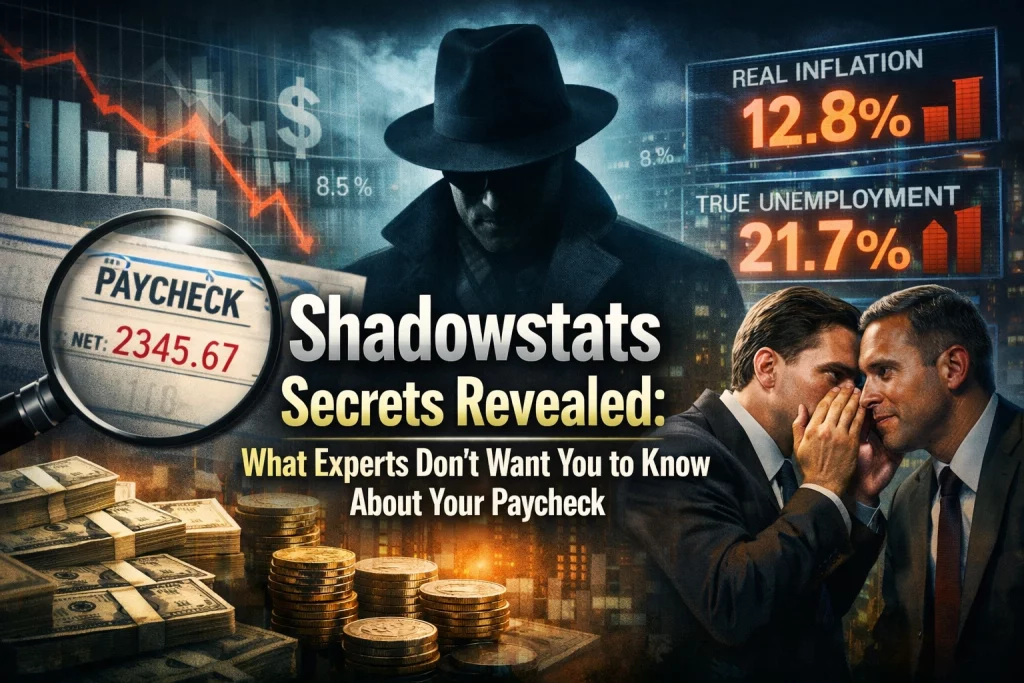
Have you ever walked out of a grocery store with two bags of food, looked at your receipt for $120, and thought, “Wait, didn’t this used to cost $60?” Then you turn on the news, and some guy in a $3,000 suit tells you that inflation is a "cool" 3.1%.
You aren't crazy. You’re just being gaslighted by a set of statistics that have been massaged, manipulated, and reimagined more times than a Hollywood reboot. Welcome to the world of Regular Guy Economics, where we look past the shiny government charts to see what’s actually happening to your wallet.
Today, we’re pulling back the curtain on Shadowstats and the "Old School" way of measuring inflation. Because if you feel like you’re working harder just to stay in the same place, it’s probably because the yardstick the government uses to measure your progress has been shortened by a few inches every year since the 1980s.
The Great Inflation Magic Trick
Back in the day: we’re talking the Jimmy Carter era: measuring inflation was pretty straightforward. You took a basket of goods that a normal family needed (bread, milk, a car, rent), and you tracked how much the price of that basket went up. That was your Consumer Price Index (CPI). Simple, right?
But in the 1980s and again in the mid-90s, the government realized that high inflation numbers looked bad. Really bad. They made Social Security payments go up (because they are tied to CPI) and they made the economy look like a dumpster fire. So, they decided to change the math.
They introduced two concepts that sound like yoga poses but are actually financial sleight-of-hand: Substitution and Hedonics.
Substitution: "Steak is for Winners, You Get Chicken"
The old CPI measured the cost of maintaining a constant standard of living. If the price of steak went up, the CPI reflected that. But the "New" CPI assumes that if steak gets too expensive, you’ll just stop being a "steak guy" and start being a "ground beef guy."
Since you "substituted" a cheaper item, the government claims your cost of living didn't actually go up that much. It’s like telling someone who can no longer afford a house that their cost of living is fine because tents are still cheap. It doesn't measure inflation; it measures your decline in lifestyle.

Hedonics: "Your Computer is Too Good to Be Expensive"
Then there’s Hedonics. This is the idea that if a product gets better, its "real" price has gone down, even if the sticker price went up.
Let’s say a new truck costs $10,000 more than last year's model, but it has a better backup camera and more horsepower. The government might argue that because the truck is "better," the price didn't actually go up: it might have even "decreased" in their math. But try telling the dealership you’ll pay for that truck with "hedonic quality points" instead of the extra $10,000. It doesn't work.
Enter Shadowstats: The Real Numbers
This is where John Williams and his site, Shadowstats, come in. Williams is an economist who got tired of the smoke and mirrors. He decided to calculate inflation using the original 1980 methodology: the one the government used before they started "massaging" the data.
The results? They’re terrifying.
While the official BLS (Bureau of Labor Statistics) might tell you inflation is hovering around 3% or 4%, the Shadowstats 1980-based alternate shows it closer to 10% or 12%.
When you look at the 1980-based charts, the line doesn't just "tick up": it screams. It explains why your paycheck feels like it’s evaporating. If your boss gives you a 3% raise because "that's the inflation rate," but the actual cost of living is up 10%, you didn't get a raise. You got a 7% pay cut.

Why the Experts Hate This
Now, if you go to a fancy university or work for a "reputable" financial news outlet, you’ll hear that Shadowstats is a conspiracy theory. Critics say the methodology is flawed or that the math doesn't hold up. They argue that the BLS is transparent and that "quality adjustments" (like hedonics) are necessary in a modern economy.
But here’s the thing: we don't live in a "modern economy" textbook. We live in the real world where we have to pay rent and buy eggs. Even if Shadowstats is slightly overstating the case, it feels a lot closer to the truth than the official numbers. The disconnect between "Official Data" and "The Price of a Taco" has never been wider.
The Final Frontier: The Medical Industry Monster
If there is one place where the "official" math of economics completely breaks down and hits a "buzz saw of madness," it’s in the American medical industry.
Think about this: In 1960, medical costs in the U.S. were about 5% of our GDP. By 2025, that number is expected to hit 20%. One-fifth of everything we produce is going toward healthcare. And for what?
Despite the "epic climb" in spending, we aren't getting healthier. For the first time in history, it looks like our children might not live longer than we do. We have more cancer per capita, more obesity, and a skyrocketing rate of diabetes. We are spending more to get less.

Medicine has become part of capitalism, and unfortunately for the people who actually need care, it shouldn't be. The medical marketplace doesn't work like a normal market. In a normal market, if a car is "totaled," there’s a maximum value established by math. In medicine, there is no "totaled." There is just a "runaway train" of costs that escapes the noose every single year.
Time to Destroy the Status Quo
What took us so long to realize this? We’ve optimized every other part of our lives. We have "just-in-time" inventory, variable workforces, and third-party outsourcing that has wrung the cost out of almost every product we buy. Yet, medical expenses keep trending up while everything else gets more efficient.
The math of medicine is actually pretty simple if you look at it from a "Regular Guy" perspective:
- Doctors and Nurses aren't the problem: For the most part, they aren't the ones making the massive, "shameful" money.
- The System is the problem: We spend billions on a "cocktail of prescription medicines" with side effects worse than the original ailment because there’s more profit in treating a symptom than curing a cause.
Recently, we’ve seen the heavy hitters start to push back. Amazon, Berkshire Hathaway, and JPMorgan Chase announced they were forming their own healthcare company to serve their employees: free from profit-making incentives. Why? Because they realized that the current medical industry is a parasite on the American worker’s paycheck.

What Can We Do?
If the government is lying to us about the value of our money, and the medical industry is eating our raises, what’s the move?
It’s time to reclassify "medical costs" as "health expenses." We need to invest in ourselves before the system gets a chance to bill us.
- The Gym over the Hospital: A $100 gym membership might save you $10,000 in cardiac care down the line.
- Organic over Processed: Spending an extra $500 a year on plant-based, organic nutrition might save you $50,000 by knocking out the risk of colon cancer.
- Stress Management over Pills: Investing time in your own mental health creates better outcomes than any "magic pill" ever could.
We spend one-third of our lives working. It’s about time we stopped letting that effort be siphoned off by manipulated inflation stats and an unsustainable medical system.
The experts will keep telling you that everything is fine. They’ll show you a chart with a 2.5% inflation target and tell you that your $8 carton of eggs is just a "temporary fluctuation." Don't believe them. Trust your eyes, trust your bank account, and trust the fact that the system was redesigned in the 80s to make the people at the top look good while you look for the cheapest chicken in the freezer aisle.
Be mindful, be watchful and good luck.