



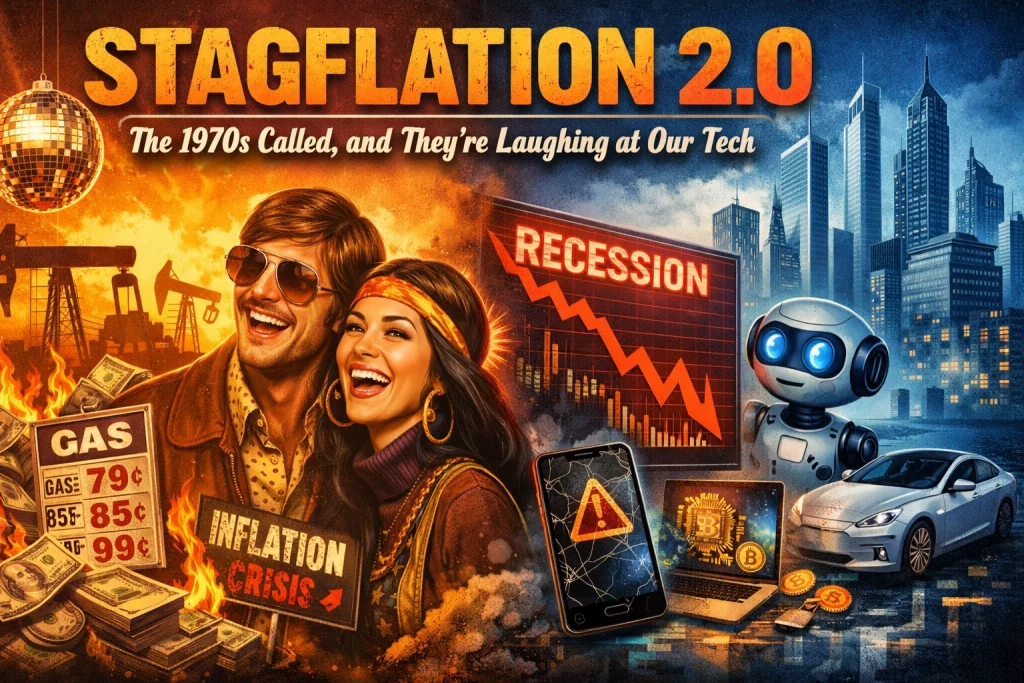
If you walked into a room in 1975 wearing bell-bottoms and carrying a rotary phone, people would think you’re a bit eccentric. If you walked into a room in 2026 and told everyone that the 1970s were actually "easier" for the average worker, they’d probably throw their $1,200 iPhone at you.
But here’s the thing: those guys in the 70s? They’re laughing at us.
Sure, they had gas lines, disco, and lead paint. But they also had a economic phenomenon that we’ve spent the last forty years pretending we "solved" with technology. It’s called stagflation, that miserable cocktail of high inflation, stagnant growth, and high unemployment. For decades, the high-priests of economics told us that between the internet, global supply chains, and AI, we were too "efficient" to ever fall back into that trap.
Well, it’s March 2026, and the trap just snapped shut.
The Efficiency Illusion
We were promised that technology would set us free. We’ve got AI that can write poetry, apps that deliver burritos in twelve minutes, and software that "optimizes" every second of a worker's day. Theoretically, we should be living in a leisure-filled utopia.
Instead, we’re living through a "Math Illusion."
Efficiency has certainly gone up, but for the "Regular Guy," it feels like we’re running faster just to stay in the same place. In the 1970s, stagflation was driven by a massive supply shock: the oil embargo. Today, the shock is more subtle, but more pervasive. It’s the "Ghost Job" market where unemployment looks low on paper, but real, living-wage jobs are harder to find than a quiet corner in a Zoom-call world.

We have all this "efficiency," yet the squeeze on the average family has never been tighter. Why? Because the gains from that efficiency didn't go into your paycheck. They went into the cost of "non-negotiables." In 1975, if things got tight, you cut back on steak or skipped the movies. In 2026, the "inflation" is baked into things you can’t skip: your high-speed internet (required for work), your mandatory health insurance premiums, and your "smart" appliances that require a subscription to make toast.
The 1970s vs. 2026: A Single Income Reality Check
Let’s look at the math, because the math doesn't care about your political leanings.
In the mid-70s, even with inflation hitting double digits, a single income from a manufacturing job or a mid-level office role could: and often did: support a family of four, buy a starter home, and put two cars in the garage. Interest rates were high (topping out at 20% by 1980), but the principal on the house was three times the annual salary.
Today? The "Stag" part of stagflation is our wage growth, and the "flation" part is our cost of living. Even with "moderated" inflation rates compared to the 2022 peak, the cumulative damage is done. We are looking at a 2026 where the "Regular Guy" needs a partner’s full-time income and a side-hustle just to afford a mortgage that is seven or eight times his annual salary.
The 1970s guy had a union card and a pension. The 2026 guy has a "flexible" gig-economy app and a 401(k) that’s currently being eaten alive by the "slow growth" side of the stagflation equation. Who’s laughing now?
The Medical Math of Madness
If you want to see where the stagflation beast is really hiding, look at the doctor’s office. This is what I call the "Math of Madness."
In 1960, medical costs in the United States were about 5% of our Gross Domestic Product (GDP). It was a manageable slice of the pie. Fast forward to 2025/2026, and we’re staring down the barrel of 20% of GDP. We have made an "epic climb" from the basement to the penthouse of expense, but we’re living in a drafty, broken building.
Think about it: we have better tech than ever. We have robotic surgery and pharmaceutical breakthroughs that sound like science fiction. And yet, for the first generation in American history, our children are not expected to live longer than we are. We have more cancer per capita, more obesity, and a cocktail of prescription meds that often have side effects worse than the original ailment.

In any other industry, technology drives costs down. Look at your TV: a 60-inch screen costs less today than a grainy 19-inch box did in 1980. But in medicine, the "capitalism" part has gone off the rails. It’s a marketplace where the consumer (you) doesn't know the price, the provider (the doctor) isn't the one paying, and the insurer (the middleman) has an actuarial interest in charging you as much as possible while paying out as little as possible.
It’s like car insurance, but without the logic. When a car is damaged beyond repair, it’s "totaled." There’s a maximum value. In the medical world, there is no "totaled" value. There is only the infinite drain of costs until the "Regular Guy" is bankrupt.
The Last Frontier: Reclaiming Our Health (and Our Wallets)
What’s interesting is that the big players are finally starting to blink. A few years ago, Amazon, Berkshire Hathaway, and JPMorgan Chase tried to form an independent healthcare company to serve their employees. They wanted something "free from profit-making incentives and constraints."
Why? Because they realized that healthcare costs are the "runaway train" that is derailing American productivity.
In a stagflationary environment, you can’t just keep raising prices on the consumer: they’re already tapped out. You have to cut costs. And the biggest, fattest, most bloated cost in the American budget is the "medical industrial complex."

We need to stop calling it "medical costs" and start calling it "health expense." If a company spends $100 on a gym membership or healthy, organic nutrition for an employee, and that reduces the chance of a $50,000 cardiac event or a $100,000 cancer treatment, that’s not just "good vibes": that’s a massive win for the balance sheet.
It’s the last frontier of expense reduction. We’ve already optimized our inventories to near zero. We’ve already outsourced everything that wasn't nailed down. The only thing left to "optimize" is our own survival.
Why Tech Won't Save Us This Time
We keep waiting for a "killer app" or a new AI model to fix the economy. But technology can't fix a supply shock if the supply being shocked is "affordable life."
The stagflation of the 2020s is different from the 70s because it’s not just about oil; it’s about the "commoditization" of everything. Private equity has bought up the starter homes. Insurance companies have "optimized" the medical bills. Trade policies (the ghosts of NAFTA) have traded our high-paying factory jobs for cheap T-shirts and high-interest credit card debt.
The guys from the 1970s are laughing because they saw the "worst of all worlds" and realized they still had a foundation. They had a middle class that wasn't built on a mountain of subscription-based debt. They had a single income that meant something.

To beat Stagflation 2.0, we have to stop looking at the "efficiency" stats on a screen and start looking at the math in our checkbooks. We have to reclassify what's important. We have to invest in outcomes: real health, real housing, real wages: rather than just "optimizing" the descent.
The 1970s are calling. They don't want their bell-bottoms back. They want us to wake up and realize that "high-tech" doesn't mean "high-standard-of-living" if you can't afford to live in the world you built.
Be mindful, be watchful and good luck.