



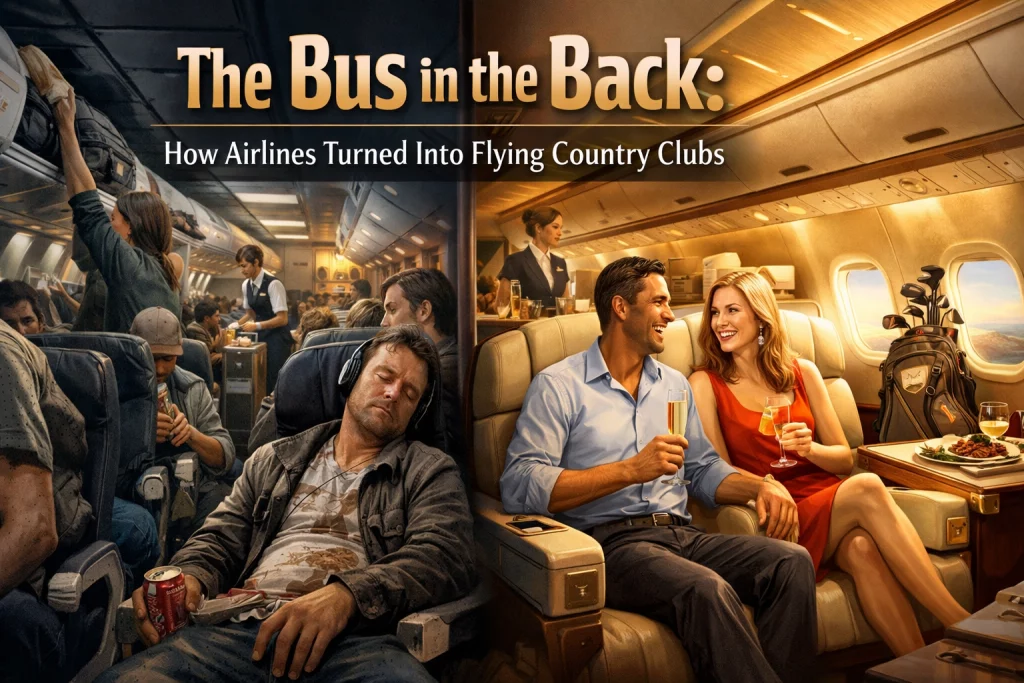
If you’ve stepped onto a plane lately: specifically here in the early months of 2026: you’ve likely experienced the "Walk of Shame." You know the one. It’s that thirty-second stroll from the boarding door to your seat in row 42, where you have to shuffle past rows of gleaming white pods, sliding privacy doors, and people sipping champagne out of actual glass stemware.
By the time you reach your seat, which has the legroom of a vertical coffin and the padding of a middle-school cafeteria chair, you realize something fundamental has changed. The airline industry isn’t in the business of transportation anymore. They are in the business of real estate, and they’ve decided to build a gated community at 35,000 feet while the rest of us are stuck in the tenements.
Welcome to the "Suite Wars" of 2026. It’s a battle for the wallets of the 1%, and the "Regular Guy" is the one paying the ultimate price in lumbar support.
The Great Flip: Delta’s 2025 Milestone
For decades, the math of an airline was simple: fill as many seats as possible. The "back of the bus" was the bread and butter. Coach passengers were the volume that kept the engines turning, and First Class was just a nice little bonus for the occasional corporate high-flyer.
That world died last year.
In 2025, Delta Air Lines hit a milestone that sent shockwaves through the industry. For the first time in history, their revenue from premium cabins: First Class, Delta One, and those fancy "Premium Select" seats: officially surpassed the revenue they made from the "cheap" seats. Let that sink in. The people in the front 20% of the plane are now more valuable to the airline than the other 80% combined.
We are living in an era where 15-20% of the physical seats on a plane are generating over 50% of the total revenue. To the bean counters in Atlanta, Chicago, and Dallas, the "Regular Guy" in seat 34B isn't the customer anymore. You're just ballast. You are the filler used to justify the fuel cost so they can fly the "Suites" across the country.
The Suite Wars of 2026
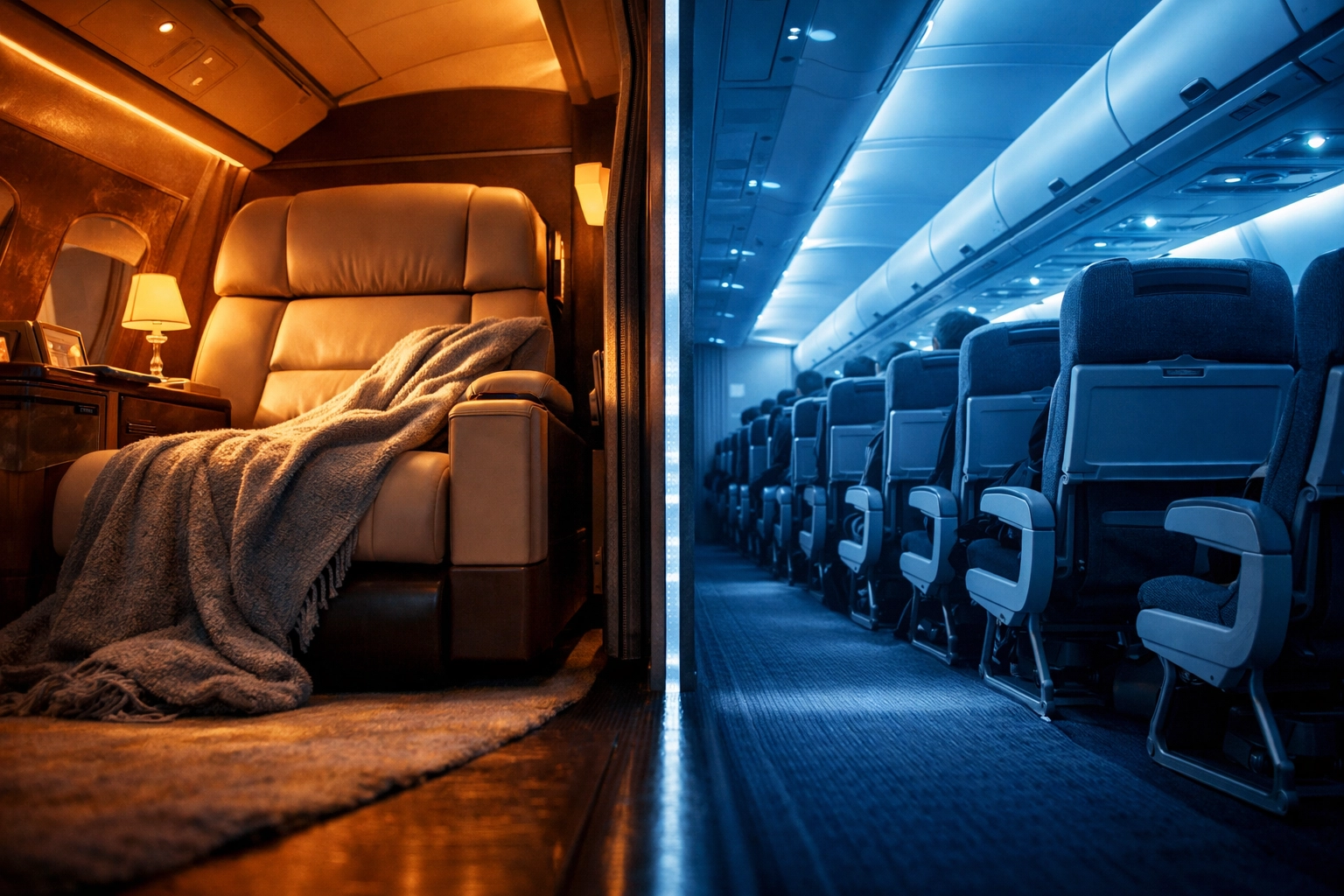
If you think a "First Class" seat is just a wider chair with a bit more legroom, you haven't been paying attention to the arms race happening in the front of the cabin. We are currently in the heat of the "Suite Wars."
Airlines are no longer competing on who has the best snacks; they are competing on who can build the most convincing "flying apartment." We’re talking about sliding doors for privacy, personal wardrobes, 32-inch 4K monitors, and bedding that costs more than my first car.
But here’s the kicker for the rest of us: that space has to come from somewhere. Airplanes aren't getting bigger. The laws of physics and Boeing’s current production backlog mean the "footprint" of the cabin is fixed. If an airline wants to install a massive "Premium Suite" that takes up the space of four old First Class seats, they don't just lose those three seats. They have to make up the revenue somewhere else.
How do they do it? They squeeze the back. They move the "slimline" seats closer together. They shave an inch off the width. They make the bathrooms so small you have to step outside just to change your mind. The luxury in the front is literally being carved out of the comfort in the back.
The Economics of the "Warm Nut Bowl"
Let’s look at the actual "Regular Guy" math of a domestic flight. Suppose you’re flying from New York to Los Angeles. A coach ticket might run you $450 if you book at the right time. That same flight in domestic First Class? You’re looking at $1,800 to $2,500.
That is a 4x to 5x price increase.
For that extra $1,500, what are you actually getting? On a domestic flight, you aren't getting a bed. You’re getting a seat that’s maybe five inches wider. You’re getting a "meal" that usually consists of a lukewarm chicken breast that’s been pressurized into submission. And, of course, the legendary warm nut bowl.
Is a bowl of cashews and a slightly wider armrest worth an extra $1,500? In no other industry on Earth would that math make sense. If you went to a restaurant and they said, "You can sit at this table for $50, or you can sit in a chair that’s two inches wider for $250," you’d walk out. But in the sky, we’ve been conditioned to accept this as the cost of "status."
The reality is that you aren't paying for the seat. You’re paying for the privilege of not being treated like a sardine. The airlines have intentionally made the coach experience so miserable that they’ve created a "protection racket." They make the "Standard" experience painful enough that you’ll consider paying double or triple just to have a modicum of human dignity.
How Did We Get Here? A Brief History of the Squeeze
It wasn't always this way. If you look back at the "Golden Age" of travel (roughly 1935 to the late 60s), every flight was essentially First Class. In 1935, a flight was an event. You dressed up. You had legroom. Of course, a ticket cost as much as a new Ford, but the experience was uniform.
Then came the Airline Deregulation Act of 1978. On paper, this was a win for the Regular Guy. It removed government control over fares and routes, which crashed the price of flying. Suddenly, the middle class could afford to fly to Disney World instead of driving for three days.
But capitalism is a hungry beast. Once price became the only thing people cared about, airlines realized they had to find a way to make money off the people who weren't price-sensitive. In 1979, Qantas introduced "Business Class," and the Great Stratification began.
Since then, it’s been a slow, steady crawl toward the "Flying Country Club" model. The airlines realized that if they could capture the 1% of travelers who put their tickets on a corporate AMEX, they could treat the rest of us like cargo.
Check out more on the history of these economic shifts at http://www.regularguyeconomics.com.
The Profitability of Exclusion
The reason this won't change anytime soon is because it works. High-margin luxury is the only thing keeping airlines profitable in 2026.
Think about it: it costs the airline almost the same amount of fuel to fly a person in a $5,000 suite as it does to fly a person in a $500 economy seat. The weight difference is negligible in the grand scheme of a Dreamliner's fuel burn. But the profit margin on that $5,000 seat is astronomical.
By turning 20% of the plane into a flying country club, the airlines have insulated themselves from the volatility of the economy. Even when the Regular Guy is cutting back on his summer vacation because inflation is eating his paycheck, the C-suite executive is still flying "Delta One" on the company dime.
The airlines have effectively abandoned the middle class. We are no longer their target demographic; we are just the "volume" required to keep the route maps viable. We are the "bus in the back" that allows the "club in the front" to exist.
The Future: Standing Room Only?
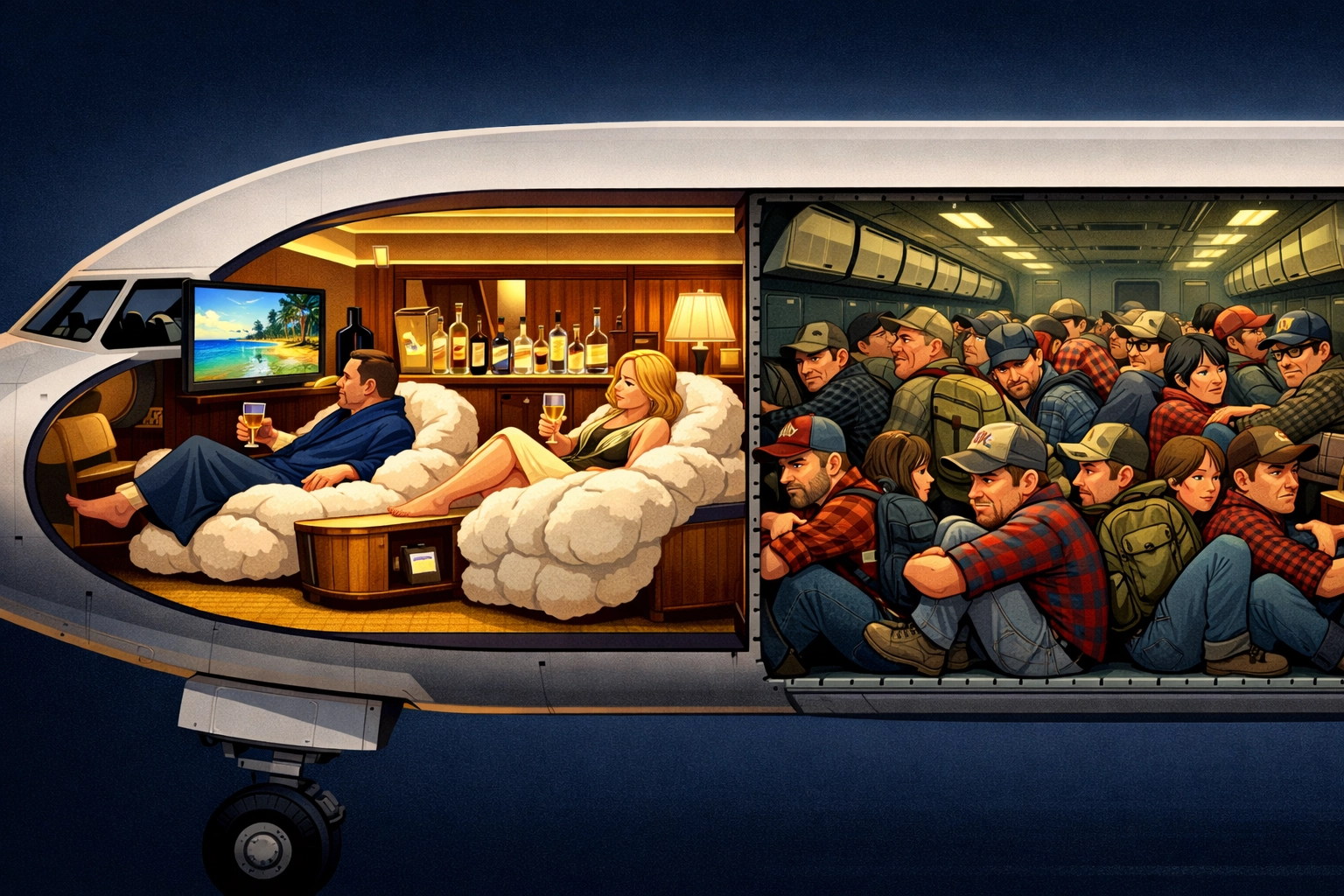
Where does this end? If the trend of the last decade continues, the "Suite Wars" will eventually consume half the plane. We’re already seeing "Basic Economy" tickets that don't even allow you to use the overhead bin. What’s next?
There have been patents filed for "standing seats" where passengers are essentially propped up against a padded board. While that might seem like a joke, look at the trajectory. We’ve gone from "Golden Age" luxury to "Slimline" plastic seats with 28 inches of pitch.
The gap between the "Haves" and the "Have-Nots" is nowhere more visible than at 30,000 feet. On one side of the curtain, you have a multi-course meal, a flat-bed seat, and noise-canceling headphones. On the other side, you’re fighting for an inch of elbow room and hoping the guy in front of you doesn't recline his seat into your kneecaps.
It’s a micro-cosm of our entire economy. The middle is being hollowed out. You’re either in the "Suite" or you’re in the "Squeeze."
Final Thoughts for the Regular Guy
The next time you’re boarding a flight and you pass those beautiful, private pods in First Class, don't feel jealous. Feel informed. Know that those people are the reason your seat is three inches narrower than it was ten years ago. They are the high-margin residents of the gated community, and you are the one paying the "occupancy tax" in the form of cramped legs and a sore back.
The airline industry has made its choice. They’ve decided that the 20% is worth more than the 80%. As long as we keep buying the "Basic Economy" tickets and complaining about it on Twitter, they’ll keep shrinking our seats to make room for more champagne storage up front.
Flying used to be about the miracle of human flight. Now, it’s just a lesson in tiered asset management.
Be mindful, be watchful and good luck.