




You can't scroll through your feed without someone promising that AI will change everything. Your job, your life, your grocery shopping: AI's coming for it all. And maybe it will. But here in early 2026, there's a question worth asking before you dump your savings into the latest AI stock: Are we watching innovation or are we watching a rerun of the dot-com disaster?
The smell in the air feels familiar. Massive valuations. Wild promises. Everyone scrambling not to miss the boat. And underneath it all, a whole lot of money moving from regular folks into the pockets of people who know exactly when to cash out.
Let's talk about what's really happening with AI: and what warning signs you should watch before this party turns into a hangover.
The Spending Frenzy That Doesn't Add Up

Here's where things get interesting. The big tech giants: Amazon, Microsoft, Alphabet, Meta, and Oracle: spent $241 billion on AI infrastructure in 2024. That's not a typo. And they're on track to hit around $500 billion in 2026. That's more than the GDP of Belgium. For servers and chips.
OpenAI alone plans to spend $1.4 trillion on computing resources over the next eight years. Let that sink in. They're planning to spend $1.4 trillion while pulling in about $20 billion in annual revenue. That's like earning $20,000 a year and announcing you're going to spend $1.4 million on tools for your side hustle.
Does this sound like solid business math, or does it sound like the late '90s when every startup with a ".com" in its name could raise millions based on eyeballs and "potential"?
Back in 1999, Pets.com spent millions on Super Bowl ads and infrastructure despite barely making any revenue. The difference? They went bust in 2000. Today's AI companies have deeper pockets and smarter PR teams. But the same question lingers: Where's the actual profit?
The 3% Problem
Here's a number that should make you pause: Only 3% of AI users actually pay for premium-tier services.
Let that marinate for a second. Everyone's talking about AI. Everyone's using ChatGPT or some AI tool. But almost nobody's paying real money for it. The free versions work well enough that most people never upgrade.
This creates a fascinating problem. If you're spending hundreds of billions to build the infrastructure but only 3% of users will ever pay you, how exactly does the math work?
The answer: It doesn't. At least not yet. The bet is that eventually, somehow, someone will figure out how to monetize all this. But "eventually" and "somehow" are the same words that fueled the dot-com bubble. Lycos, Webvan, eToys: they all had traffic. They just couldn't turn clicks into cash before the money ran out.

The Infrastructure Squeeze
Meanwhile, the costs of building AI infrastructure are skyrocketing. DRAM prices: that's the memory chips these systems need: jumped 172% year-over-year in Q3 2025. Electricity costs, which AI data centers devour like a teenage boy at an all-you-can-eat buffet, are up 39% over the past five years in the U.S.
So you've got falling revenue per user (because nobody's paying) and exploding costs to deliver the service. That's not a business model. That's a bonfire with a tech logo.
The Croupier's New Casino
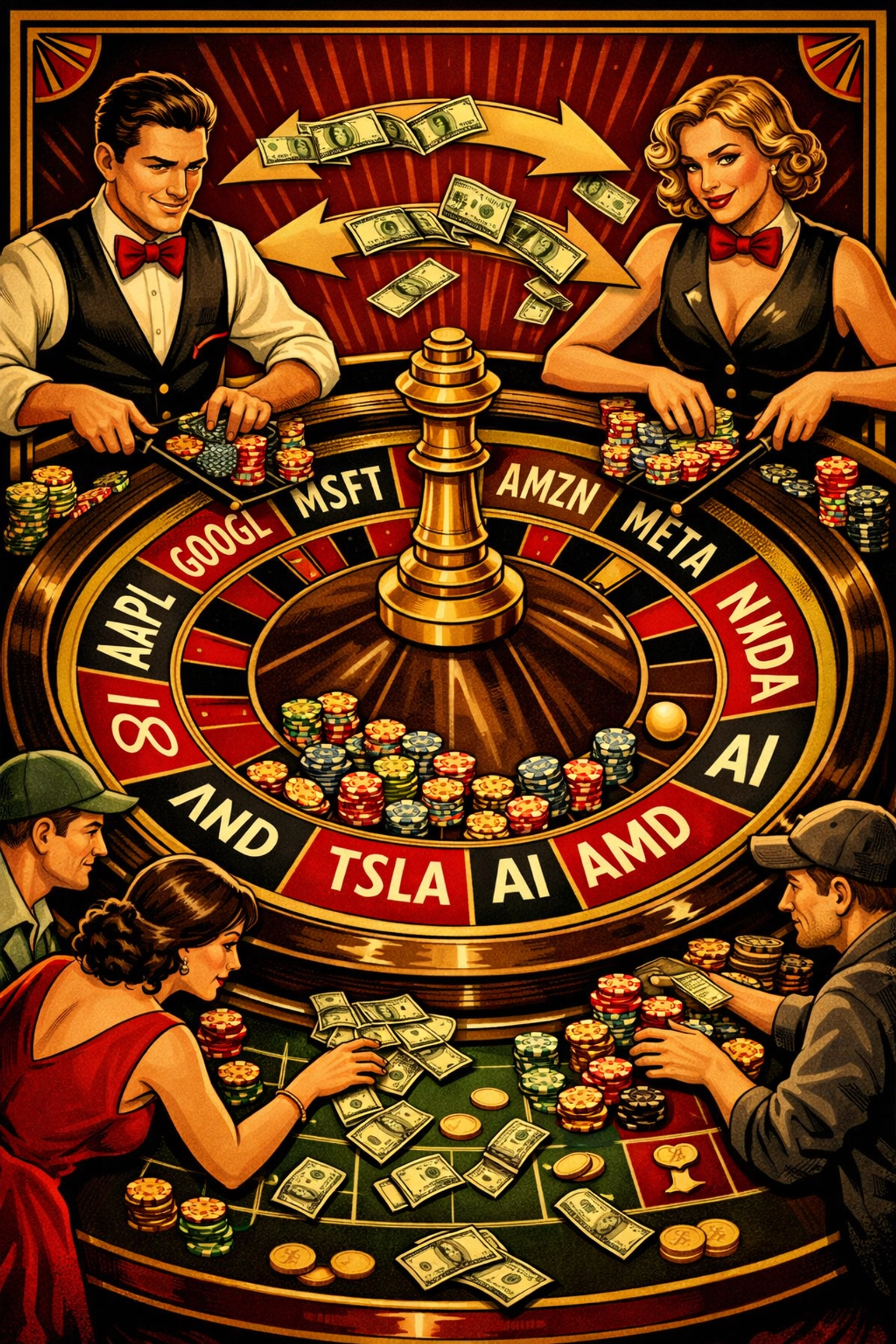
Remember our Croupier Economics concept? Money flowing from the many to the few? AI is shaping up to be the latest casino table.
Here's how it works: Regular investors see AI stocks soaring and don't want to miss out. They buy in at $200, $300, $500 a share. The early insiders: venture capitalists, hedge funds, company executives with stock options: they bought in at $5 or $10. When the hype peaks, they sell to you at $500. When reality sets in and the stock drops to $150, guess who's holding the bag?
There's another layer to this. A chunk of AI investment is essentially circular: the big tech companies investing in each other's AI projects, buying each other's cloud services, partnering on AI initiatives. It's like a game of financial musical chairs where the same players keep passing money around the table. This makes it incredibly hard to measure genuine external demand.
Is there real customer demand driving this, or is it just the house betting on itself?
What's NOT Happening (Yet)

To be fair, we need to acknowledge what's different from the dot-com bubble. As of early 2026, some traditional warning signs aren't flashing red yet:
- Big tech companies are financing AI growth through operating cash flows, not massive debt
- They're buying back $1 trillion in stock, not issuing new shares
- Free cash flows haven't collapsed
- Credit spreads haven't widened dramatically
These companies aren't broke. They're profitable giants making big bets. That's fundamentally different from 1999 startups burning through venture capital with no revenue.
But here's the thing: A rich gambler can still make a terrible bet. Just because you can afford to lose doesn't mean you should.
Warning Signs for the Regular Guy
So what should you watch for? Here's your practical checklist:
The Revenue Reality Check: Keep asking: Who's actually paying? Not who's using the product, but who's paying real money for it? If usage is exploding but revenue isn't, that's a problem.
The Productivity Paradox: For all this AI spending, where are the actual productivity gains in the economy? If AI is revolutionary, we should see it in GDP growth, labor productivity numbers, and company earnings. So far? Not much. Companies are spending billions but not seeing proportional returns.
The Valuation Disconnect: When stock prices rise faster than earnings, eventually gravity kicks in. If a company is valued at 100 times earnings because "AI will change everything," ask yourself: What happens if it doesn't? Or if it takes 20 years instead of 2?
The Circular Money: Watch for who's investing in whom. When the same five companies are funding each other's projects, buying each other's services, and investing in each other's AI ventures, that's not a market: that's a closed loop.
The Exit Timing: Pay attention to when insiders sell. When executives and early investors start cashing out in big numbers while telling you to buy, that's the house leaving the casino before the fire alarm goes off.
What Should You Do?
First, don't panic. AI is real, and some applications will be genuinely transformative. But transformative doesn't always mean profitable, and profitable doesn't always mean your investment will make money.
Second, be skeptical of FOMO (fear of missing out). The dot-com bubble made early investors rich and late investors broke. The difference was timing. If you don't know where we are in the cycle, you're probably not early.
Third, ask the basic questions: Does this company make money? How much? Is that profit growing faster than costs? Can I explain the business model to my neighbor without using buzzwords?
And fourth, remember that the house always wins. In Croupier Economics, the people moving money make their cut whether the bet wins or loses. The venture capitalists, investment banks, and insiders selling at the top: they're not betting on AI's success. They're betting on your enthusiasm.
AI might be the future. But futures can take a long time to arrive, and you can go broke being early just as easily as being wrong.
The dot-com bubble taught us that revolutionary technology and terrible investments can coexist. The internet did change everything: just not fast enough to save most of the companies that bet on it in 1999.
Keep your eyes open, your wallet close, and remember that spectacular promises often lead to spectacular losses.
Be mindful, be watchful and good luck.