



Remember when every business meeting turned into a blockchain pitch session? When your cousin who sells insurance suddenly became a "distributed ledger consultant"? When someone, somewhere, genuinely suggested putting their corner deli on the blockchain?
Yeah. We're doing it again. But this time, it's AI.
The Blockchain Orgasm Years: A Brief History
Between 2017 and 2021, we witnessed something special. Not special in a good way, special in a "watching a train wreck in slow motion while someone plays techno music" kind of way. Every company, from Fortune 500s to your local dry cleaner, was having what can only be described as a blockchain orgasm.
The symptoms were unmistakable: executives who couldn't explain what a hash function was suddenly demanded blockchain integration into everything. Supply chains that worked fine for decades needed to be "revolutionized" with distributed ledgers. And yes, people actually discussed putting restaurants, art galleries, and literally anything with a physical address onto the blockchain.

The pitch was always the same: "Imagine a world where trust is decentralized, transactions are transparent, and middlemen are eliminated!" What we got instead was a bunch of slow databases that cost more to run than the problems they claimed to solve.
By 2023, the blockchain hype had mostly deflated. Not because the technology was fundamentally broken, blockchain does have legitimate use cases, but because 99% of the applications were solutions desperately searching for problems.
Welcome to AI: The Sequel Nobody Asked For
Fast forward to 2026, and we're watching the exact same movie with a different soundtrack.
Now it's "AI-powered this" and "machine learning-enabled that." Your email provider has AI. Your toaster probably has AI. There are AI resume builders, AI meeting summarizers, AI fitness coaches, and AI companions that will tell you you're doing a great job (for $19.99 a month, of course).
The buzzword bingo card has simply been updated. Where we once had "distributed ledger," "smart contracts," and "immutable records," we now have "neural networks," "large language models," and "generative AI."
And just like the blockchain era, the actual utility for regular people? That's still pending.
Corporate Buzzword-itis: A Chronic Condition
Here's how it works in the corporate world. Some executive reads an article on the flight to a conference. By the time they land, they've decided the company needs an "AI transformation initiative."
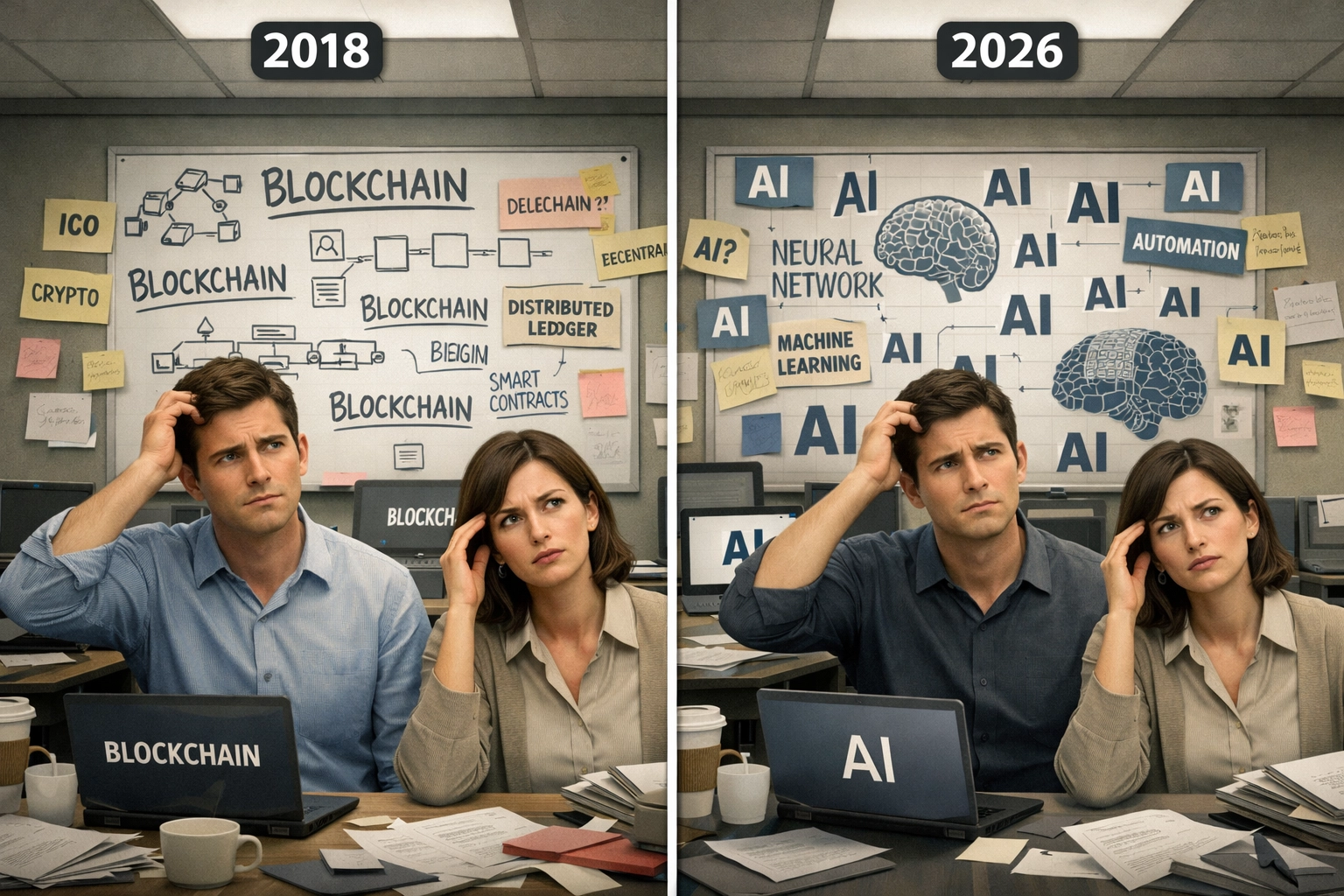
A task force is assembled. Consultants are hired at eye-watering rates. PowerPoint decks are created with lots of gradients and stock photos of diverse people pointing at transparent screens. Everyone nods seriously when someone mentions "synergizing our AI capabilities across the enterprise ecosystem."
Six months and several million dollars later, the company has:
- An AI chatbot that answers customer questions worse than the FAQ page
- An "intelligent" document processor that still requires three people to check its work
- A meeting notes AI that summarizes your one-hour meeting into a five-paragraph summary that still doesn't tell you what you're supposed to do next
But hey, the press release looked great, and the stock got a little bump when they announced they were "leveraging cutting-edge artificial intelligence."
The ROI That Never Shows Up
Let's talk about return on investment, because that's where the blockchain comparison really hits home.
During the blockchain boom, companies spent billions, yes, billions with a B, trying to implement blockchain solutions. IBM alone threw over $1 billion at blockchain projects. The result? Most of them were quietly shelved, produced underwhelming results, or proved more expensive than the traditional systems they were supposed to replace.
Now we're seeing the same pattern with AI. Companies are hemorrhaging cash on AI implementations that promise to "revolutionize operations" and "increase productivity by 10x." The reality? Most employees are secretly still doing their jobs the old way because the AI tool is clunky, doesn't understand context, or produces work that needs so much editing that you might as well have done it yourself.

A recent survey found that 80% of AI projects fail to deliver expected value. But that won't stop the next round of funding, because admitting you wasted money on the hot buzzword is career suicide. Better to declare victory, bury the real metrics, and move on to the next shiny object.
The Plot Twist: Now They're Converging!
Just when you thought the narrative couldn't get more absurd, the tech industry has found a way to double-down on the buzzwords. The new pitch? AI and blockchain are "converging as complementary technologies."
That's right, we're not abandoning one failed hype cycle for another. We're combining them! It's like mixing two mediocre cocktails and claiming you've invented sangria.
The story goes like this: AI agents need blockchain for "programmable money, tradable digital assets with instant global settlement, and trust minimized infrastructure." Blockchain needs AI for "smart contract security" and "decentralized finance applications."
It's beautiful, really. The market for "AI for blockchains" is projected to hit $3.46 billion by 2034. That's a lot of money for technology that most people still can't explain at a dinner party and fewer can point to as actually improving their daily lives.
What Regular Guys Actually Need (Spoiler: It's Not This)
Here's the thing that gets lost in all the buzzword bingo: regular people don't need AI everything. They need tools that actually work and solve real problems without requiring a PhD to operate.
You know what would be revolutionary? If my bank's app didn't crash when I'm trying to transfer money. If customer service phone lines weren't designed to make me give up and accept my problem. If "smart" home devices didn't require troubleshooting every other week.

The blockchain deli never happened because nobody actually needed their sandwich orders on an immutable ledger. And most AI applications are following the same path, lots of investment, lots of buzzwords, not a lot of practical value for the people who are supposedly being helped.
We're seeing AI meeting tools that produce summaries nobody reads. AI writing assistants that sound like a robot trying to pass a Turing test. AI customer service bots that make you want to throw your phone across the room. These aren't solutions; they're expensive party tricks dressed up in venture capital funding.
The Pattern Repeats Because We Let It
The real story here isn't about technology. It's about human nature and market dynamics.
Every few years, a new technology comes along with genuine potential. Early adopters find legitimate use cases. Then the hype machine kicks in. Consultants need new services to sell. Companies need new initiatives to justify budgets. Investors need new sectors to chase returns.
Before you know it, we're not talking about solving actual problems anymore. We're talking about "positioning ourselves at the forefront of the paradigm shift" and other phrases that mean nothing but sound impressive in board meetings.
The blockchain boom wasn't entirely without merit, the technology has found some genuine applications in supply chain tracking, certain financial instruments, and digital identity verification. But for every legitimate use case, there were a hundred ridiculous ones that wasted time and money.
AI is following the exact same trajectory. Yes, there are real applications: medical imaging analysis, fraud detection, certain types of data processing. But for every legitimate use, there are countless examples of AI being jammed into places it doesn't belong, solving problems that don't exist, or creating new problems that are worse than the old ones.
The Bottom Line for Regular Folks
If you're running a small business and someone pitches you an "AI transformation," ask them one simple question: "What specific problem does this solve, and how much money will it save or make me?"
If they can't give you a clear, numbers-based answer: if they start talking about "future-proofing" or "staying competitive" or "positioning for the next wave": you're looking at blockchain orgasm 2.0.
The deli didn't need blockchain. Your business probably doesn't need AI in everything. And that's okay.
Sometimes the best technology is the one that quietly works without you having to think about it. It's not sexy. It won't generate press releases. But it also won't waste your money on solutions to problems you don't have.
We've been here before. We'll probably be here again in a few years when quantum computing or brain-computer interfaces become the next buzzword du jour.
The question is: will we learn from the blockchain orgasm era, or are we doomed to repeat the same expensive mistakes with slightly different vocabulary?
Based on what we're seeing in 2026, I'm not optimistic. But at least we can laugh at it together while we watch companies burn through cash chasing the next big thing that probably won't pan out the way they think it will.
If you see me giving a Ted Talk on Blockchain AI later this year, watch for my knowing wink as we all laugh at this insanity together. In the meantime; Be mindful, be watchful and good luck.