



If you're getting déjà vu watching AI stocks rocket toward the moon, you're not crazy. Anyone who lived through 1999 is having flashbacks to when every company with ".com" in its name could raise a billion dollars by promising to "disrupt" something that didn't need disrupting.
But here's the thing: this time actually is different. Sort of.
The AI boom isn't pure fantasy, real money is flowing into the real economy, creating real productivity gains. But that doesn't mean your neighbor's nephew is right about going all-in on semiconductor stocks. The gap between "AI is changing everything" and "AI stocks are priced for perfection" is where regular investors need to pay attention.
Let me break down what's actually happening versus what Wall Street wants you to believe.
The Real Stuff Nobody Talks About at Parties
Since ChatGPT showed up in late 2022 and made everyone realize their job might be easier (or obsolete), AI investment has pumped roughly $250 billion into U.S. GDP. That's not Monopoly money, that's actual economic activity.

The projections get even wilder. Researchers estimate AI could add $1 trillion to GDP and influence $4.4 trillion in consumer purchases in the U.S. alone. Vanguard, those boring index fund people who usually predict nothing exciting ever, put a 60% probability on the U.S. economy hitting 3% real GDP growth in the coming years, largely because of AI capital investment.
Here's the kicker: AI could automate or assist with $4.5 trillion worth of work across the economy. That's not replacing humans entirely (despite what your conspiracy theorist uncle posts on social media), but it's making a lot of work faster, cheaper, and more efficient.
So yes, the AI boom is real. Companies are spending real dollars on real infrastructure that's creating real productivity improvements.
But, and this is a big but, those improvements aren't spread evenly across the economy.
The Uneven Reality Nobody Wants to Admit
Walk into a software company or financial services firm and you'll see AI everywhere. Marketing teams are using it to write emails. Developers are using it to debug code. Analysts are using it to crunch numbers that would have taken days.
Now walk into a warehouse, a restaurant kitchen, or a hospital. You'll see… people doing the same jobs they've been doing for decades, maybe with slightly better software.
The productivity gains are concentrated in information technology, professional services, and financial firms. Meanwhile, transportation, warehousing, and leisure/hospitality are lagging way behind. This means the overall economic benefits, while significant, aren't lifting all boats equally.
It's like saying "the average American is doing great financially" while ignoring that most of the gains went to the top 10%. Technically true, but missing the point.
The Valuation Problem That Should Scare You
Here's where things get sketchy. AI infrastructure stocks: the companies building the picks and shovels of the AI gold rush: returned 44% year-to-date. Sounds great, right?
Except their consensus earnings estimates only increased by 9% over the same period.
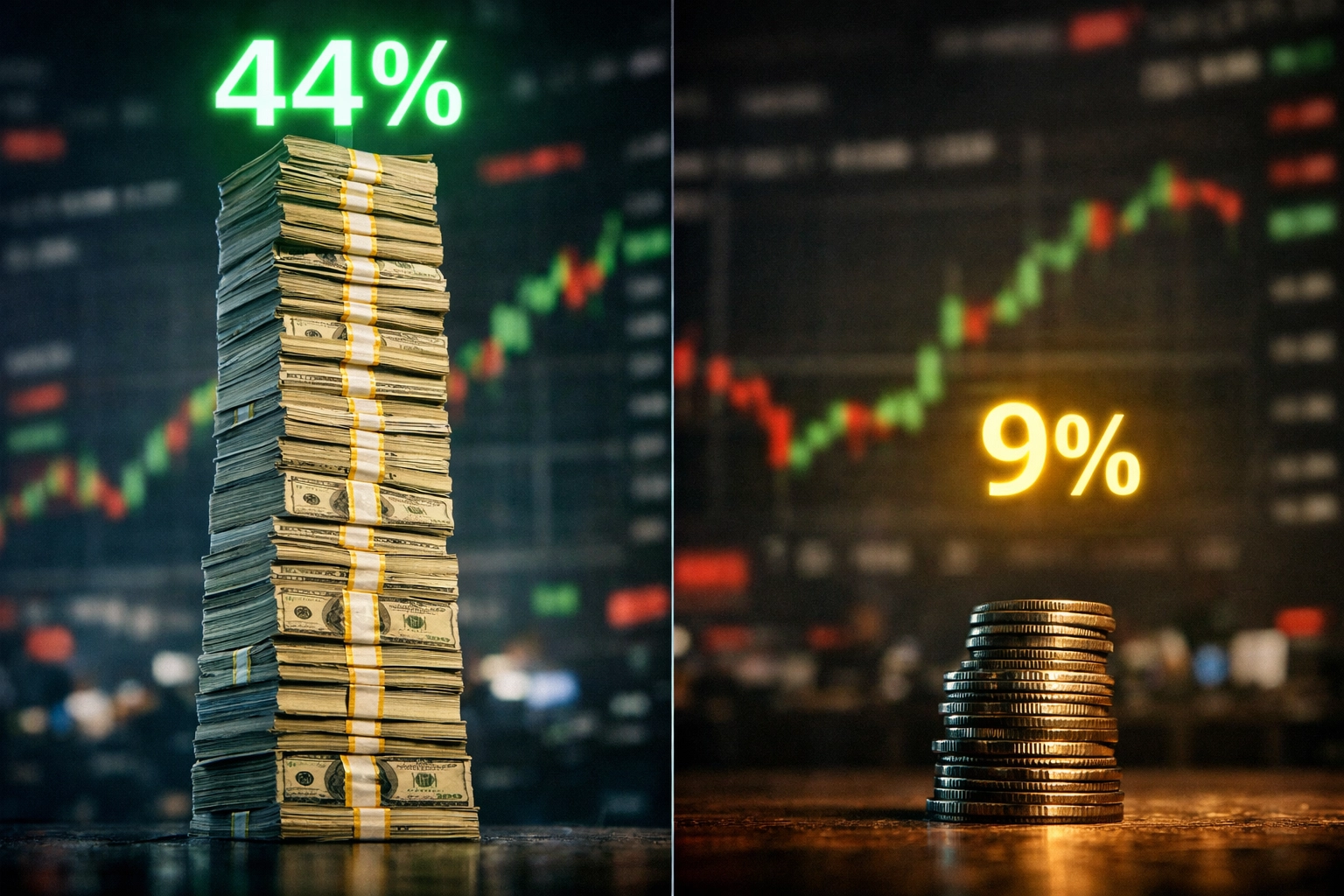
Do that math again. Stock prices up 44%. Earnings estimates up 9%. That's a 35-point gap between what investors are paying and what companies are actually expected to earn.
Goldman Sachs analysts are basically waving red flags, warning that "the timing of an eventual slowdown in capex growth poses a risk to these companies' valuations." Translation: companies are spending money hand over fist right now to build AI infrastructure, but that spending spree won't last forever.
The numbers tell the story. Hyperscaler capital expenditures (that's the big tech companies building data centers and buying GPUs like they're going out of style) grew 75% year-over-year in Q3 2025. By Q4, that's projected to drop to 49%. By the end of 2026? 25%.
That deceleration might not sound dramatic, but when stock prices are based on the assumption that growth continues at warp speed forever, a slowdown becomes a problem. A big one.
The 1999 Comparison Everyone's Whispering About
During the dot-com bubble, investors poured money into infrastructure companies: the fiber optic cable layers, the server manufacturers, the web hosting providers. Many of those companies went bankrupt even though the internet absolutely did change everything.
Why? Because the infrastructure buildout was front-loaded. Once the cables were in the ground and the data centers were built, demand didn't grow fast enough to justify the valuations. Companies that survived had to wait years for usage to catch up with capacity.
We might be watching the same movie with a different soundtrack. AI infrastructure is being built at breakneck speed, but the companies that will actually profit from AI might not be the ones laying the groundwork. They might be the ones who figure out how to use that infrastructure to create value years from now.
The market is starting to catch on. The correlation among large AI hyperscalers, basically how much their stock prices move together: collapsed from 80% in June to just 20% now. That means investors are getting pickier, trying to separate the companies with real revenue potential from the ones just riding the hype wave.
That's healthy. It means the "everything AI goes up" phase is ending and the "prove it with earnings" phase is beginning.
What Regular Investors Actually Need to Know
If you're a regular investor: not a venture capitalist, not a hedge fund manager, just someone trying to build wealth for retirement: here's what matters:
First, understand the difference between infrastructure plays and productivity plays. Infrastructure stocks (semiconductors, data center operators, power companies) have already had massive runs. Their valuations assume years of perfect execution and continued spending growth. That's a tough bet.
Productivity plays: companies using AI to generate actual revenue and profit improvements, particularly in software and services: are where the market's attention is shifting. Goldman Sachs notes that "AI Platform" stocks providing database and development tools have recently outperformed. These are companies that help other companies use AI, rather than just building the infrastructure.
Second, ignore the hype and watch the earnings. The AI boom is real, but stock prices have gotten way ahead of fundamentals for many companies. Look for businesses that can show you: not promise you, but show you: how AI is improving their margins, reducing their costs, or increasing their revenue per customer.
Third, remember we're entering the measurement phase. Stanford AI experts note that 2026 marks the shift from arguments about AI's potential to careful measurement of its actual impact. Companies and governments are going to start demanding proof that AI spending translates to productivity gains and profitability.
That measurement phase is brutal for overvalued stocks and great for undervalued ones.
The Bottom Line for Your Portfolio
The AI boom is neither pure bubble nor slam-dunk investment opportunity. It's both real economic transformation and overheated speculation happening at the same time.
The economy is genuinely benefiting from AI. Productivity is rising in sectors that have adopted it. Companies are finding real uses that create real value. That part isn't hype.
But stock prices for many AI infrastructure providers have already priced in years: maybe decades: of future growth. When that spending growth slows down, those valuations will get tested. Hard.

If you're investing in AI, focus on companies positioned to capture productivity improvements rather than those building the infrastructure. Look for businesses with diversified revenue streams that aren't betting everything on AI capex continuing to grow at 75% per year. And for the love of your retirement account, don't assume that "AI" in a company's investor presentation means the stock is a good buy.
The companies that will win the AI revolution might not be the loudest ones in today's headlines. They might be the quiet ones figuring out how to use AI to serve customers better, cut costs smarter, and build sustainable competitive advantages.
That's not as exciting as betting on the next NVIDIA, but it's a lot more likely to build wealth that lasts.
Be mindful, be watchful and good luck.