



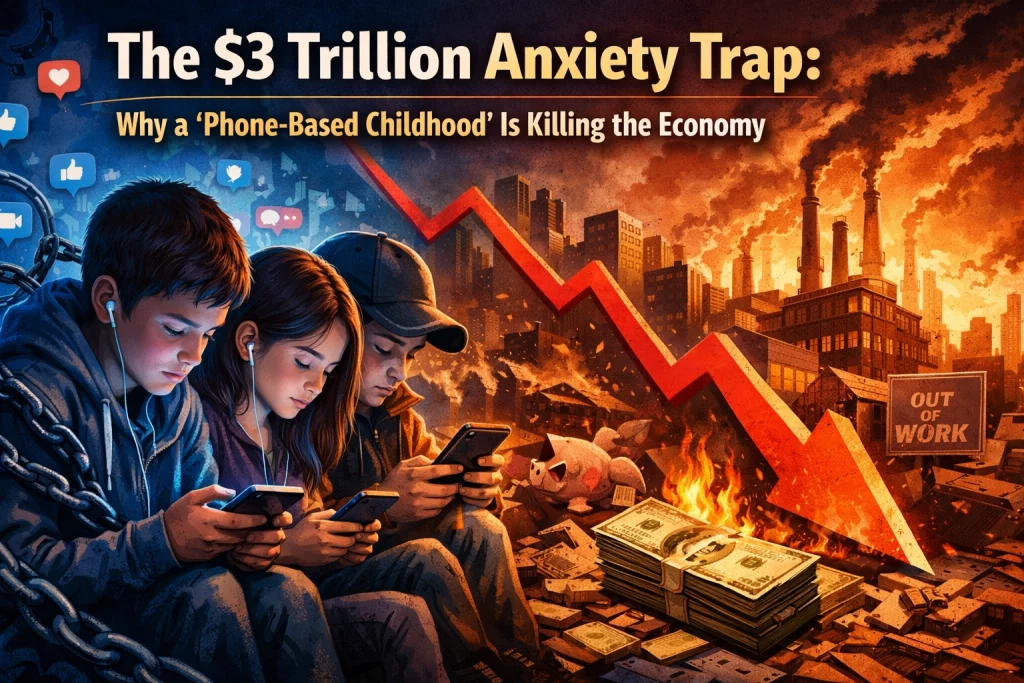
Something broke between 1995 and 2015, and we're only now starting to count the cost.
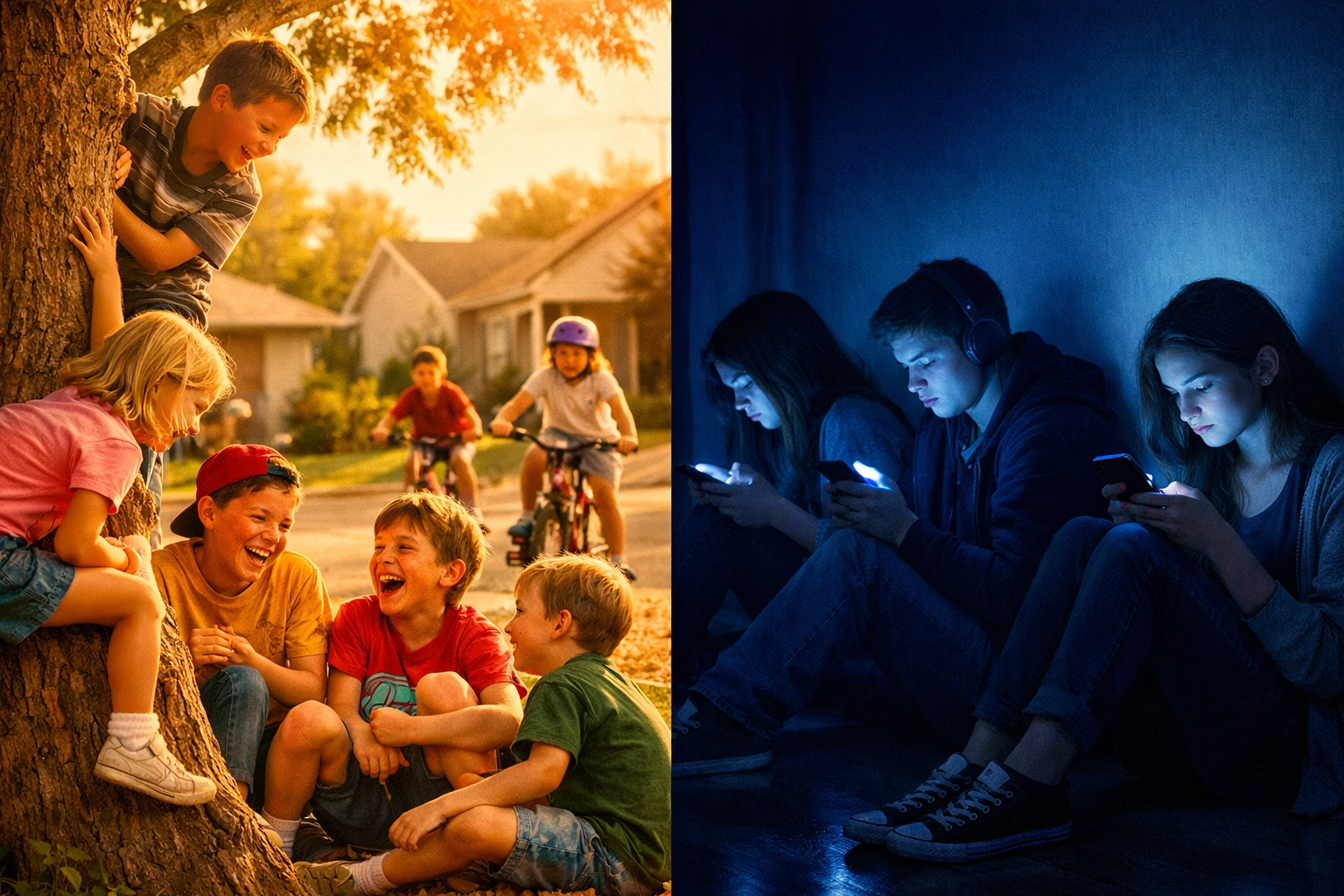
Kids who grew up in the '80s and '90s had a "play-based childhood." You went outside, got scraped knees, argued with friends, made up, and figured out how to navigate the world without a parent hovering over your shoulder. Fast forward to today, and Jonathan Haidt's bestseller The Anxious Generation paints a disturbing picture: we've swapped that childhood for a "phone-based" one. Kids are indoor creatures now, glued to screens, their social lives mediated by apps designed to keep them anxious, comparing, and scrolling.
The result? An entire generation drowning in anxiety, depression, and a mental health crisis that's costing us more than we can afford, not just emotionally, but economically. We're talking $185 billion in direct medical costs and an estimated $3 trillion in lost productivity and wages over the coming decades. That's not a typo. That's the price tag of giving every kid an anxiety machine before they hit puberty.
The Great Rewiring: What the Hell Happened?
Haidt calls it "The Great Rewiring of Childhood," and it happened faster than anyone realized. Between 2010 and 2015, smartphones became ubiquitous. Social media platforms like Instagram and Snapchat exploded. Suddenly, childhood moved indoors and online.
Here's the kicker: human beings didn't evolve to grow up this way. Kids need unstructured play, risk-taking, face-to-face conflict resolution, and independence to develop into functioning adults. Instead, we locked them inside, handed them devices engineered by the smartest behavioral psychologists money can buy, and then acted shocked when anxiety and depression rates skyrocketed.
The stats are brutal. Teenage depression and anxiety rates have doubled since 2010. Hospital admissions for self-harm among girls aged 10-14 have tripled. Boys aren't immune either, they're checking out into video games and porn, struggling with motivation and purpose.
And parents? We got scared. We became helicopter parents, terrified of letting kids walk to school alone or play unsupervised, even as we handed them devices that expose them to cyberbullying, predators, and algorithms designed to prey on their insecurities.
The Economic Toll: It's Not Just a "Mental Health Problem"
Here's where this stops being a parenting issue and becomes an economics disaster.
Medical costs in the United States were 5% of GDP in 1960. Today, we're pushing 20%. Part of that climb is the usual suspects, cancer, obesity, heart disease. But there's a new driver in town: mental health treatment for an entire generation.
We're spending $185 billion annually on treating anxiety, depression, and related mental illnesses. That's direct costs, therapy, medication, hospitalization. Then there's the indirect hit: lost productivity. Anxious, depressed workers call in sick more, perform worse, and burn out faster. Over the next few decades, economists estimate this will cost the U.S. economy $3 trillion in lost wages and productivity.
Think about that. We've engineered a childhood that's creating workers who can't function at full capacity. It's like buying a fleet of cars and then kneecapping the engines before they leave the lot.
And here's the cruel irony: we're spending more on interest payments on the national debt than we are on defense. Meanwhile, education budgets get squeezed year after year because there's no money left after we pay the credit card bill. So we can't invest in the schools and programs that might actually prevent this mess in the first place.
The Pharmaceutical Trap: Medicating the Symptom, Not the Cause
So what's our solution? We drug them.
Prescriptions for SSRIs (antidepressants) and anti-anxiety medications for kids and teens have exploded. Big Pharma is thrilled, there's a whole new customer base that might be on medication for life. But here's the problem: we're putting a Band-Aid on a bullet wound.
These kids aren't depressed because of a serotonin deficiency. They're anxious because they're spending six hours a day on apps designed to make them feel inadequate. They're lonely because they're not hanging out with friends in person. They're stressed because they have no privacy, no downtime, and no escape from the relentless social comparison machine in their pockets.

Medicating kids for a problem caused by screens is like giving someone painkillers for a broken leg and never setting the bone. Sure, it might dull the pain temporarily, but it doesn't fix the underlying injury. Meanwhile, pharmaceutical companies rake in billions while parents and insurance companies foot the bill.
This is the medical-industrial complex at its finest. We've taken a behavioral problem, rebranded it as a medical one, and created a permanent revenue stream. And the kids? They're the product.
The Leadership Crisis: Who's Going to Run Things?
Here's the part that should terrify every CEO, business owner, and manager in America: this generation is going to struggle to lead.
Leadership requires resilience, risk-taking, conflict resolution, and the ability to handle criticism without falling apart. But if you grew up in a world where every disagreement happened via text, where you never had to navigate face-to-face conflict, where your parents swooped in to solve every problem, how are you supposed to lead a team? Manage a crisis? Make tough decisions when people are counting on you?
Haidt calls it "safetyism": the idea that kids need to be protected from every possible harm, including hurt feelings. The result is a generation that's excellent at identifying microaggressions but struggles to give critical feedback, negotiate difficult conversations, or handle a "disagreeable" email without spiraling.
Businesses are already feeling this. Managers report that younger employees struggle with in-person collaboration, can't handle constructive criticism, and burn out quickly under normal workplace stress. That's not a character flaw: it's what happens when you rewire childhood around safety instead of growth.
If we don't fix this, we're looking at a leadership vacuum. Who's going to run companies, governments, and institutions when the current generation retires? Who's going to make the hard calls, take the risks, and navigate uncertainty?
What Do We Do? (Haidt's Rules Are a Start)
The good news? This is fixable. But it requires parents, schools, and policymakers to make some hard decisions.
Haidt lays out four simple rules:
- No smartphones before age 14. Give kids flip phones or smartwatches for communication, but keep the internet out of their pockets.
- No social media before age 16. Let them develop a sense of self before they're thrown into the comparison machine.
- Phone-free schools. Devices locked up during the school day. Kids need to actually talk to each other.
- More independence and free play. Let kids walk to school, play outside unsupervised, and take age-appropriate risks.
These aren't radical ideas. They're basically how childhood worked for millennia. We just forgot.
Some states and school districts are already moving in this direction. France banned phones in schools in 2018. Several U.S. states are considering similar legislation. Companies like Amazon, Berkshire Hathaway, and JPMorgan are exploring ways to lower healthcare costs by addressing root causes instead of just medicating symptoms.
This is the last frontier of expense reduction: stop paying to fix problems we're creating. Invest in prevention. Incentivize health. Build systems that work instead of just treating the damage.
The Bottom Line
We've engineered an anxiety epidemic, and it's costing us trillions. We're medicating kids instead of addressing the screens that are making them sick. We're raising a generation that struggles with leadership, resilience, and basic human connection. And we're paying for it in medical bills, lost productivity, and a future where fewer people are capable of steering the ship.
The solution isn't complicated. It's just hard. Put down the phones. Let kids be kids again. Stop outsourcing childhood to Silicon Valley. And for God's sake, stop pretending that a pill can fix what a screen destroyed.
We've got a choice: invest in health and resilience now, or keep writing checks to Big Pharma while the economy slowly suffocates under the weight of an anxious, medicated, leaderless generation.
The clock's ticking.
Be mindful, be watchful and good luck.