



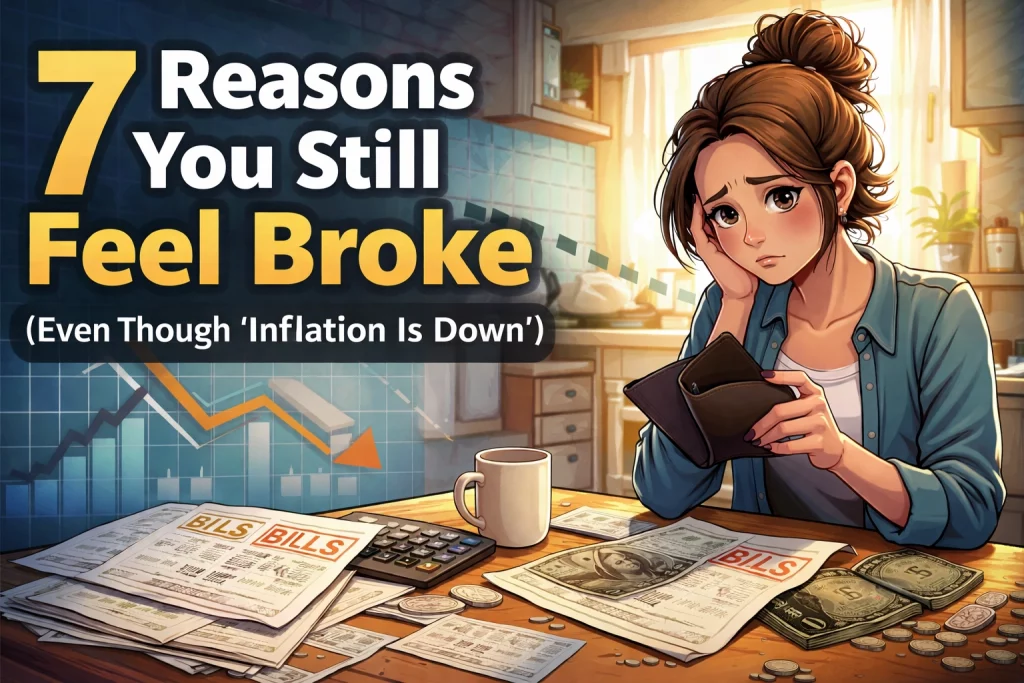
You've heard the news. The experts are celebrating. Inflation is down to 2.7%. The economy is "growing." Everything should be fine now, right?
So why does your bank account still feel like it's on life support?
If you've been scratching your head wondering why your paycheck disappears faster than ever despite all the good economic news, you're not alone. Millions of Americans are experiencing the same disconnect between what the headlines say and what their wallets feel.
Let's break down the seven real reasons you still feel broke: even though inflation is supposedly under control.
1. Prices Went Up 25% and Never Came Back Down
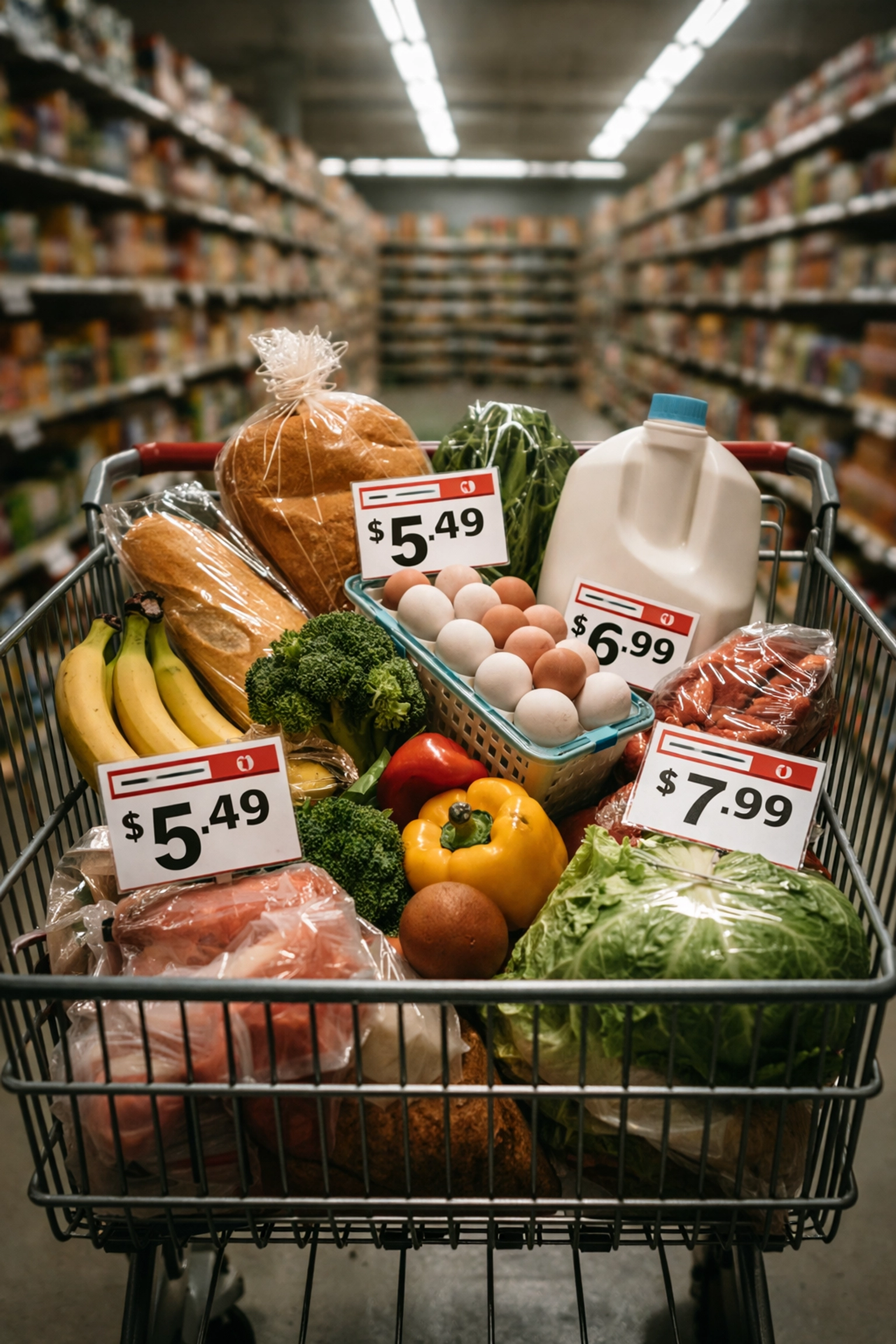
Here's the thing nobody talks about: inflation going "down" doesn't mean prices are dropping. It just means they're rising slower than before.
Over the past five years, prices have climbed roughly 25% across the board. That gallon of milk that cost $3.50 in 2021? It's still sitting at $4.50. Your grocery bill that used to be $150 a week? Now it's pushing $200.
Lower inflation doesn't erase five years of cumulative price hikes. Those increases are baked into everything you buy: forever. The damage is done, and your budget is still dealing with the aftermath.
Think of it like gaining 50 pounds over five years, then celebrating because you only gained 2 pounds this year. You're still carrying all that extra weight.
2. If You're Not Rich, You're Still Getting Squeezed
The economic recovery hasn't been evenly distributed. If you're in a lower or middle-income household, you've felt the pain way more than the folks at the top.
Housing costs are still brutal. Food prices remain elevated. Services like childcare, healthcare, and car repairs keep climbing. And while wages have technically gone up, they haven't kept pace with how much more expensive life has become.
The people who had money before inflation hit? They're doing just fine. Their investments recovered. Their real estate appreciated. Their salaries adjusted.
But if you were already living paycheck to paycheck? You're now living paycheck to paycheck with less purchasing power than before. The math just doesn't work out in your favor.
3. The Job Market Is Weird Right Now
Even if you have a job, there's a creeping anxiety that didn't exist a few years ago. We're in what economists call a "low-hire, low-fire" labor market.
Companies aren't laying people off in massive waves, but they're also not hiring like they used to. If you lose your job right now, finding a new one could take months: or longer.
This uncertainty affects how you spend money. You're not going out to eat as much. You're holding off on that vacation. You're keeping a tighter grip on your savings (if you have any) because you're not sure what tomorrow looks like.
Job anxiety is expensive in its own way. It makes you feel broke even if your income hasn't changed.

4. All the Gains Went to the Top 10%
Here's a stat that might make you want to flip a table: the top 10% of earners now account for about 50% of all spending in the United States.
Let that sink in.
Half of all consumer spending comes from the wealthiest slice of the population. The rest of us are fighting over the other half while dealing with higher costs, stagnant wages, and mounting debt.
This is what they call a "K-shaped economy." Some people are shooting up toward prosperity while others are sliding down toward struggle. If you're reading this article and nodding along, you probably know which direction you're headed.
The economy can technically grow while most people don't feel it. That's exactly what's happening.
5. Consumer Debt Is at Record Highs
Americans are carrying more credit card debt than ever before. And it's not because people are being irresponsible: it's because they're trying to survive.
When your groceries cost more, when your rent goes up, when unexpected expenses hit, and your paycheck stays the same, something has to give. For most people, that "something" is putting expenses on plastic and hoping to pay it off later.
The problem? "Later" never seems to come. The debt piles up. The minimum payments grow. And suddenly you're spending hundreds of dollars a month just servicing debt instead of building anything.
Here's the kicker: most Americans don't have $1,000 in emergency savings. So when the car breaks down or the medical bill arrives, it goes straight onto the credit card. The cycle continues.
6. Interest Rates Are Still Crushing You
Remember when interest rates were practically zero? Those days are long gone.
The Federal Reserve raised rates to fight inflation, and while that might have helped cool prices a bit, it also made borrowing way more expensive. Credit card APRs are now averaging over 20%. Auto loans are brutal: the average car payment is around $749 per month, and a record number of people are paying over $1,000.
If you're trying to buy a house? Good luck. Mortgage rates have made homeownership feel like a fantasy for a lot of people.
High interest rates mean you're paying more for everything you finance. That car costs more. That house costs more. That credit card balance is growing faster. Even if your income is decent, the cost of borrowing eats into everything.
7. Your Feelings Are Valid: Consumer Confidence Is Tanking
Consumer confidence has dropped to its lowest point in nearly 12 years. That's not a coincidence. People feel broke because, for most people, things actually are harder than they used to be.
The disconnect between "the economy is doing great" and "I can barely afford groceries" is real. It's not in your head. The official numbers measure things like GDP growth and unemployment rates: they don't measure how stressed you are about making rent or whether you can afford to take your kid to the dentist.
Your lived experience matters more than any headline. And right now, that lived experience for millions of Americans is one of constant financial pressure.
So What Can You Actually Do?
Look, this isn't a feel-good article where I tell you to cancel your Netflix and suddenly you'll be rich. The structural problems here are real, and they're not going away anytime soon.
But here are a few things worth considering:
- Track where your money actually goes. Not to shame yourself, but to understand. You can't fix what you can't see.
- Attack high-interest debt first. Every dollar you're paying in credit card interest is a dollar that's not working for you.
- Build even a small emergency fund. Even $500 can be the difference between a setback and a spiral.
- Don't compare yourself to the highlight reel. Social media makes everyone look rich. Most people are struggling just like you.
The economic game is rigged in a lot of ways. But understanding the rules is the first step to playing smarter.
You're not crazy for feeling broke. You're just paying attention.
Be mindful, be watchful and good luck.