



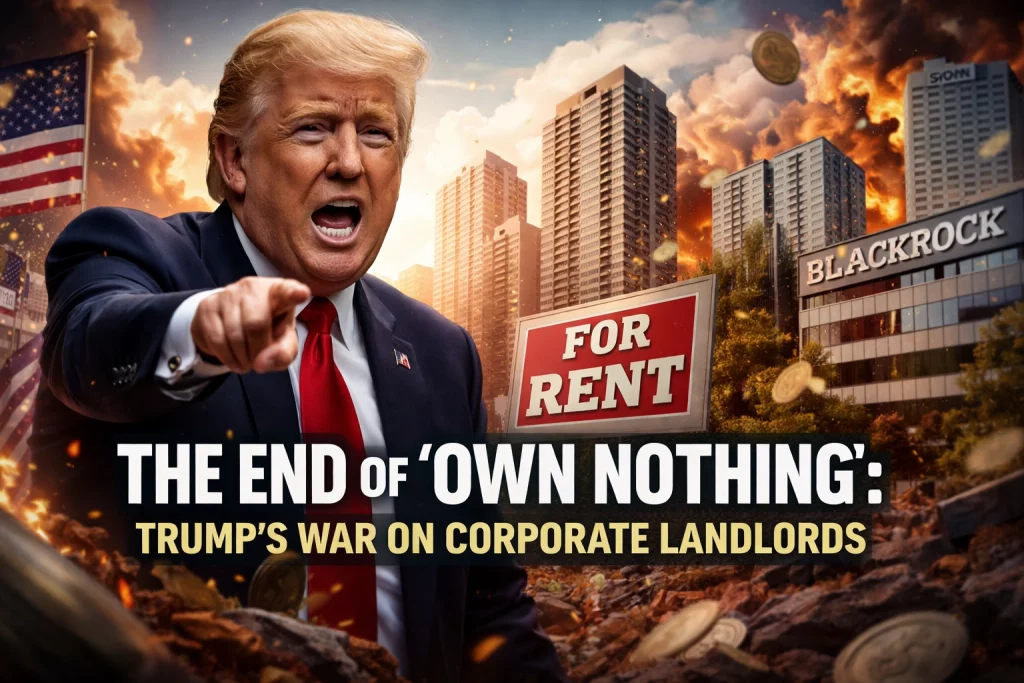
You've probably heard the phrase floating around the internet for a few years now: "You will own nothing and be happy." It started as a World Economic Forum talking point about the future of consumption, but for millions of Americans watching their dream of homeownership slip through their fingers, it started feeling less like a prediction and more like a threat.
Well, someone in Washington finally decided to push back.
On January 20, 2026, President Trump signed an executive order that takes direct aim at large institutional investors buying up single-family homes. The message is clear: houses should be for families, not hedge funds.
But here's the question every regular guy should be asking: Will this actually work, or is it just another headline that sounds great until you read the fine print?
The Problem: You vs. Blackstone
Let's paint a picture that's become painfully familiar across America.
You've been saving for years. You've got your down payment scraped together. Your credit score is decent. You find a nice three-bedroom in a neighborhood where you could actually see yourself raising a family. You put in an offer at asking price, maybe even a little over.
Then you get the call from your realtor: "Sorry, someone came in with an all-cash offer, twenty percent over asking, no contingencies, closes in two weeks."
That "someone" isn't a family. It's not even a person. It's a corporation with a spreadsheet that decided your future home would generate a 7.2% annual return as a rental property.

This isn't some rare occurrence. In some markets, particularly in Sun Belt states like Nevada, Arizona, and Florida, institutional investors have been gobbling up single-family homes at an alarming rate. In Nevada alone, approximately one-quarter of single-family homes are now investor-owned.
A 2025 survey found that 93 percent of Americans believe corporate landlords are making homeownership less accessible. That's not a partisan issue. That's just math meeting reality at the kitchen table.
What the Executive Order Actually Does
Trump's order doesn't ban corporations from owning homes outright. That would be a massive legal undertaking requiring Congressional action. But it does put up some significant roadblocks.
Here's what's in the order:
Blocking access to government programs. Large institutional investors will be barred from accessing government loan programs and federal housing products. This means they can't piggyback on the same favorable financing that's supposed to help regular Americans buy homes.
First-look policies on foreclosures. When a home goes into foreclosure and ends up in federal hands, individual owner-occupants will get the first opportunity to purchase before any investor can swoop in.
Disclosure requirements. Companies will have to disclose their ownership in single-family rentals, and there will be anti-circumvention measures to prevent shell games with LLCs.
Defining the enemy. The Treasury Secretary has been tasked with defining exactly what qualifies as a "large institutional investor." This is crucial because without clear lines, the whole thing becomes a legal gray area.

The order also directs the Attorney General and FTC to review institutional investor acquisitions for anti-competitive practices. Translation: they're going to look at whether these massive buying sprees have been rigging the market against regular buyers.
There's also a carve-out for build-to-rent properties that were "planned, permitted, financed and constructed as rental communities." In other words, if a company builds apartments or rental communities from scratch, that's different from buying up existing family homes.
The "Regular Guy" Angle
Let's be honest about who this is really supposed to help.
The regular guy who's been renting for a decade because every time he tries to buy, he gets outbid by someone with deeper pockets. The young couple who did everything right, got their degrees, got their jobs, saved their money, and still can't catch a break. The family that's watching their rent go up every year while their landlord is some faceless corporation based three time zones away.
This isn't about being anti-business or anti-capitalism. It's about recognizing that housing is different from other markets. When corporations treat homes purely as financial instruments, they're not just buying property. They're buying pieces of communities. They're buying someone's future.
And when they buy enough of them, they start setting the prices. They start dictating the terms. And suddenly, you're not competing in a free market anymore. You're competing against the house, and the house always wins.
The Skeptic's Corner: Will This Actually Work?
Now, here's where I have to pump the brakes a little.
Executive orders are powerful, but they're not magic wands. This order directs federal agencies to issue guidance within 60 days. That's guidance, not law. It can be challenged, watered down, or simply ignored by future administrations.
There are also some real implementation concerns that experts have already flagged:
The LLC problem. Large companies could simply create new limited liability companies to circumvent restrictions. If the definition of "large institutional investor" isn't airtight, clever lawyers will find holes.
Unintended consequences. Here's a counterintuitive one: some analysts warn that reducing investor demand could actually decrease new construction. Developers build when they know there's demand. If institutional buyers step back, some construction projects might not pencil out anymore.
State-level gaps. Housing markets are local. An executive order from Washington can set the tone, but states and municipalities will have to do a lot of heavy lifting to make it stick.
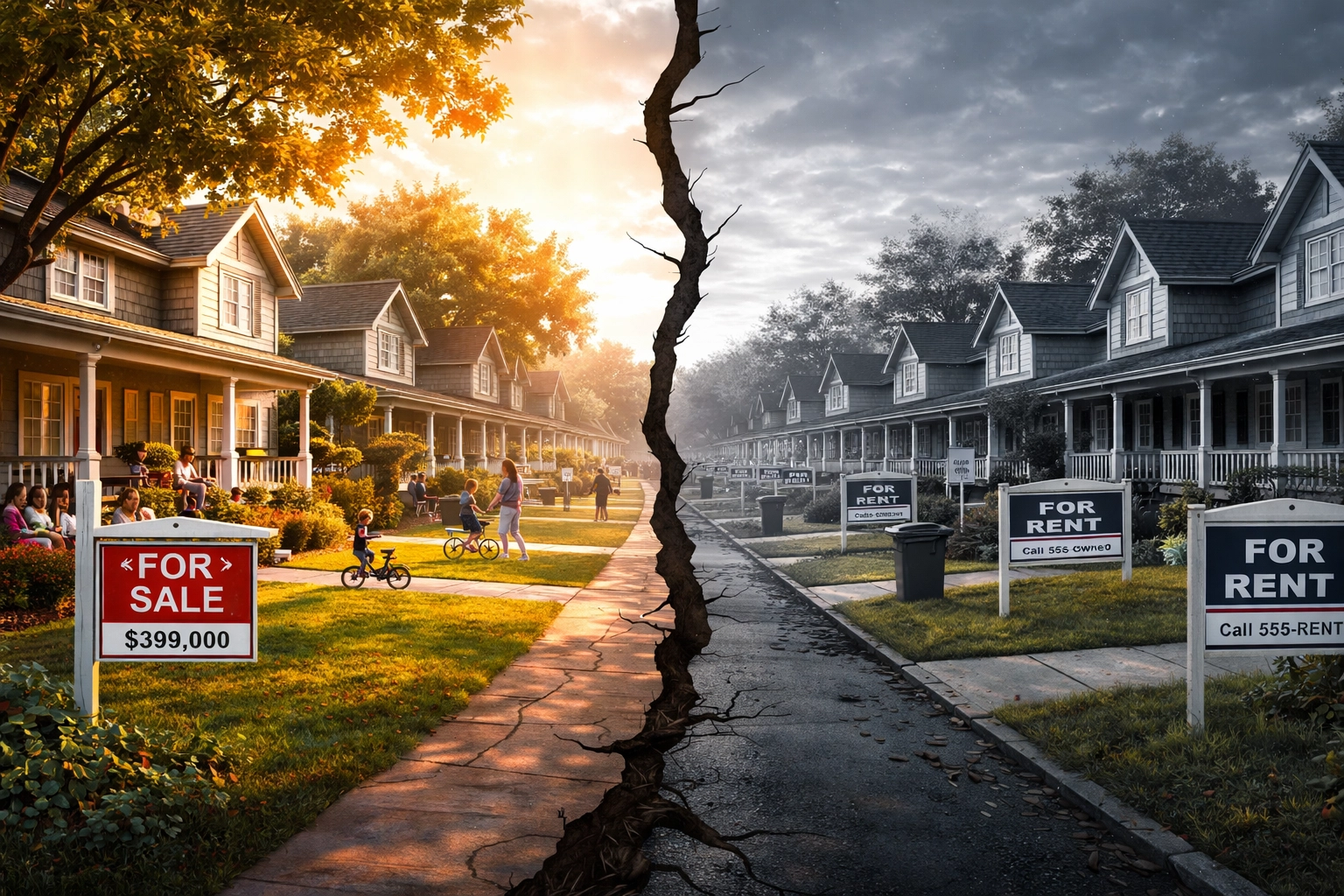
And then there's the biggest question of all: Will this actually lower prices?
Blocking institutional investors from buying doesn't automatically mean prices will drop. It might just change who you're competing against. Instead of losing to a hedge fund, you might lose to a wealthy individual buyer or a smaller investment group that flies under the radar.
Housing prices are driven by supply and demand. Unless we also see meaningful action on building more homes, particularly starter homes for first-time buyers, we're treating a symptom rather than the disease.
The Political Reality
Both Democrats and Republicans have expressed support for limiting corporate home purchases. That's rare these days. When you can get people on both sides of the aisle to agree that something is broken, it usually means it's really broken.
Some Democrats are pushing for the HOME Act, which would establish permanent limitations on government investments in companies driving up housing prices. They argue the executive order doesn't go far enough.
Fair point. Executive orders can be undone by the next president with a stroke of a pen. Legislation is harder to kill.
The administration has already signaled that they want Congress to codify these policies into law. Whether that happens depends on the usual Washington circus of priorities, horse-trading, and midterm election calculations.
What This Means for You
If you're in the market to buy a home, this is cautiously good news. It's not going to magically make your dream house affordable overnight, but it might level the playing field a bit.
Keep an eye on those first-look policies for foreclosed properties. If you're a first-time buyer, those programs could be your ticket in.
If you're renting from a large institutional landlord, don't expect much to change in the short term. Your landlord isn't going to suddenly sell their portfolio because of an executive order.
And if you're just watching from the sidelines, wondering if you'll ever be able to afford a home of your own, at least know that someone in Washington acknowledged the problem. Whether they actually fix it is another story.
The Bottom Line
The "you will own nothing and be happy" crowd just got put on notice. Trump's executive order is a direct shot at the idea that regular Americans should accept permanent renter status while corporations build empires on the rooftops of their dreams.
Will it work? Maybe. Partially. It depends on implementation, on Congress, on state governments, and on a thousand other variables that are impossible to predict.
But it's a start. And sometimes, a start is all you need.
Be mindful, be watchful and good luck.