



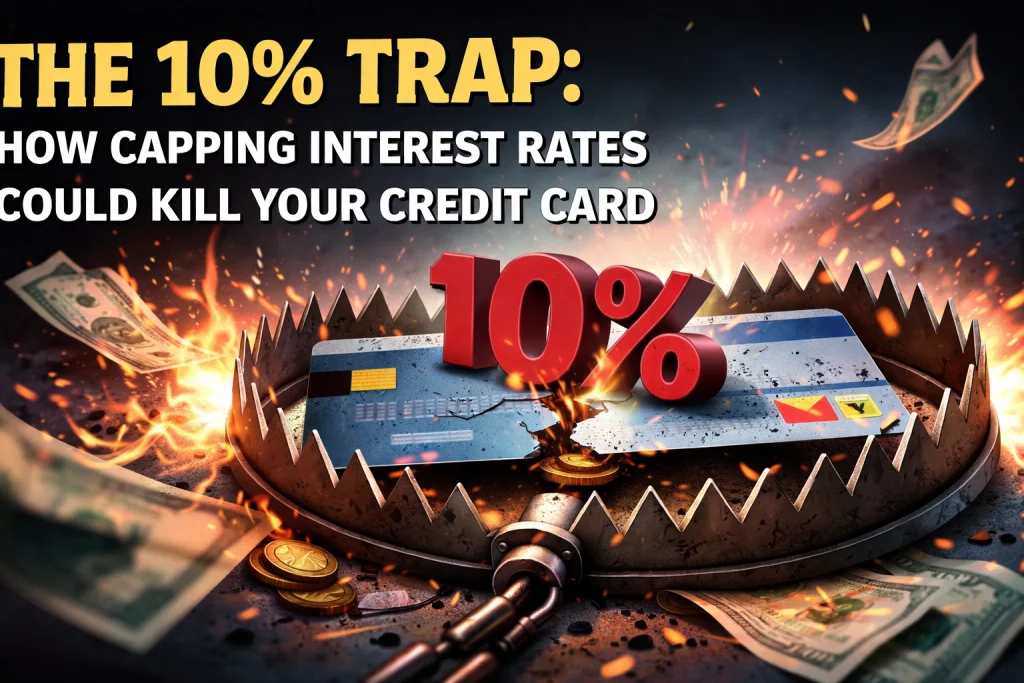
So President Trump took to Truth Social on January 20th and dropped a bomb on the banking world: a call for a 10% cap on credit card interest rates. Effective immediately. One year. Done.
Sounds great, right? Who wouldn't want to pay 10% instead of the 20-something percent most cards charge these days?
Here's the problem: this is one of those ideas that sounds fantastic at the kitchen table but falls apart the second you think about how banks actually work. And if this silly governmental effort somehow gets legs, the consequences for regular folks could be way worse than paying high interest rates.
Let me explain why this "help" might actually hurt you.
The Populist Promise vs. Cold Hard Reality
Look, I get the appeal. Credit card interest rates are brutal. The national average is hovering around 20%, and if your credit score isn't sparkling, you might be staring at 25% or higher. Store cards? Even worse. When you're carrying a balance month to month just to keep the lights on and food in the fridge, that interest piles up fast.
So when the President says "I'm capping it at 10%," it sounds like someone finally standing up for the little guy.
But here's what that announcement actually did: it sent bank stocks tumbling. Synchrony Financial, Capital One, American Express, all took significant hits. Citigroup, JPMorgan Chase, Bank of America, down across the board.
Why? Because the people who actually run the numbers at these banks immediately understood something that the announcement conveniently ignored: you cannot force banks to lose money and expect them to keep handing out credit cards.

Banks Aren't Charities (Shocking, I Know)
Here's a quick economics lesson that doesn't require a fancy degree.
Credit cards are unsecured debt. That means when you swipe your card at the grocery store, there's no house or car backing up that loan. If you stop paying, the bank can't repossess your Cheerios. They just… lose the money.
This is fundamentally different from your mortgage or car loan. Those are secured by assets. If you don't pay, the bank takes the house or the car. It's not great for anyone, but the bank has something to sell.
With credit cards? Nothing. Just your promise to pay and your credit history.
That's why credit card rates are higher than mortgage rates. The bank is taking on more risk. And the riskier you are as a borrower, lower credit score, spotty payment history, the higher your rate goes. It's not because banks are evil. It's because math exists.
When a bank charges 22% to a subprime borrower, they're not swimming in pools of gold coins like Scrooge McDuck. They're covering the statistical certainty that a chunk of those borrowers won't pay them back.
What Happens When You Cap Rates at 10%
So let's play this out. The government somehow caps rates at 10%. What does the bank do?
Option A: Keep lending to everyone at 10% and lose money on a huge portion of their portfolio.
Option B: Stop lending to anyone who represents a risk they can't cover at 10%.
If you picked Option B, congratulations. You understand business better than whoever drafted this proposal.
Truist analyst Brian Foran put it plainly: a 10% cap "would swing the business to unprofitable if enacted, with subprime credit cards hardest hit." He specifically flagged Synchrony and Bread Financial Holdings as particularly exposed.
An executive at a large bank told CNBC (anonymously, because of course) that "we cannot offer products at a loss; there's no scenario where we would take our entire portfolio to 10%."
Translation: they'll cancel cards, slash credit limits, and stop approving applications from anyone who isn't already wealthy.
The Numbers Are Staggering
Let's put some real figures on this.
According to industry analysis, 82-88% of Americans with credit scores below 740, that's roughly 175 to 190 million people, would lose access to credit cards if a 10% cap were imposed.
Read that again. We're not talking about a minor inconvenience. We're talking about the majority of American adults potentially losing their credit cards.
And it's not just people with bad credit who get hurt. Even folks with good scores would see changes. Banks would likely gut rewards programs, estimated to cost consumers about $27 billion in lost rewards value. That cash back? Those airline miles? Gone or drastically reduced.
The Economic Peril Nobody's Talking About
Here's where this goes from "annoying policy debate" to "potential economic disaster."
Think about how many Americans use credit cards for day-to-day life. Groceries. Gas. Utility bills. Car repairs. Medical co-pays. The stuff you can't really skip.
A lot of people aren't putting these expenses on credit because they're irresponsible. They're doing it because their paycheck doesn't quite stretch to the end of the month. The credit card is the bridge that gets them from here to payday.
Now imagine that bridge disappears.
What happens when 175 million people suddenly can't finance their daily expenses? They stop spending. Or they turn to worse options: payday loans, pawn shops, loan sharks: that charge effective rates way above 20% and trap people in cycles of debt that make credit card interest look like a bargain.

Consumer spending is roughly 70% of our economy. If a huge chunk of Americans suddenly have their purchasing power yanked away, the ripple effects hit everyone:
- Retail takes a hit because people can't buy stuff
- Restaurants and service industries suffer because discretionary spending vanishes
- Auto sales slow down because people can't finance repairs or down payments
- Small businesses struggle because their customers have less money to spend
And the irony? The people this policy is supposed to help: working-class Americans struggling with high interest rates: are the exact people who get their cards cancelled first.
Can He Even Do This?
Here's some good news, depending on how you look at it: Trump probably can't actually make this happen unilaterally.
Raymond James analyst Ed Mills noted that "any broad cap would require Congress to act." The January 20th effective date? Basically impossible from a legislative timing standpoint.
Could he pressure bank regulators or the Consumer Financial Protection Bureau? Maybe, but the legal authority is murky at best. Wolfe Research's Tobin Marcus said he's "not aware of an authority that they can use to do this unilaterally in any kind of a sweeping way."
Some analysts think this might be a negotiating tactic: throw out a big scary number and pressure banks into voluntary rate reductions. That's politics, not policy.
But here's the thing: even the threat of this kind of regulation changes behavior. Banks are already treating this seriously. Credit committees are probably meeting right now discussing how to reduce exposure to riskier borrowers "just in case."
The Regular Guy Bottom Line
I'm all for making life more affordable. Nobody likes paying 22% interest on their Visa bill. But there's a difference between wanting something and understanding what it takes to get there.
Slapping a price cap on credit cards doesn't make credit more affordable. It makes credit disappear for the people who need it most. It's the economic equivalent of trying to cure a headache by cutting off your head.
If we want to actually help people struggling with credit card debt, there are real conversations to have about financial literacy, debt management programs, and maybe even some targeted relief for people who got in over their heads during tough times.
But pretending we can just wave a magic wand and declare interest rates to be 10% without consequences? That's not help. That's a fantasy that ignores how the world actually works.
Keep an eye on this one. Even if it doesn't pass, the political pressure on banks could lead to tighter credit and fewer options for regular folks trying to make ends meet.
Be mindful, be watchful and good luck.