



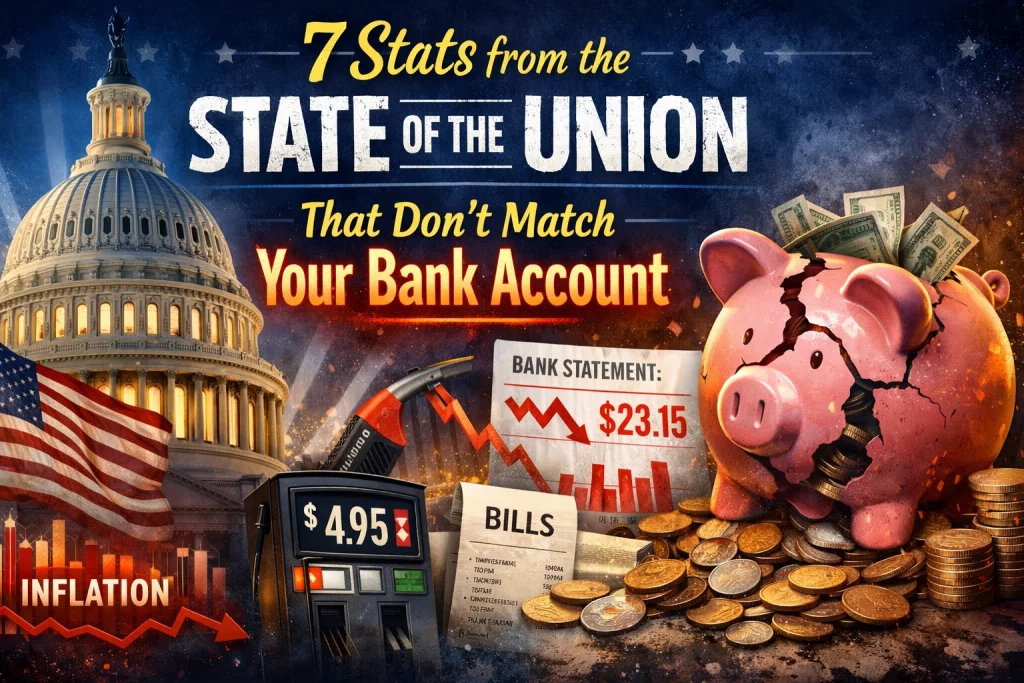
If you sat through all 108 minutes of the State of the Union address last night, I owe you a coffee. It was a marathon of "Golden Age" rhetoric, "roaring" economic claims, and a lot of back-patting from folks who don’t have to check their bank balance before tapping their card at the grocery store.
The President painted a picture of an America that looks more like a high-gloss brochure than the reality most of us see when we walk down Main Street. While the teleprompter was scrolling through stats about a "booming" GDP and "plummeting" inflation, back home, the math just isn't adding up.
At Regular Guy Economics, we don’t care about the politics; we care about the pocketbook. Let’s look at the seven stats from the 2026 SOTU that feel like they’re coming from a different planet than the one we live on.
1. The "Roaring" GDP vs. The Empty Pantry
The President leaned heavily on the idea that we are in a "golden age" because the Gross Domestic Product (GDP) is up. Look, GDP is just a fancy way of saying "a lot of money is moving around." But here is the thing: if I have to pay twice as much for a carton of eggs and a gallon of gas, the GDP goes up, but I’m actually poorer.
And here’s another quiet driver of that “look how great we’re doing” GDP number: the AI investment frenzy. Companies are dumping mountains of cash into chips, data centers, cloud contracts, and “AI transformation” consulting. All of that spending shows up as economic activity, which can create a nice, clean bump in GDP.
But for the average citizen, it doesn’t feel like prosperity because it isn’t trickling down in the ways that matter. A lot of this AI spend is capex-heavy (servers and infrastructure) and productivity-themed (doing the same work with fewer people), which is a polite way of saying it doesn’t necessarily translate into broad job growth or better pay. Meanwhile, plenty of these projects aren’t producing meaningful new revenues yet—they’re pilot programs, internal tools, or “we can’t fall behind” spending. GDP gets the sugar rush; regular people get the bill and maybe a layoff memo.
While the "macro" numbers look great on a chart in D.C., the struggle to pay for basic groceries and rent is at an all-time high. A rising GDP doesn’t mean the average guy is doing better; it often just means the cost of surviving has increased. If the economy is "roaring," it’s mostly roaring for the people who own the companies selling us the eggs, not the people buying them.
2. The 15% "Emergency" Tariff: A Stealth Tax in Disguise
One of the biggest headlines from the speech was the move to a 15% "emergency" baseline tariff. The President framed this as a way to "make foreign countries pay" and "protect American jobs." It sounds patriotic, but let’s do some Regular Guy math.
A tariff is a tax on imported goods. When a company imports a TV, a car part, or a bag of coffee, they pay that 15% tax to the government. Do you think that company is just going to eat that cost? Of course not. They’re going to tack it onto the price tag. Research shows that about 95% of tariff costs are actually paid by American consumers. This isn't a "foreign penalty": it’s a 15% stealth sales tax on almost everything you buy. It’s a direct hit to your bank account disguised as a win for the country.

3. Inflation is "Plummeting" (But Prices Aren't)
The speech made it sound like the inflation monster has been slain because the rate slowed to 2.4%. Here’s why that feels like a lie: inflation slowing down doesn’t mean prices are going back down. It just means they’re going up slightly slower than they were before.
If a steak went from $10 to $15 over the last two years, and now it’s "only" $15.36, the government calls that a win. But to you, that steak is still 50% more expensive than it was a few years ago. Your wages likely haven’t jumped 50% in that same timeframe. When D.C. brags about "low inflation," they’re ignoring the fact that the "new normal" for prices is already breaking the average family's budget.
4. The Housing Affordability Gap
The President skipped over the fact that housing affordability is hitting levels we haven’t seen in generations. He talked about "new construction," but he didn't talk about the fact that most regular guys can’t afford the mortgage on those new houses, and rent is eating up 40% to 50% of the average paycheck.
We are seeing a massive disconnect here. If the economy is so "golden," why are we seeing record-high homelessness in cities across the country? People with full-time jobs are living in their cars because the math of "Rent + Insurance + Groceries" is greater than "Take-Home Pay." You can’t claim the state of the union is strong when a record number of citizens don’t even have a roof over their heads.
5. The Healthcare Runaway Train
One of the most frustrating parts of the economic "Golden Age" claim is the state of the medical industry. Back in 1960, medical costs in the U.S. were about 5% of our GDP. As we sit here in 2026, we’ve hit that 20% mark we’ve been dreading. One out of every five dollars moving in this country is being swallowed by the medical machine.
But are we four times healthier? Not even close. We have more cancer per capita, more obesity, and more diabetes than ever. We’re taking a cocktail of prescription meds with side effects that sound worse than the original problem. Medicine has become a arm of capitalism where shareholders and investors matter more than bedside care.
Compare it to car insurance. If you wreck your car, there’s a finite value. It gets fixed or "totaled" based on clear math. But medical costs sit at a "precipice of madness." There is no ceiling. This is why companies like Amazon, Berkshire Hathaway, and JPMorgan are trying to build their own independent health systems: they’re trying to escape the "profit-making constraints" of a broken industry. Until we treat health as an outcome rather than a line item for investors, your bank account will keep bleeding out to cover your deductible.

6. The "Golden Age" of Debt
While the President boasted about a strong economy, he failed to mention that household debt is remaining stubbornly high. Americans are leaning on credit cards just to bridge the gap between their paychecks and the rising cost of living.
In a truly "roaring" economy, people pay down debt and build savings. In this "2026 Golden Age," people are maxing out their cards to buy school supplies and fix the transmission. If the economy is doing so well, why is everyone so broke? The answer is simple: the wealth is concentrating at the top, while the "Regular Guy" is just a conduit for money to flow from his employer to his creditors.
7. The Reality of the "One Big Beautiful Bill"
The President kept teasing a new economic package: the "One Big Beautiful Bill": meant to "supercharge" the economy. But history tells us that these massive stimulus packages usually just mean more debt for our kids and more fuel for the inflation fire.
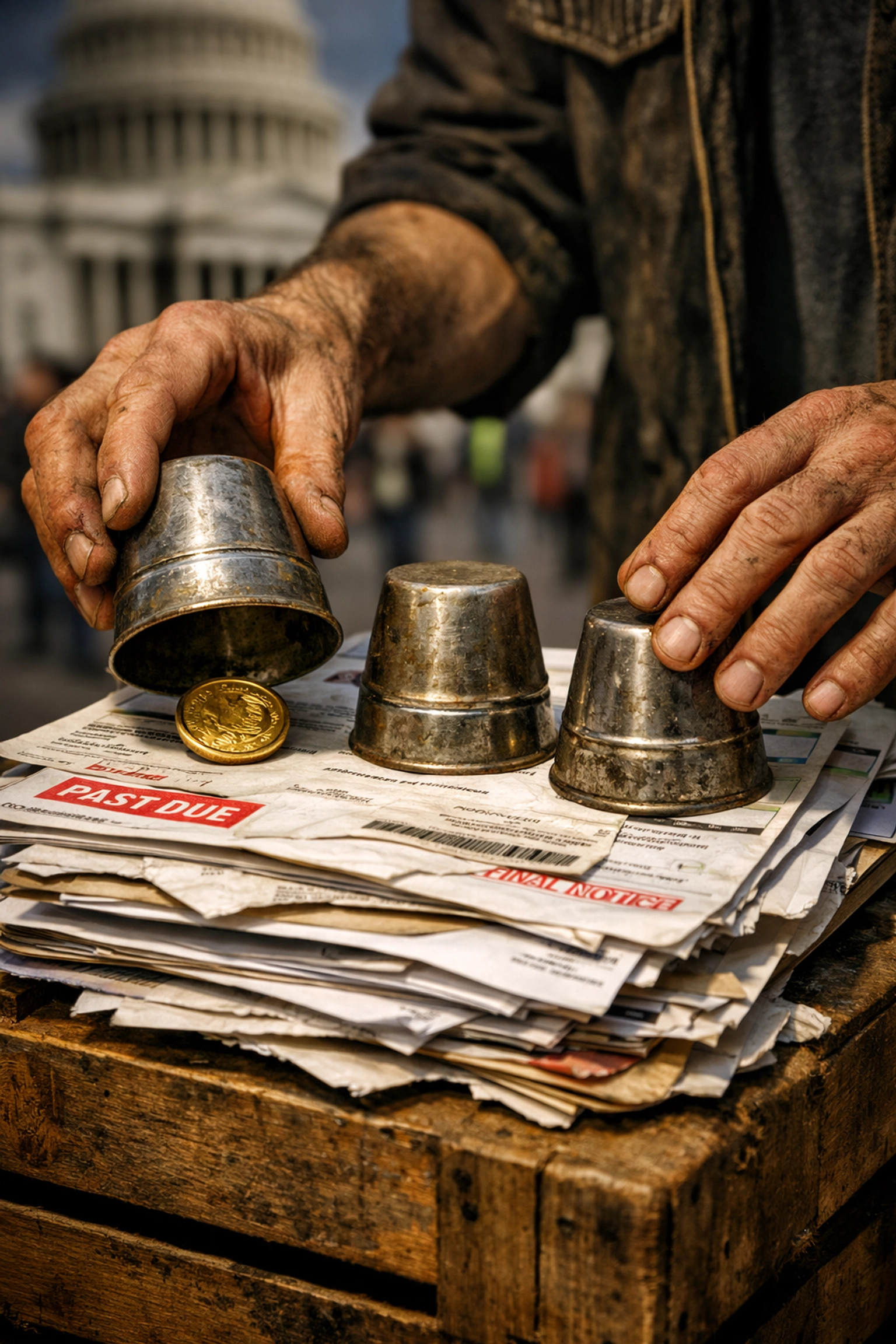
Every time the government prints more money to "fix" the economy, the value of the dollars in your pocket goes down. It’s a shell game. They give you a small tax credit or a one-time rebate, and then the resulting inflation takes twice that amount back from you at the gas pump over the next six months. It’s time to stop falling for the "Big Bill" promise and start looking at the actual math of our daily lives.
The Last Frontier: Taking Control
The "Reality Gap" is the space between what the politicians say and what we feel. They see charts; we see receipts. They see "growth"; we see a medical industry that is essentially a runaway train.
It is high time to reclassify medical costs as "health expenses" and start looking for ways to opt out of the broken systems. Smart companies are already doing this: negotiating drug costs directly and building their own clinics to keep their employees healthy and their costs down. We need to apply that same "Regular Guy" logic to everything. We need to invest in the $100 gym membership that saves us $10,000 in cardiac care later. We need to look at the 15% tariff and realize we need to be more mindful of where our money is going.
The state of the union might be "strong" according to the guys in suits, but for those of us on the ground, it’s a daily grind of trying to make the numbers work. Don't let the shiny stats fool you: trust your bank account, not the teleprompter.
Be mindful, be watchful and good luck.