



Imagine walking into your local coffee shop tomorrow morning and hearing that your usual $4 latte is now $12. Not because the beans got better. Not because the milk is organic. Not because there’s a live jazz trio in the corner suddenly turning your caffeine run into a nightclub act. Just $12 for the same cup of coffee.
You’d call that what it is: a rip-off.
Now zoom that little outrage out to an entire continent.
As of this morning, Wednesday, April 29, 2026, our friends in the European Union are living through that exact kind of insanity, only this time it’s not coffee. It’s energy. The European Commission just laid out the ugly math: since the Middle East conflict escalated on February 28, the EU has paid an extra €24 billion, or about $28 billion USD, for energy.
And here’s the part that should make people spit out their coffee: they didn’t get extra oil, extra gas, or extra reliability for that money. They just got a higher bill.
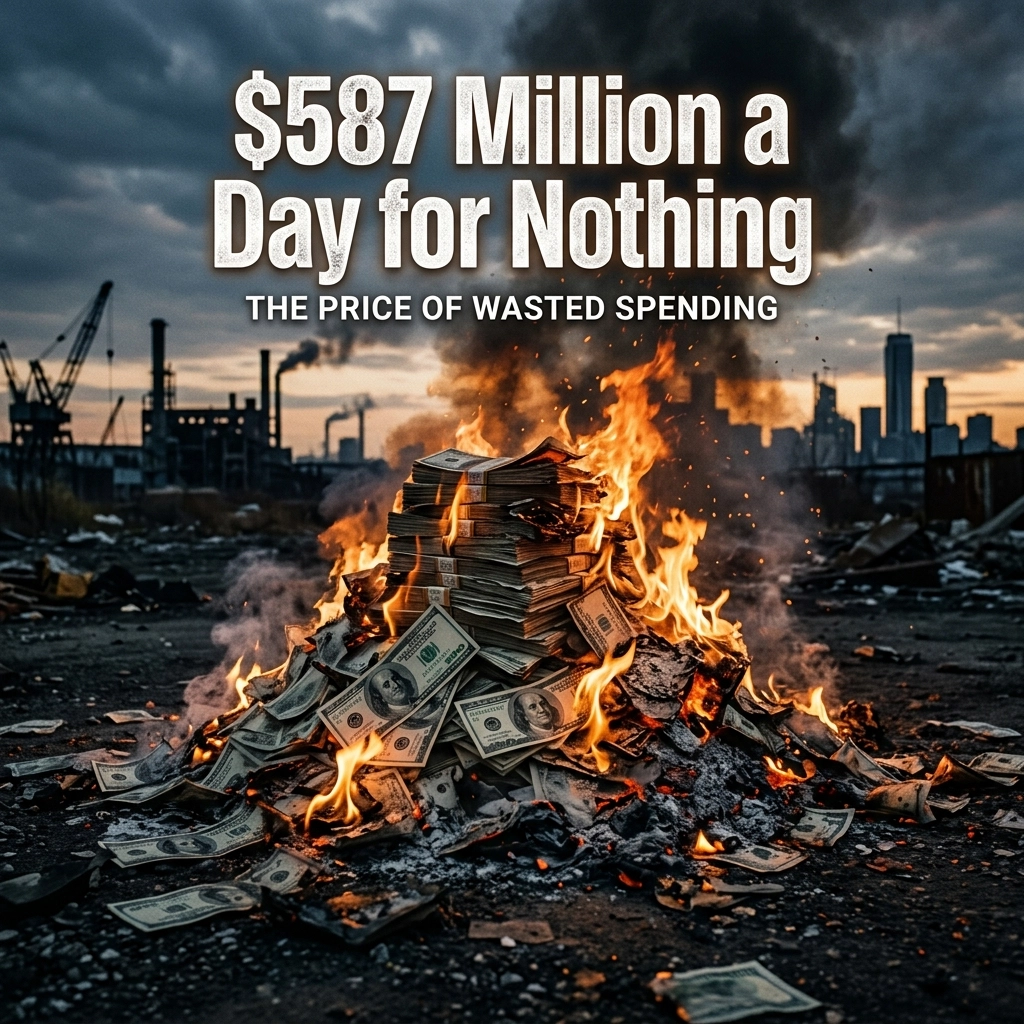
That comes out to roughly $587 million a day, every day, for absolutely nothing new.
At Regular Guy Economics, we’re not terribly impressed by polished geopolitical speeches from Brussels or D.C. We care about what lands on the kitchen table. And right now, the global economy is paying a war tax so large it makes your local sales tax look like a loose coin in the couch.
The Math of the "Nothing" Sandwich
Let’s break down that $587 million-a-day figure, because once numbers get this big they stop sounding real.
For perspective, $587 million a day is enough to buy every person in Chicago a very nice steak dinner every single night. It’s enough to build a brand-new high school roughly every twelve hours. It’s enough to fund real things, useful things, things that actually improve daily life.
Instead, that money is evaporating into the lovely little black hole known as the "war premium."
Since the Strait of Hormuz got squeezed back in February, the problem hasn’t just been supply. It’s been risk. And risk is expensive. When somebody buys a barrel of oil today, they’re not just paying for drilling and transport. They’re paying for war-risk insurance, rerouted shipping, longer transit times, tighter inventories, and the market’s favorite emotional overreaction: fear.
Europe is the canary in the coal mine here. Because it relies so heavily on imported energy, it feels the punch first and hardest. The continent is basically signed up for the world’s most expensive subscription plan, and the only benefit is that the lights stay on another month.

The Great Invisible Wealth Transfer
This brings us to the real story: the giant invisible wealth transfer.
In economics, money rarely disappears. It moves. And when the EU spends $587 million a day for no additional energy benefit, that money is moving out of the hands of manufacturers, families, truckers, restaurants, and small business owners and into the hands of energy producers, shippers, insurers, and every middleman lucky enough to stand near the toll booth.
Think of it like a massive straw stretched across the global economy. On one end is the regular guy in Lyon or Berlin trying to heat his apartment or keep his bakery running. On the other end are state-backed producers, giant commodity traders, and energy companies collecting the premium.
That’s not just a price increase. That’s a redistribution of wealth.
And it’s a nasty one, because it works like a regressive tax. The family driving a 10-year-old car and watching the utility bill jump gets hit much harder than the executive working from a comfortable home office. Energy feeds into everything: food, fertilizer, packaging, shipping, manufacturing, clothing, airfare, you name it. So this so-called "nothing" fee quickly turns into an "everything" fee.
The US Angle: Don’t Let the Trade Numbers Fool You
Now, you might hear some pundits on the news trying to find a silver lining for the United States. They’ll point to the trade deficit.
Here’s how the logic works: the U.S. is a net energy exporter. When Europe gets squeezed, it turns to U.S. LNG and crude to help fill the gap. On paper, that can make our export numbers look terrific. The trade deficit appears to improve because the dollar value of what we’re shipping out jumps right along with the price.
But this is exactly where people need to stop admiring the spreadsheet and start using common sense.
An "improving" trade deficit driven by war-inflated energy prices is like a doctor congratulating you for losing weight because one of your legs fell off. The number may look better. The reality is obviously worse.
If our allies are bleeding cash to keep their homes heated and factories running, they have less money to buy everything else we sell. If a German household is throwing an extra couple hundred dollars a month at energy, that money is not going to American software, farm goods, machinery, travel, or consumer products.
So yes, the trade number can look prettier for a while. But it’s lipstick on a very ugly pig. Selling very expensive energy to customers who are getting financially weaker is not a healthy economic strategy. It’s a sugar high, and those usually end with a headache.

The "War-Driven" Economy Warning
There is a dangerous habit in politics and finance where people see higher spending and immediately call it "growth." Money is moving, GDP is twitching upward, and everybody wants to spike the football.
But we need to separate productive growth from cost-push inflation.
Productive growth is when somebody finds a better, cheaper, smarter way to build a house, move a product, or create a service. That adds value. Cost-push inflation is when a war makes it $587 million a day more expensive to do the exact same thing we were already doing yesterday.
One builds wealth. The other burns it.
And right now, we’re burning it. Money spent "for nothing" is money not going into technology, infrastructure, medical care, research, or business expansion. It’s the economic equivalent of sprinting on a treadmill while wearing a backpack full of bricks. You’re sweating, you’re exhausted, and somehow you’re still in the same spot.
Why the "Receipt" Lags the Headline
The last thing the regular guy needs to understand is the lag.
The $587 million a day is what’s happening at the wholesale and national level today. But the full punch doesn’t usually show up on your grocery receipt or utility bill overnight. It works through contracts, inventories, shipping schedules, and supply chains first.
That means the pain Europe is feeling now has a habit of washing up elsewhere a few months later. Fertilizer, plastic packaging, industrial chemicals, shipping costs, food distribution, retail pricing, all of it moves with a delay.
So when summer rolls around and your cookout bill looks strangely aggressive, remember this number. The world is smaller than it looks on a map, and a chokepoint in the Strait of Hormuz has a funny way of showing up in the price of burger buns, paper plates, and just about everything else.

The Bottom Line
We’re constantly told the economy is "resilient." We’re told the numbers are "stable." But when half a billion dollars a day is being lit on fire just to preserve the status quo, that story gets pretty hard to believe.
The war premium is a shadow tax nobody voted for, yet everybody gets stuck paying it. Whether you live in Louisville or London, the math works the same way: when the cost of energy explodes without delivering any extra value, the regular guy ends up eating the bill.
So don’t get hypnotized by polished talk about trade deficits, strategy, or diplomatic positioning. Look at the receipt. If the world is spending billions to stand still, that is not strength. That is slow-motion damage.
Be mindful, be watchful and good luck.